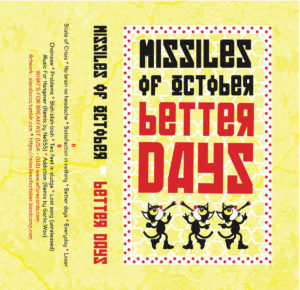
 Belgium’s Missiles of October have been cranking out their own brand of post-hardcore/noise rock since 2012. Approximately five years on from that time, the self-proclaimed “three old guys” are still very much an underground act, gleefully making listeners’ ears bleed whilst recycling various familiar influences. Their 2017 release ‘Better Days’ really drives home their love of retro hardcore, Jesus Lizard-esque angular art rock and more, in a package that some will find hard to swallow and yet others will lap up with twisted merriment.
The Great 70s Project: 1974
Maybe as a reaction to the previous year, though maybe just coincidence, 1974 didn’t have the all round focus of it’s forebears. Whereas 1973 had been a home to various albums that have spanned generations, ’74’s best strengths were in the singles market.
Bowie’s escalating drug habit left him with ideas of an unfinished musical and an album that’s arguably his most unfocused of the decade. ‘Rebel Rebel’, however, remains a great and enduring single cut, brimming with the last vestiges of glam. Lulu did an excellent job of covering ‘The Man Who Sold The World’ and ‘Watch That Man’, filling both sides of an essential 7″, Ace’s ‘How Long’ – while easily dismissed as soft radio filler has stood the test of time and now sounds like a near perfect piece of songcraft, while everyone’s favourite ragamuffin, David Essex, topped the UK chart with a smart and disposable single about making disposable pop music.
It Was Fifty Years Ago Today… The Continuing Saga of Sgt. Pepper
It was fifty years ago today…that the world was first introduced to Sgt. Pepper. It’s hard to imagine, at this point, that there was even a time when the album didn’t exist. Whether you consider yourself a fan or not, for the past two generations the album has become omnipresent. Two generations of people have loved it and hated it, while those who have yet to hear the record itself will still be aware of it’s presence. Visiting a record shop, there’s a good chance that its technicolor collage artwork will be seen. It’s always there; for most of us, it’s always been there.
NIGHTMEN – Can’t Avoid Success
 In 2016, Scandinavian garage rockers Nightmen dropped one of the greatest musical surprises of the year. Exploring various elements of garage rock and proto-punk, ‘Fifteen Minutes of Pain‘ delivered a short and sharp aural assault of a record that was not only loving of the past, but also keen to bring such sounds kicking and screaming into the present. It was also the kind of debut that sounded like the work of a band who might burn themselves out too quickly. For this second release, the band could’ve decided to churn out more of the same and that would’ve been great, but being smart cookies, they’ve avoided that inevitable burnout and adapted their previous sounds to allow for growth. Amongst various garage rock and proto-punk staples, this time around, they also show more of a talent for classic power pop.
The Great 70s Project: 1973
If 1972 were the year where the 1970s took on its own distinctive image with glam rock flaunting its majesty in a peacock-like fashion, then 1973 was the year the beards fought back. Every up has its flipside and so it goes here. The polar opposite of Bolan’s optimism, 1973’s biggest selling albums included Pink Floyd’s ‘Dark Side of The Moon’ (a lavish concept album about depression and mental stability), The Who’s ‘Quadrophenia’ (a concept album about angst, youth and mental stability) and Mike Oldfield’s ‘Tubular Bells’, arguably the biggest foray into self-indulgent prog rock this side of Yes’ double platter bore-fest ‘Tales of Topographic Oceans’ (also released in 1973).
That’s not so say the great and accessible pop and rock had been swept away, of course. Nor that glam was dead – far from it, in fact. Sweet scored some big hit singles, Bolan told us the ‘Children of the Revolution’ couldn’t be fooled and one time hard rockers Slade escalated in popularity on the back of some great singles.