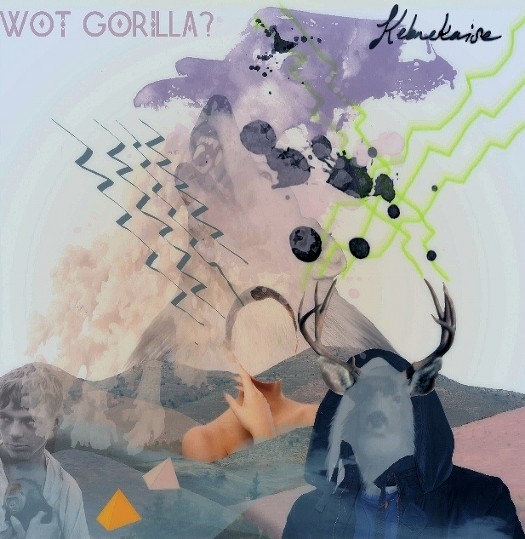
WOT GORILLA? – Kebnekaise

Although they take their name from a classic mid-70s Genesis instrumental, no further comparisons with the UK’s arguably most successful prog-rockers-turned-stadium-rockers should be sought from the work of Halifax-based band Wot Gorilla?  Yes, the complexity of their sound could be considered progressive, but always progressive in a math/art-rock way as opposed to a “classic” prog approach.

‘Kebnekaise’ (the band’s full-length debut, following two self-released EPs) presents a world of arty, jazzy, angular and occasionally noisy sounds which somehow come together effectively to create a challenging kaleidoscope of art-rock.  As if Tubelord decided to collaborate with Animals As Leaders, members of Mr Bungle and King Crimson, the results are often amazing.

The opening instrumental ‘I Beat Up The Bathroom, I’m Sorry’ shows an incredible musical tightness.  To begin with, guitarist Ben Farnell plays a jazzy riff mixing finger-picked musical motifs with a little tapping.  His tone is superb.  The drums – again slightly jazzy – make excellent accompaniment, as Si Marks offers percussive fills and a funky groove.  As the electric guitars crash in (albeit briefly) things become more of the common or garden indie rock variety, before sliding almost seamlessly into the oddly titled ‘Melted Welly’, where Marks really gets the opportunity to cut loose and show off his talents.  Again, a hefty mix of jazz, funk and rock creates an impressive rhythm from which the rest of the band can build.  Farnell’s guitar parts are an obvious extension of the earlier instrumental, while the tune has an abundance of rhythmic changes (and stops), never appearing fully settled.  Mat Heigh’s lead voice is of the slightly nasal, higher pitch indie variety – similar to Tubelord’s Joseph Prendegast – which will provide enough leverage for younger listeners to remain convinced that (much in the same way they feel about Radiohead), Wot Gorilla? are not a prog band.

‘Suspects’ takes Wot Gorilla?’s core sound an pushes it a touch farther.  From the avant-garde approach during the intro – featuring some almost ridiculous stops – the band move through musical passages where the vocals meet with more ringing, jazz-edged guitar lines, before tackling various off-kilter funky grooves tempered with brief spells of anger.  It’s challenging and sounds like it could fall apart at any time, yet the band always manage to keep things together in a most impressive way.  The bouncy ‘Holy B’Jesus’ is one of the most accessible numbers, at first working around a solid indie groove with jangling guitar work.  Like the rest of Wot Gorilla?’s work, however, it doesn’t stay that way for long: by the middle of the track, they’re throwing in odd time signatures, lolloping across slower riffs, and generally being all arty.  The final section of the number proves one of many highlights of ‘Kebnekaise’, featuring some superb hi-hat/percussion work and a warm bassline, before careening into a wall of noisy indie-rock guitars that – before long – hammer the same chord until coming to a jarring halt.

Moving away from the arty and farther towards the aggressive, lead single ‘Snow White’ eschews the jazzy, finger-picked guitar parts at first for some noisier alt-rock chops.  To balance out the (relatively) simpler sounding arrangement, Jonny Hey’s bass parts are pushed right up front and the end sound is impressively chunky.   Just as the indie rock gathers momentum, it’s all change for a rather pointed, jazzy tune, which sounds like one of the best things Tubelord never recorded.  These two contrasting styles would be enough to ensure ‘Snow White’ left an impression on its listening audience, but to finish, Wot Gorilla? take things a step further with a brief moment of extreme metallic riffing.  A good way to finish this musical journey.

If there is any downside to this release at all, it’s that there’s a bit too much of a kitchen sink approach to most of the tracks.  Perhaps breaking things up a little would have given the album more of a varied feel, overall.  It could be argued that it’s all so impeccably played, that the sheer complexity of the material constantly showcases a band sticking rigidly to their best strengths – and that’s an argument which certainly holds true.  That complexity, however, will make the album somewhat challenging to get through in one sitting for some.  For the more patient, however – and for those math-rock and art-rock devotees (for most of whom, “progressive rock” are likely dirty words) – ‘Kebnekaise’ is a cornucopia of twisted musical delights.

August 2012

BRYAN FERRY – These Foolish Things

By the summer of 1973, Roxy Music had released two fantastic, groundbreaking albums mixing pop and glam rock with a heavy dose of experimentation to produce an art-rock sound which sounded quite unlike anything heard before.  The second of those albums, ‘For Your Pleasure’ – released in March 1973 – captured the early Roxy’s most avant-garde side at its peak.  With Roxy’s career barely out of the starting blocks, frontman Bryan Ferry began work on a solo career.  His first album, ‘These Foolish Things’ – a covers record – was released in June of that year.

Continue reading →

FRIEND SLASH LOVER – The Grey Area EP

Friend Slash Lover began life as a project in the mind of singer-songwriter Josh Mintz (aka Stupid Human).  After settling on the new moniker, Mintz teamed up with bassist Frank Day, guitarist Greg Pajer and drummer Jake Hayden to create a final line up for the band.  A debut EP, ‘As American As Ones and Zeros’ was released in the summer of 2010, followed by live shows including appearances at the world famous Roxy (a regular haunt for Jane’s Addiction in their early days) and the Viper Room.

The band’s second EP, ‘The Grey Area’ comprises of six numbers which mix a solid pop/rock base with new wave keyboards and occasional harder rock riffs.  ‘As Seen On TV’ comes with a great guitar riff which gives off a very confident air.  Mintz’s slightly emo-ish vocal style is at odds with the heaviest parts of this opening tune, but the arrangement is so well crafted that the constant pull between the hard rock elements and the alt-pop edges keeps things interesting throughout.  The early eighties sounding keyboards lurking beneath add just enough depth to make the track sound far more complex than it actually is, while the guitar riff leaves a great lasting impression; so much so, the chorus doesn’t really grab the listener initially.  On the title cut, the tables are turned:  musically, things are much poppier, fusing radio-friendly rock chops with a chorus hook that’s absolutely superb.  After two or three spins, this tune sticks out as Friend Slash Lover’s best: the vocal delivery is very much suited to the overall sound with a strong mix of acoustic/electric guitars and tinkling keys.

Turning their attention to something softer, the dreamy pop/rock of ‘Unaware’ crosses adult-oriented singer-songwriter moods with some very new-wave keys and programmed drum sounds.  ‘Carry Your Weight’ explores similar lighter tones, but fares better through an extensive use of electric piano, an atmospheric guitar part and a huge sounding climax.  In fact, despite a slow-ish start, the second half of this number ranks among Friend Slash Lover’s best; there’s enough oomph to make the tune sound meaty – if never quite epic in the true sense – while retaining enough melody and accessibility to make it just right for radio.

Perhaps of greatest interest on this second release – and particularly for slightly older listeners – is Friend Slash Lover’s choice of cover tune.  They’ve chosen to tackle XTC’s somewhat controversial ‘Dear God’ (originally from XTC’s 1987 release ‘Skylarking’).  It’s not the first time this tune has been given a makeover; Sarah McLachlan put her own stamp on it back in the nineties. Unsurprisingly, Friend Slash Lover’s recording has more of a rock feel.  The use of electric piano during the intro is particularly lovely, as is the mechanical banjo-esque keyboard loop.  Multi-tracked vocals are also a nice touch here.  Initially, the hard beats of the marching drum seem a little jarring, but once the piece gathers momentum and the sound becomes much fuller, it’s easy to see why this particular stylistic choice was made.  The whole thing builds to a suitably angry finish, and while it doesn’t quite retain the sneer of the XTC original, it’s a decent cover overall.   As one of Britain’s greatest songwriters, the works of Andy Partridge really ought to be explored more often…

In summary:  There’s very little wrong with Friend Slash Lover’s chosen sound, but they don’t always do much that makes them stand out from the world of dozens and dozens of sounding bands out there.   As it is, though, any band which takes the time to cover XTC are deserving of a little of your time in return, while in terms of the self-written material, ‘The Grey Area’ is worth checking out for the title cut alone.

July/August 2012

DEAD WOLF CLUB – Dead Wolf Club

The members of Dead Wolf Club weren’t out of primary school when Pixies called it a day the first time around, or when My Bloody Valentine released the seminal ‘Loveless’, but the influences and legacy of late eighties and early nineties arty alternative/noise rock is deeply rooted within their sound.  While Dead Wolf Club’s re-visitation of a 90s alternative sound could draw parallels with the much praised revivalists Yuck and A Place To Bury Strangers – at least in terms of attitude – on their debut album they’re not always as consistent as either.  That’s not to say the ideas aren’t there, though – these guys have plenty of inspired musical moments.

Behind the brightly coloured origami wolves which adorn the sleeve lies a world of visceral noise, interjected with atmospheres.  ‘Wave’, the centrepiece from both this album and the band’s live set, shows DWC at their absolute best.  On this mini-masterpiece of swirling anger, a four chord, looping riff has an almost hypnotic appeal, starting slowly and gaining momentum throughout.  Eventually, a much weightier riff (recalling early Smashing Pumpkins and Slint) crashes in under which the treated lead vocals are barely audible.  The sprawling six minute ‘Colossus’, works its magic via a similarly simple riff, creating a world of general trippiness via various alt-rock and shoegaze influences.  The multi-layed guitar parts (courtesy of John Othello and Alwin Fernandez) rise and fall, while Othello’s lead vocal interjects in an echoing fashion, like a man shouting from the end of a long corridor.  Looking beyond the twin guitars – fuzzed up and at maximum jangle – Martha’s hard bassline really carries the weight of the tune.  While not quite as distinctive as ‘Wave’, this tune represents a more than solid slice of arty indie rock.

On the slightly more aggressive front, ‘Headful of Horrors’ opens with a heady mix of clanging rhythmic chords overlaid with heavily distorted lead guitar and some similarly distorted vocals.  Surprisingly, given the DIY approach, there’s still a clear separation between the multi-layered guitar parts, allowing an occasionally used clean lead ample opportunity to ring out above the world of fuzz.  A busy drum part underpins the verses of ‘Radar’, but an ugly vocal and uninspiring tune initially suggests this song needed more work.  However, something more melodic soon appears over the horizon: a clean-toned guitar bridges the verse and chorus via a great (but all too brief) interlude, while the chorus itself is okay too.  By the track’s end, it fares better than initial impressions suggest, but measured against a couple of DWC’s best numbers, though, it’s not a classic by any stretch.  ‘Allison’ is even more guttural and basic with most of the song hammered home with a screamy vocal, occasionally backed by a shouting counter-voice.  Despite the brief running time, there’s still time for a couple of quieter sections where Martha offers some superb sounding bass.  On those quieter parts, for those willing to invest the time it takes to tune in fully, DWC prove the creation of multi-layered soundscapes within even their briefest of numbers is just as important as throwing primal aggression out there.

While some more discerning listeners may detect a slight inconsistency in drum sounds [the album itself having been recorded with three recording engineers/producers and as many different drummers], there are enjoyable results on ‘Dead Wolf Club’. While it may not always capture the levels of anger present during parts of their live set (which is worth catching to see drummer Serra Petale attacking her kit), this independently released disc has a ragged appeal and a bristling energy that captures Dead Wolf Club’s “geek rage” well enough for a first outing.

Listen to or buy the album via the widget below.

July/August 2012

REDD KROSS – Researching The Blues

Over the course of their career, Los Angeles punk/power poppers Redd Kross (formerly Red Cross) have released some great records.  Although their early raw releases are loved by some, for most listeners, their finest works are not those punk/garage influenced records at all, but the handful of later releases heavily indebted to Cheap Trick. ‘Third Eye’ – the first and most accessible of that short run of albums – is a largely unheralded masterpiece.

The band’s 2012 album ‘Researching The Blues’ breaks a fifteen year hiatus for Redd Kross, but it’s not as if the McDonald bothers faded entirely from view during that time.  Jeff played in Ze Malibu Kids with The Go-Gos’ Charlotte Caffey, while Steven turned his hand to producing records for others, before resurfacing in 2009 as bassist for hardcore punks OFF!

When a band or artist returns after such a long time out, quite often the results can be a little disappointing.  Thankfully, that is far from the case with regard to this record, since ‘Researching The Blues’ is a classic Redd Kross release on all fronts.  Firstly, it features the line-up that recorded 1987’s ‘Neurotica’ – a somewhat pivotal release which saw Redd Kross making the transition from garage-based tunes to developing stronger pop sensibilities.  Secondly, and perhaps most importantly, it blends the best elements of their three 90s records [1990’s ‘Third Eye’, 1994’s ‘Phaseshifter’ and 1997’s ‘Show World’].

It may have been a long time coming, but Redd Kross have given their fans a selection of brilliant tunes here and the album’s overall sound picks up where the band left off, almost as if it was recorded without any hiatus at all.   The short and punchy ‘Meet Frankenstein’ puts the band in a Flamin’ Groovies mode, all sixties chords and jangle.  In classic style, that’s not quite enough for Redd Kross, who then decide to dress an already enjoyable romp with some smart Cheap Trick styled harmonies.  Keeping with a horror theme, the potentially tacky ‘Dracula’s Daughter’ is equally wondrous.  With a much slower pace, dominated with echoing drums (which, in turn, absolutely drenched in crashy cymbals), the McDonald brothers share their love for all things sixties sounding, a fusion of Big Star and Teenage Fanclub.    The more throwaway ‘One of the Good Ones’ provides a little fun via an almost danceable beat, clean rhythmic chord patterns, a bass part which has more going on than initially expected and a world of handclaps.  While slightly more bubblegum than most of ‘Researching The Blues’, doesn’t get anywhere close to the high camp of ‘Bubblegum Factory’ or their 1994 cover of ‘Yesterday Once More’ in the name of trashy fun, but it’s fun all the same.

The simplistic arrangement of ‘Winter Blues’ allows plenty of room for a multi-layered vocal, while beneath pounded drums, a great bassline pulls everything together.  Although not quite stretching to two and a half minutes, there’s also room for a brief twangy lead guitar break which tips the hat to some sixties greats.  Sounding like The Byrds dressed in glam-rock clothes, Redd Kross sound terrific during ‘Hazel Eyes’ which places their complex vocal arrangements against a brilliant jangling guitar line.  Just as you think you’ve heard it all, Steve breaks into a fat bass lead and Robert Hecker tops everything with some brief Pete Townshend-eque  bluster with brilliant results.   In a slightly angrier fashion, the title cut fuses choppy guitar with another pounding drum part.  The album’s most direct offering – perhaps more in keeping with material on the band’s 1994 release ‘Phaseshifter’ as opposed to anything more bubblegum – the guitars are fuzzy and a lead break appears suitably aggressive while throwing out melodies in favour of whammy-bar antics.

While the catchy choruses and harmonies come thick and fast throughout, best of all is ‘Stay Away From Downtown’, a high energy rocker which combines 60s riffs and harmonies with a rawer post-punk attitude.  It’s ringing guitar tones have a relentless approach, but the general mood of the number is absolutely joyous.  The simple chorus which barely extends beyond the one line but it’s so, so infectious.  A casually thrown in “Yeah you!” at the end of each chorus refrain is a throwback to the arrogant teen attitude which peppered their earliest discs, while the shameless “sha laa laa” which brings the track to a close echoes the sugary pop hooks of ‘Third Eye’s best outings.  In short: the harmonies, energy and attitude collide in a way that’s so distinctly Redd Kross that long standing fans will absolutely love this track after the very first listen.

With a running time of just over half an hour for ten songs, there’s no padding here. Like Van Halen’s first couple of records, Redd Kross exploit the theory of “quality, not quantity” and ‘Researching The Blues’ really benefits from such a lean and mean style.  It’s one of those albums which, once ended, you’ll find yourself listening to again…and again. If you loved ‘Third Eye’, this release should be high on your priority list.  If you’ve never heard Redd Kross before this release is a good a place as any to start listening.

August 2012