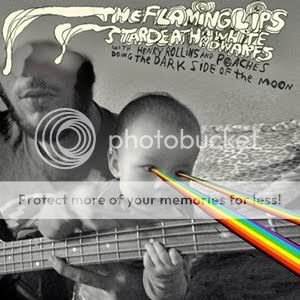
THE FLAMING LIPS w/STARDEATH AND WHITE DWARFS – The Dark Side of The Moon

Pink Floyd’s 1973 album ‘Dark Side of the Moon’ requires no introduction.  It’s one of the world’s best selling albums and a genuine rock classic.  In 2009, indie/psych-pop darlings The Flaming Lips teamed up with Stardeath And White Dwarfs (a band featuring the nephew of The Lips’ frontman Wayne Coyne) to pay tribute to ‘DSOTM’ with a re-imagining of the almost omnipresent album.   The album features three songs performed by The Flaming Lips, two performed by Stardeath And White Dwarfs and four performed by both bands together.  Initially I was sceptical; I love Pink Floyd and ‘Dark Side’ (although I will tell you I still think ‘Wish You Were Here’ and ‘Animals’ are superior) and wasn’t really keen on the idea of someone else having a bash at paying “tribute” to a classic.  However, as a fan of The Flaming Lips, I realised I couldn’t just ignore it – curiosity would certainly get the better of me.

If the idea of a couple of whacked-out Syd Barrett obsessed bands tackling this album with an equal measure of spacey oddness and distorted ugliness isn’t enough to pique your interest, then you should also take note that all the famous spoken passages found within the grooves of ‘DSOTM’ are reproduced verbatim here and read by Henry Rollins.  ROLLINS!

Floyd songs + Flaming Lips + Rollins was enough to make me sit up and take notice (unlike the live version by Dream Theater which has also done the rounds).  You could say that this kind of deconstruction of a classic is disrespectful, but essentially it’s an interesting listen.  After all, it had plenty of scope for being awful and, as it is, it only really loses its way for a couple of tracks in the middle – and surprisingly, those are two of the three numbers performed by The Flaming Lips alone.

After the all too familiar heartbeat pulse sends us on our journey, things are thrown into near chaos.  Instead of atmospheric guitars and smooth harmony vocals, the version of ‘Breathe’ here is distorted and spiky.  A bass riff leads the piece; a riff which sounds like it was inspired by part of ‘Echoes’ (from Floyd’s 1971 ‘Meddle’ LP).  This becomes a little more obvious once aggressive guitar work appears – again heavily influenced by the same section of ‘Echoes’.  The vocal melodies are similar to the original version of ‘Breathe’ in places, but the delivery is weary and slightly ugly – in keeping with the new musical arrangement.  I’m not sure how they got this to work, but somehow it does.  At this point, however, it’s easy to imagine that most of the Floyd fans who’ve actually bothered to listen to this have likely turned it off.  Fact is, this release is far more for Flaming Lips fans, but that’s how it should be.   Pink Floyd’s original version of ‘On The Run’ stands as one of the great early pieces of electronica and was so ahead of its time.  Here, the musicians involved have deconstructed it and given it an almost disco rhythm (possibly a backhanded compliment to Scissor Sisters and their disco reworking of ‘Comfortably Numb’?).  Whatever, it’s great – even though it’s ‘On The Run’ in name only.

In another piece of odd futurism, the medley of chiming clocks and alarm bells which open Floyd’s version of ‘Time’ have been replaced with even more extreme sounding alarms and a loop of a man coughing.   When the opening riff comes in, there’s something about it which is both discordant and sinister.  In contrast, the vocal sections are treated lightness and feature some rather pleasing semi-acoustic guitars and slightly reverbed drums.  This is the first of two numbers performed by Stardeath without any Flaming Lips input, but all the same, it’s not hard to spot the huge influence Wayne Coyne and co have had over them during making of this album. After the distorted riff of ‘Breathe’ makes its reprise, the members of Stardeath take a back seat and the Flaming Lips perform as a solo band for the next three numbers.

Although during the later Floyd live shows Sam Brown and Durga McBroom do a fantastic job with ‘The Great Gig In The Sky’, it’s Clare Torry’s original performance which remains the definitive one and the version here does nothing to change that.  The female wail is handled by Peaches and with the amount of distortion and studio trickery used, the performance is so masked the voice could belong to anyone.  Disappointing to say the least – and this marks the first of this album’s two drastic misfires.  Similarly, ‘Money’ goes for broke in the ugly vocal department; all vocals are heavily treated and run through keyboards and other stuff to make them sound like Sparky’s Magic Piano.  If you also consider that ‘Money’s classic riff has been slowed down just enough to make it an uninspiring plod, this one gets the firm thumbs down. Henry Rollins making a cameo at the end makes it a little better, but generally it’s bad.

‘Us and Them’ represents the moment this version of ‘Dark Side’ most closely represents the original album – and even then, there are so many differences.  The main part of the song is driven by a keyboard drone, creating a blanket of atmosphere.  Wayne Coyne’s nasal vocal isn’t a match for Rick Wright’s georgous original performance; of course, it still maintains its own charm.  It almost feels like an unreleased Lips performance, one which could’ve been slotted among the looser aspects of their ‘Clouds Taste Metallic’ album from ’96.  Rollins makes a timely appearance to deliver the ‘Short, sharp shock’ speech (rather more aggressively than the man on the original release naturally) and that in turn brings us to the track’s key difference: there are no saxophones; all smooth sax breaks are represented by a slightly distorted jazz guitar.  While the fairly sparse arrangement works fine enough, it might have been nice for the Lips to have created something multi-layered here (especially when you know they’re capable of it).

As the end notes of ‘Us and Them’ fade into the instrumental of ‘Any Colour You Like’, we are treated to what could be this release’s greatest moment.  The funky flow of the original Floyd instrumental is still there, but there’s a new ingredient – new for this track, perhaps, but yet it feels like an old friend.  A distorted bass riff cuts through the rhythm and all becomes clear: the bass part here, once again, bears an uncanny resemblance to Roger Waters’s bass part during the mid section of the previously mentioned ‘Echoes’.  It’s a nice touch and surprisingly one which here feels very natural.  The fuzz bass works well with the sharp guitar work and the whole thing is driven by a superb drum rhythm.

Performed solely by Stardeath And White Dwarfs, ‘Brain Damage’ seems a little empty in comparison to the jam feeling of ‘Any Colour’, although the vocal here is respectful to Roger’s original performance and Stardeath frontman Dennis Coyne has a far less quirky voice than his Uncle Wayne.  Closing proceedings, the version of ‘Eclipse’ captures the grandiosity of the original album’s closing statement but adds many layers of fuzz guitar.  It’s surprising how much of this really sounds like a (fairly noisy) Flaming Lips vehicle once they’ve got their hands on it.

This isn’t the first time an attempt has been made to recreate ‘DSOTM’, of course.  Aside from the aforementioned Dream Theater live version issued via their fan club, in 2003 The Easy Star All-Stars released ‘Dub Side of The Moon’, a reggae re-interptation and in the 1990’s the Magna Carta record label issued ‘The Moon Revisited’, a collection of progressive rock bands (including Shadow Gallery and Fates Warning among others) peddling out the album’s songs in an enjoyable but workmanlike fashion.  The Flaming Lips et al could take the crown here for the best ‘Dark Side’ tribute so far.  The bones of the songs are indeed there, yet they’ve been brazen enough to cast aside any pomposity associated with the original album and make it their own.

May 2010
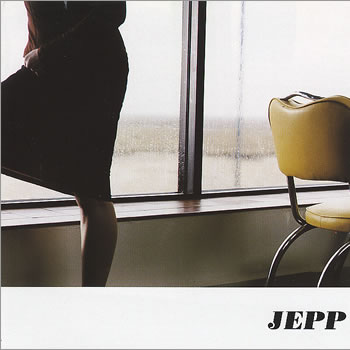
JEPP – Jepp

Jepp

The 1990s were a great time for discovering new music.  Back in those days, there were hundreds of great albums in the bargain bins of London’s independent record shops and at record fairs.  Sometimes they’d be familiar after reading reviews, but mostly cheap albums were purchased because they looked interesting, or somehow seemed right – like they were produced by someone interesting or had decent guests, you know the sort of thing…  If you’re someone who has obsessively bought albums, you’ve certainly gone through similar rituals yourself.

This self titled album by Jepp received a favourable review in the UK’s Mojo Magazine at the time of its original release, a review which compared her to Rickie Lee Jones.  The reviewer also said that Jepp had a voice which would be an acquired taste.  It sounded like something worth hearing…and sure enough, with a lack of promotion, one appeared in a record fair bargain bin not long after.

There are flashes of music recalling Rickie Lee on this debut, but quite why the reviewer seemed so keen to draw comparisons is a bit odd, since there’s a far stronger one:  Jepp’s voluminous, vibrato filled vocal style owes a great debt to Grace Slick (albeit Grace bellowing rather loudly). ‘Bowling Night’ gets things underway with a marriage of 90’s style fuzz bass and 60’s style vibraphone.  The song is a snapshot of a life, a mother, her migraines and a job she hated.  Jepp’s voice soars to attention-grabbing levels, becomes absorbing and by the end of this, you’ll know whether you love her or hate her – it’s really that instant.  ‘Superglue Low’ has a more blues-rock feel, but as with most of the music on this album, it’s not quite so simple.  Over the low-tuned rhythms, Jepp’s voice is softer than on the opener, less impassioned, but often retaining a sharpness. Lyrically, it sounds like specific storytelling, but the messages seem fairly oblique.

‘Parsons Green’ is much gentler and it’s slightly jazzy acoustic work provides a nice contrast to the fuller sounding previous tracks.  One of the albums strongest moments, Jepp’s voice remains soft and intriguing; the vibes return and some soaring guitar work adds colour.  ‘Go Home Early’ makes great use of string sounds, a solid but simple drum rhythm and more vibraphones – and Jepp’s voice wanders into Grace Slick territory.  By this point, it becomes clear that the album’s great appeal and longevity lies in the care that’s gone into the arrangements and songcraft.  Jepp’s music has so many layers, its retro charm becomes enticing.  The haunting ‘Tiny Dancer’ pushes Jepp’s voice to its most extreme.  The Grace Slick-isms are at their most blatant with forced vibrato; the music is at its most spiky, altogether creating a slightly unsettling atmosphere. ‘The Guy I Like’ pulls together fuzzy electric guitar, great use of marimba and neo-calypso stylings, which at the outset make it sound like an aggressive cousin to Rickie Lee Jones’s ‘Ghetto of My Mind’ (so maybe that’s why that magazine review picked her as an obvious reference point?).  Again the musical layers are appealing – unlike lots of other tracks, the guitar is heavily featured.

Another softer track ‘Las Vegas’ sees the acoustic side of Jepp’s work make a return.  It resembles some of the quieter moments from Bree Sharp’s ‘More B.S.’ album (although Jepp’s debut was recorded some years before), while the acoustic jangle intro of ‘Orbit’ pulls us into album’s most accessible track – Jepp’s voice isn’t quite as hard here and it’s musically simpler.  It’s not without those layers, though, as electric guitars are used to created fuzz (but always sparingly) and beneath everything, the sound of the vibraphone provides a much welcome addition (if you find yourself really getting  into this album, you’ll understand that the vibraphones are key in giving it most of its retro coolness).

Many of those London record stores and their bargain bins are long gone; the record fairs gather dust and attract only the most faithful, but this Jepp album still shines.  It’s been many years since that very first listen, but in all honesty, it’s lost none of that spark.  It’s still unconventionally beautiful and surprisingly demanding on the listener for a singer-songwriter album in the pop/rock vein.  On the whole, this seems to be an album which has been largely overlooked. There’s very little about it, or Sara Jepp (or even her second album ‘7:11’) on the internet.  If you find a copy, do yourselves a favour and pick it up.  Provided Jepp’s quirky voice doesn’t turn you off – or else you aren’t too quick to write her off as an Alanis impersonator (as some, indeed, have in an amazing display of knee-jerk opinions, never taking time to spot that sixties coolness) – there are some great songs to be heard.

February 2010


FIRECRACKER – Born of Fire

Firecracker is a project featuring Stefan Lindholm and Pontus Larsson of Vindictiv and Tommy Korevik of Seventh Wonder.  Before looking at the songs, it needs to be noted that this CD comprises work recorded prior to Lindholm, Larsson and Korevik having any success – some sources claiming it to be a Vindictiv demo from 2005.  Regardless of that, though, ‘Born of Fire’ with its hybrid of Swedish style hard rock and progressive metal influences contains some stand out moments.

The opening of ‘Blind Date’ offers one of my favourite intros on the album, with Lindholm announcing his presence by offering a flurry of notes.  In contrast to the shreddy bits, his more melodic, vibrato-led work has a great tone (although sadly, throughout a proportion of this disc, it’s the faster and edgier styles he favours).  Tommy Korevik’s vocals are very confident, a hybrid of Dream Theater’s James LaBrie at his most tuneful (on the softer parts) and any number of prog-metal vocalists on the louder parts.  Despite not having a particularly original vocal approach, Korevik has a decent set of lungs and his style is perfectly suited to most of the material here.  Not to be outdone by Lindholm, the mid-section of this track features a blistering keyboard solo by Pontus Larsson, who in turn, almost gets upstaged by Lindholm once again, upon making return for another fretboard hammering.
‘Second Self’ begins with a melodic metal intro with a classic sound, reminiscent of mid-eighties Iron Maiden, before leaning farther towards progressive metal once Korevik begins singing.  There are some off-kilter rhythms during this number and Hasse Wuzzel’s drum work is the key here with its double bass parts.  During ‘Gamekeeper’s Song’, though, some of the drums are so aggressively pneumatic, I’m not entirely convinced they haven’t been subject to some pre-programmed assistance or some post-production studio trickery.  A pity, since some of the more aggressive drum parts of this song seem to detract from one of Korevik’s best performances – especially from a melodic viewpoint.
The first of two instrumental numbers, ‘Instru(metal)’, gives each of the musicians time to stretch out.  If you’re looking for metal guitar work, Lindholm’s performance throughout this number is first rate (if a little wearing in places); Wuzzel’s drums take the pneumatic approach once again, but here they’re far less intrusive.  Larsson’s keyboard work is an equal match for Lindholm’s fretboard theatrics and those who enjoy prog-metal keyboard solos should enjoy this, especially those who enjoy keyboard word at the more squealy, extreme end of the spectrum.  The only downside is that bassist Frederik Forlkare sounds like he’s contributed some really decent work here; but sadly, his bass is so low in the mix it’s hard to pick out the intricacies of his playing, especially once Lindholm and Larsson get going.
‘Back Broken’ begins slowly with a chugging rhythm, before Linholm starts soloing frantically. This track seems to lose its way fairly quickly due to an odd time signature and a vocal melody which Korevik struggles to make scan properly. Despite this, his performance still remains decent. The interplay between Lindholm and Larsson is tight (as Vindictiv fans should expect), but it’s not quite enough to maintain interest over the song’s near six-minute playing time.  ‘The Refrain’ begins with a strong melodic bent, as Korevik delivers an effortless performance.  Unusually, Lindholm’s guitar work is far more restrained, complimenting Wazzel’s sporadic drum rhythms very well.  Korevik’s voice occasionally lapses into theatrical grandeur, but even so, it’s a track which best demonstrates his range.  By the time it comes to the guitar solo, Lindholm steps things up a gear (as expected), contributing edgy playing which is tempered nicely with more melodic moments.
Closing the album, ‘Speed Devil’ does exactly what is says on the tin.  In a textbook example of Swedish metal (a la Yngwie Malmsteen), Lindholm and Larsson trade off guitar and keyboard solos respectively, seemingly as fast as they can manage while retaining a tune.  Not being a musician myself, I find it harder to appreciate this on a technical level even though there’s clearly a truck-load of skill involved.  If I’m going to listen to virtuoso instrumental rock stuff, I’d much rather spend time listening to Gary Hoey, Jan Cyrka or Eric Johnson – y’know, the chaps who approach things from a song-based angle, even if they’re playing instrumentally.
Despite most of the musicianship being top notch, I’ve always found similar levels of shredding hard to cope with in long doses (especially true when it comes to stuff like ‘Speed Devil’) and a few more obvious vocal hooks and choruses would have made this all the more appealing.  That said (personal preferences aside), as an album, ‘Born of Fire’ achieves its goals.  Forget the chaps from Vindictiv, though: it’s Tommy Korevik who is the big draw here (for me, at least) and fans of Seventh Wonder should give this a listen – especially if they’ve not heard any of this material previously.

April 2010

THE BIRD AND THE BEE – Interpreting The Masters Volume 1

Signed to the Metro Blue imprint of the legendary Blue Note label, The Bird And The Bee is a electronic pop duo comprising of Greg Kurstin and Inara George (daughter of Little Feat legend Lowell George).

The first couple of albums by the duo are fine as far as electronic based pop is concerned, but every once in a while, something comes along which you’re not expecting. Such is the case with The Bird And The Bee’s third release, ‘Interpreting The Masters, Vol. 1: A Tribute to Daryl Hall and John Oates’. It doesn’t really need to be said, but for years now Hall and Oates have been considered very uncool and it’s possible that, had any other electronic duo tackled this, it’d be with “ironic” smiles on their faces. However, given Inara’s parentage, there’s a fair chance this is done with a love of the original tunes – it’s even likely her father knew the velvety voiced one and his moustachioed companion. The end result is a mixed bag, but often interesting listening for those with more than a passing interest in Hall & Oates. There are a few excellent covers here, alongside some okay ones and, thankfully, nothing comes out terribly.

Firstly, why they bothered covering ‘Maneater’ and ‘I Can’t Go For That’ is the biggest mystery surrounding this release. The Bird & The Bee are a talented pair and it’s probable they could have put more of their own stamp on this pair of eighties tunes.  However, they choose to play things as straight as they can: ‘Maneater’, in particular, even sounds like it’s been created from the same drum loop… Inara’s voice is fine, but aside from a couple of interesting keyboard sounds, compared to some of the other stuff featured on this release, this is very workmanlike, despite a cameo vocal from Garbage’s Shirley Manson. Similarly, ‘I Can’t Go For That’ utilises a few unnecessarily harsh keyboard sounds as well as a few fills borrowed from 80s soul-pop. While Inara’s voice here is enjoyable, there’s something uninventive about the end result.‘Kiss On My List’ is a little better – that’s mainly due, once again, to Inara George’s performance. This is a decent cover, even though the stabbing keyboards which drive the original are completely absent and the closing guitar part has been replaced with a really nasty keyboard solo.

The best of the bunch here are the takes on the 70s Hall and Oates material, and arguably being better songs from the outset, so too are The Bird & The Bee’s take on them. The electronic nature of The Bird And The Bee’s music means that a couple of these have been given a proper re-imagining. ‘Sara Smile’ features Inara at her vocal best, a smooth voice which really pulls in the listener. Musically, the drum beat gives the song a good amount of depth, but never quite drops into full trip-hop mode. The classic ‘Rich Girl’ begins with noises which sound like they’re created for a children’s song, while the main thrust comes from a pre-programmed loop which is pure Casiotone. The hand-claps are a little unnecessary and some of the arrangement could’ve been a little more subtle, but somehow it has more than enough charm to make you forgive any shortcomings. Their version of ‘She’s Gone’ could well be one of the most perfect examples of electronic pop ever. Fantastic multilayered vocals are used against a well-crafted loop (I can even ignore the Casio samba elements); the bass sounds add a decent amount of bottom end despite not being very natural sounding. Granted, they had a belter of a song to work with, but this, alongside ‘Sara Smile’ could be reason enough to give this a listen.

The version of ‘One On One’ improves upon the original (if you’re a Hall and Oates fan yourself, you’ll understand this isn’t a claim to be made lightly). The version here is still a slow-burning, soulful affair, but this arrangement actually beats the drum programming from the original. It’s still all programmed, but most importantly, they’ve done away with that horrible Casio samba (they obviously realised having used one for ‘She’s Gone’, using another would have been extravagantly bad taste). The music concentrates on sporadically used chords against a heavily reverbed drum sound. During the instrumental breaks, the lead also employs some harder electronic treatments. Also, Inara’s voice is well suited to the song (far be it to suggest Daryl and John weren’t, there’s just something about ‘One On One’ which sounds like a weak link compared to most of their ‘H2O’ album).

This release also features one original composition: a single release, ‘Heard It On The Radio’ is supposedly designed to fit the mood of the rest of the disc and conjure an AM radio mood. It’s fairly successful in its attempt. While the verses have a slightly funky dance/pop vibe, slightly Moloko-esque, the guitars during the chorus are reminiscent of Rick Springfield and that style of feel-good 80s pop/rock – and this track more than makes up for a couple of the Hall and Oates numbers not quite hitting the spot.

If you liked The Bird and The Bee previously, their take on a selection of Hall and Oates’s tunes should leave you smiling. There’s something about this release which feels as if it were made for iPods and summer days; and for the rest of the year, file it under “quirky and fun”. However, it’s entirely possible that most Hall and Oates fans are not going to be very tolerant of this kind of meddling.

April 2010

Posted in pop

URIAH HEEP – Very ‘Eavy, Very ‘Umble

As the optimism of the late 60s crumbled, music became darker. In 1970, Deep Purple (Mark II) recorded their genre-shaping masterpiece ‘In Rock’ and, Black Sabbath, in their debut, gave the world something which would be seen as of the first truly heavy metal albums. That same year, Uriah Heep released their debut, ‘Very ‘Eavy…Very ‘Umble’, an album which often gets overlooked.

Heep fans hate that the band often gets referred to negatively as a poor man’s Deep Purple (especially given that Uriah Heep’s music drew from a broader palette than Purple’s as their respective careers wore on). Fact is though, Uriah Heep are always likely to be mentioned in the same breath as the Purps, purely based on the music contained within the grooves of ‘Very ‘Eavy…’ – some of the songs tread a similar path of blues and hard rock (with a smidgeon of prog) as the Deep Purple output from ‘In Rock’.

Before delving into the tracks on the record, it should be noted that ‘Very ‘Eavy…’ is a little bit of a mess, band line-up wise. The album features David Byron (vocals), Mick Box (guitar) and Paul Newton (bass) on all tracks. Keyboard player Ken Hensley lends his chops to most of the album, but a couple of songs were recorded prior to his appointment. Likewise, although Nigel Olsson is the best known drummer from the sessions, he only appears on two tracks – the majority of the drum work having been performed by Alex Napier. Put simply, Uriah Heep weren’t exactly a cohesive unit in 1970. Luckily, though, ‘Very ‘Eavy…’ contains some cracking tracks.

Opening the album is one of the band’s best known songs, ‘Gypsy’. This is one of the tracks which is largely responsible for the Purple comparison – combining, as it does, slabs of Hammond organ work with a monolithic guitar riff. ‘Dreammare’ takes a similar hard rock approach, but tempers it with psychedelic blues elements. Mick Box’s aggressive guitar work throughout is the tracks main focus, but lots of pompy harmony vocals (something of an early Heep trademark) help give the band an individual quality. A melodramatic cover of ‘Come Away Melinda’ (previously recorded by Judy Collins, Harry Belafonte and others) highlights a softer side to the band. David Byron’s aching (dare I say crooned?) vocal is complimented by sounds from a mellotron and a fantastic bass line.

‘Real Turned On’ remains an unremarkable rock number despite a decent riff and is probably the album’s weakest track. It achieves its goal, but up against the rest of the material there’s not much to make it stand out. The epic ‘Wake Up (Set Your Sights)’ is another moment where Deep Purple comparisons are almost unavoidable. The Hammond organ comes in waves and Mick Box’s guitar work occasionally slips into Ritchie Blackmore territory, while Byron’s powerful voice more than occasionally wanders into similar territory as classic Ian Gillan. There’s an element weaving in and out which is reminiscent of Deep Purple’s under-rated Mark I line-up too (actually, there are elements of ‘Come Away Melinda which share similar traits to Deep Purple’s fledgling pre-1970 line-up; interesting how people only lazily compare this album to Deep Purple Mark II’s work… It shares just as much in common with the Mark I stuff). It should never be considered second-rate compared to Purple though, no matter what line-up it most resembles. This album represents a band who bring enough of their own talents and flourishes to make it hold up beyond all the easy comparisons. The unmistakable Heep harmonies make well-timed appearances during ‘Wake Up (Set Your Sights)’, but it’s the track’s more subtle elements which make it a winner. Alex Napier’s hard rock drumming is full of jazz flourishes (his work here is excellent and you have to wonder why he did not want to stick with the band) and Paul Newton’s bass runs are not only complex, but beautifully played. Forget ‘Gypsy’ – it’s this track which really should be the album’s most treasured song.

Rolling Stone famously slated ‘Very ‘Eavy…Very ‘Umble’ upon release and they weren’t alone in their dislike of Uriah Heep. Granted, the album is unlikely to be part of the public consciousness in quite the same way as the early Zeppelin, Purple and Sabbath classics, but it’s a solid debut. Uriah Heep would go on to record more adventurous albums than some of the music found on ‘Very ‘Eavy…Very ‘Umble’ would suggest, but despite its stupid Dickens-referencing title, this first outing from Uriah Heep is a fine start to a long career.

February/April 2010