THIRD EYE – Recipe For Disaster

Photobucket

Hailing from Denmark, Third Eye are a progressive metal outfit featuring Michael Bodin (ex-Prophets Doom), Martin Damgaard (ex-Sweet Leaf) and Per Johansson (ex-Crystal Knight/Fate) and in terms of heaviness, they’re up there with the mighty Symphony X. For their debut album they’ve taken a bold step: ‘Recipe For Disaster’ is a concept piece about a man diagnosed with Attention Deficit Hyperactivity Disorder (ADHD) and Obsessive Compusive Disorder (OCD) late in life. Be warned, though, before going any further, that although this album is musically great, it’s lyrics are mostly rubbish and in terms of vocal abilities, Per Johannson’s voice is grating at best. With regard to the concept, it’s only really clear that there’s a concept at all since the band points it out in the introductory sleeve notes! In terms of linear storytelling, it’s actually impossible to follow. Presented with a concept album with a medical theme, it’s hard not to think of Queensryche’s classic ‘Operation: Mindcrime’, but while Third Eye are gifted musicians, any hope they had of creating a 21st Century ‘Operation: Mindcrime’ seems to be lost in translation.

As a listener, you’re not broken in gently… ‘Solitary Confinement’ begins with a crunchy riff, combined with a punchy rhyhmic quality which quickly demonstrates the band’s musical abilities. A solid rocker, this it’s certainly one of the album’s more straight ahead pieces aside from an occasional off-kilter feel which helps bring it firmly into the progressive metal field. ‘Recipe For Disaster’ follows swiftly and things are taken up a couple of notches. Martin Damgaard’s complex drum work is one of the track’s main features – his angry double bass work provides a great deal of power. This track sees the first appearance of the growlier end of Per Johannson’s vocals; in places he alternates his wailing voice with an angry shouting. This shouting approach is possibly meant to represent the frustrations within the album’s central character; it doesn’t quite work though, and from a listener’s perspective, it soon becomes more than aggravating. ‘Dark Angel’ sounds better on the surface, as the vocals have been tempered a little. While Johannson’s voice is a strong one, it’s not the easiest to listen to – and even at its most melodic it’s has an edge which some may call “an acquired taste”.

‘Six Feet Under’ pretends at the outset that it’s the album’s big ballad. During the intro, it’s easier to spot why Johannson’s vocals have been compared to Queensryche’s Geoff Tate in another review – the lower part of his range bares a passing resemblance, albeit not a very tuneful one. However, anyone comparing Third Eye to Queensryche was likely just looking for an easy (for that, read ‘lazy’) comparison – like comparing all melodic rock bands to Bon Jovi or Def Leppard. Once the band take a heavier stance, ‘Six Feet Under’ loses most of his promise. The hard edged riffs can be heard better elsewhere on the album. ‘Eye of Envy’ provides a decent amount of riffing, this time leaning a little farther away from prog and farther towards power metal. While this is technically brilliant on all fronts, you’d be unlikely to reach for it before Symphony X, but it’s not hard to imagine big fans of Symphony X and Evergrey finding plenty to get their teeth into here. It’s also worth noting that one of the guitar solos is played by Finn Zierler (from the excellent goth/prog metal band Beyond Twilight).

‘Psychological Breakthrough’ reinforces the band’s power metal elements and as such is the album’s angriest moment. Again, lyrically it deals with the feelings of frustration within the protagonist, but sadly it has too much anger and no real direction. The lyrics comprise half-formed spite directed at a neighbour (“I say hello, you say goodbye / I smile and you send me a dead letter file”), backed up with lots of “You make me sick / I wanna spit it out” and “you stupid fuck”. Not good at all. At this point, any patience a lot of people might have had in this album could well be dwindling… In contrast, ‘Darkness Into Dawn’ features the band’s softer side. Andreas Schumann’s bass work is subtly funky – in fact, there are more subtle elements here than anywhere else on the album and it’s great to hear the band relax and stretch out, albeit temporarily. Per Johansson’s vocal is misplaced though – he still tackles his job at full pelt, oversinging at nearly every step. Business as usual for ‘Snake In The Grass’ and ‘Sacred and the Profane’: in a build up to the album’s big finish, Third Eye plod through a couple of pieces of prog metal by numbers, offering no variation on anything they’ve played previously.

Closing the album is the ten minute epic ‘The Psychiatrist’. After a slightly unsettling intro featuring a conversation between our protagonist and a futuristic automated medical machine, ringing guitars and an uncharacteristically melodic vocal come to the fore. The main riff has a solid chug which sounds natural between the verses and initially the track shows a great amount of promise (although Johannson’s voice creeps into annoying territory before too long). Beneath the heavy parts of the song, Andreas Schumann’s rolling bass work has a great deal of power and a few of the twin lead guitars recall mid-80s Iron Maiden (never a bad thing).
However, any of the track’s good points are undone once the second part of the song appears… Under his medical haze, we hear the thoughts in our protagonist’s mind: “Take this/Eat this/Drink this/Cat piss”… Cat piss? Surely they could have come up with something better? This is swiftly followed by “Do that/Do this/Take that/Read this/Take that/Who cares? They care!” and by this point, it’s hard to even care at all. Three guitar solos towards the end of the track restore some faith – one each played by Michael Bodin and Thomas Kuhllman, and one played by Finn Zierler.

‘Recipe For Disaster’ isn’t a terrible debut if you look at the big picture – it’s got some moments of fantastic musicianship and a great production job, especially considering it’s on a small label – but its weak points are very damaging to the end result.

May 2010

DIO – Holy Diver

The name Ronnie James Dio will mean many things to his fans.  He was the first (and arguably best) frontman with Ritchie Blackmore’s Rainbow; he was the man who gave Black Sabbath an almighty kick up the arse when he replaced Ozzy Osbourne; he was one of the most recognisable voices in hard rock and heavy metal, but for all those fans, regardless of which band he happened to be fronting, Dio was the man who gave 100% every time.

Never was this attitude more obvious than on ‘Holy Diver’, released in May 1983.  Having left Black Sabbath following high tensions a few months previously, Dio was not about to take things laying down: his new eponymously named band – featuring his Black Sabbath mate Vinny Appice, Vivian Campbell and an old Rainbow bandmate, Jimmy Bain – rocked as hard (if not harder) than any outfit Dio had previously been associated with.

Stripped of the lengthy, pompous guitar solos which dominated early Rainbow, but retaining the heavy crunch of Sabbath, this debut by Dio (the band) turns things up a notch.  The opening number ‘Stand Up and Shout’ comes full throttle, embracing the energy of the then recent New Wave of British Heavy Metal – faster than anything Rainbow or Sabbath could muster even in their wildest dreams – and instantly commands attention.  Vivian Campell’s guitar work is fantastic and has a real edge; in many ways, his work throughout this album represents him at a career best, even though he was an eighteen year old not far into a long musical journey.  Of course, despite the sharp musical edges, it’s Dio who remains the true star – his huge soaring voice careening above the extremely tight band.  Always a master of knowing his vocal strengths, Dio accentuates lots of the two syllable words throughout the song, making excellent showmanship of “desire”, “fire” etcetera.  When his performance is combined with his on-form musicians, ‘Stand Up and Shout’ becomes a fantastic opener.

Things slow down to a menacing stomp for the title cut.  Viv Campbell’s guitar riff tips the hat to Ronnie’s tenure with Sabbath, yet his playing has the lighter tone which Tony Iommi’s approach often lacks.  Appice provides fantastic accompaniment on the drums, his pounding approach counterbalanced by some subtle hi-hat work.  The vocal performance brings out all the best elements in RJD’s performance – the stressed ‘ah’s are used to fantastic effect – and his delivery is so effortless, as a listener you’re totally sucked in by his enthusiasm and self-belief it’s easy to ignore the ridiculousness of many of the lyrics.   ‘Straight Through The Heart’ may not have as much energy as some of ‘Holy Diver’s more upbeat moments, but it has just as much power.  Driven by Appice’s solid drumming, Dio turns in a masterful performance with a suitable amount of gusto; Campbell’s guitar work here cannot pass without comment either: here he offers one of the album’s sludgiest riffs, replete with squealy horse noises (technical term).

‘Don’t Talk To Strangers’, another of the album’s undisputed high points begins gently before breaking into a classic hard rock riff; it’s Ronnie’s lyrics that give the track it’s long-lasting charm, though – full of paranoia, we are warned not to dance in darkness and that heaven and hell are closer together than you might think; Ronnie in turn plays the part “of master, of darkness, of pain”.  Vocally he’s at the top of his game, his delivery loaded with over-pronounced words, adding weight to the slightly sinister air.  Similarly, ‘Invisible’ has a very dark vibe; Ronnie’s lyrics are total flights of fancy here – a lesser vocalist would make it all sound more than a bit silly – but as always, his total dedication and faultless delivery mean it’s nothing short of superb.  Viv Campbell’s mid paced guitar riff stands as one of the album’s heaviest.  In short, it’s a timeless piece of leather bound metal – as heavy as the heaviest moments of Black Sabbath’s ‘Heaven and Hell’, but Campbell’s sharp guitar sound is far superior to Tony Iommi’s stylistic muddiness. (As great as ‘Heaven and Hell’ is, try playing it straight after ‘Holy Diver’, and the difference between the two guitarists’ styles is astounding.  ‘Heaven and Hell’ may be of the Sabs’ best albums, but it’s severely lacking in any real punch when compared to ‘Holy Diver’.)

‘Holy Diver’ also offers a couple of slightly lighter moments in ‘Gypsy’, ‘Caught In The Middle’ and ‘Rainbow In The Dark’.  The sound of ‘Rainbow In The Dark’ in particular looked forward to the stadium rock which dominated the 80’s.  Ronnie’s rudimentary keyboard work during the intro (and the sections which bridge the verses) ages the song a little and could be seen as the album’s only weak point.  Despite that, it remains an excellent chorus driven single.

‘Shame On The Night’ has a superbly menacing quality and  here it’s Jimmy Bain’s pulsing bass work which drives the piece, but yet again, no matter how punchy the arrangement, it’s Dio’s vocal prowess which remains its defining element.  His voice here is pushed to even more extremes, but at no point does he ever sound like it was a struggle.  Viv Campbell’s guitar work focuses largely around an intimidating riff (particularly evident during the track’s closing moments), and in all, this track presents the Dio band at their most outright angry.  It’s an effective closing statement – one which undoubtedly leaves the listeners wanting more.

‘Holy Diver’ is Dio’s greatest post-Rainbow release – it may even be the greatest release featuring Ronnie on vocals. It’s a genre classic; and for anyone who has ever heard it and subsequently fallen in love with it, the magic never fades.  The years may pass, but Ronnie James’s commanding performance retains every bit of its bombastic brilliance.  His vocal talent remains unsurpassed. A man loved by his many peers and fans, he will never be forgotten and ‘Holy Diver’ stands at the peak of his musical legacy.

(Ronnie James Dio  10.07.42 – 16.05.10)

May 2010

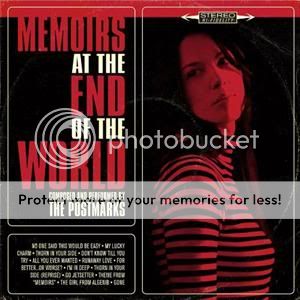
THE POSTMARKS – Memoirs At The End Of The World

I was introduced to this album by The Postmarks by my friend Walt, a lover of Squeeze and kitschy sci-fi television.  Since we share so many tastes I had to check it out, even though the Belle and Sebastian-esque monochrome sleeve art sent alarm bells ringing.  My dislike of Belle and Sebastian (aside from the odd song) is well known amongst my internet chums, so I figured Walt would be unlikely to recommend my listening to something which would be too much like them.

There are a couple of twee moments which I imagine may appeal to Belle and Sebastian’s many devoted followers, but that doesn’t really mean The Postmarks share much in common with them.  The Manhattan based outfit have a degree of twee and kitsch values, but the majority of their music is borne from lush soundscapes evoking sixties film music, particularly that of John Barry.  This third outing sees Postmarks regulars Tim Yehezkely (vocals), Jonathan Wilkins (drums) and Christopher Moll (guitar) augmented by Brian Hill (bass) and Jeff Wagner (keys).

Despite the strong sixties feel, there’s something more modern, circa 1990s, in The Postmarks’ sound. Maybe it’s the Saint Etienne style pop element. Like Saint Etienne, with The Postmarks, plenty of sixties pop influences are present – and maybe even more so, since The Postmarks’ sound never employs any of the nineties dance-pop vibes which made Saint Etienne so difficult to pigeonhole.  It’s hard to say which of The Postmarks’ musical elements hold the key to their retro themed style.  The cinematic arrangements are vital, yet Yehezkely’s wistful voice – often more tuneful than Sarah Cracknell, but never as sultry as Beth Gibbons on Portishead’s ‘Dummy’ – is charming and perfect for the sound The Postmarks set out to achieve.

‘No One Said This Would Be Easy’ begins the album with an almost perfect snapshot of The Postmarks’ typical sound: lush strings come in waves; the guitars and keys add more depth and the sound of castanets adds a touch of extra drama.  Tim Yehezkely’s vocals could easy get lost if the music were overplayed; however, despite the overblown nature of the arrangement, somehow the music and light vocal manage to create a natural sounding union.  Staccato piano and a bouncing beat are at the centre of ‘My Lucky Charm’ which is closer to straight ahead pop.  A multi-tracked vocal is used to good effect and an infectious, upbeat chorus makes decent (but light) use of a sixties horn arrangement.

‘All You Ever Wanted’ provides another standout track.  The verses concentrate on woozy eastern drones combined with acoustic guitar – and you could be forgiven for thinking it’s not really going anywhere.  Then the chorus kicks in.  While it’s not instantly singalong, it’s a chorus with a more upbeat quality and the horn sounds give it a totally feel-good vibe.  ‘For Better…For Worse’ breaks continuity with most of the album, since its kitsch sixties elements are pushed aside completely.  This track is almost pure nineties pop – and while I’m not keen to mention Saint Etienne again for fear of labouring a point, they tend to be one of the bands (if not the band) huge chunks of this album’s sound recalls the most. (Walt had said it was like having Sarah Cracknell arranged by John Barry and if you’re looking for The Postmarks’ essence diluted to one sentence, that’d be it.)
In contrast to ‘For Better…For Worse’, ‘I’m In Deep’ is very gentle which allows the listener to slowly drown in its arrangement and the hushed vocals call to mind the softer work of the New York trio Ivy (a band with a strong connection to The Postmarks; The Postmarks were discovered by Ivy’s Andy Chase, who signed them to his Unfiltered Records label).

‘Go Jetsetter’ goes for broke in the pop stakes with its sixties soul beat driving the melody while Tim’s vocals add a summery air; the addition of brass sounds here help to reinforce the retro feel.  While it could do with a more memorable chorus, the other elements are strong enough to make this an almost perfect example of the kind of pop The Postmarks produce during their more upbeat moments.  In contrast, ‘Theme From “Memoirs”’ does exactly what it says on the tin – the sound of a film-less film theme. It’s an almost James Bond pastiche – imagine a cross between classic John Barry and Gene Pitney’s ‘Town Without Pity’; the twanging reverb of the guitars are complimented with string sounds and a breathy wordless vocal. ‘Si Tu Vieux Mon Couer’ represents the only time the album really misfires; the bigger elements of The Postmarks’ sound are played right down, the French vocal is just that little bit too twee and the whole thing comes off like mid-60’s cult singer songwriter Margo Guryan but without any real charm.

The album closes with a couple of reprises: Firstly, ‘Go Jetsetter’ appears in a more eighties guise.  With a bigger punch and stripped of most of the usual Postmarks sound, it ends up a sort of Cars/Black Box Recorder hybrid.  This harder edged arrangement allows a greater look at the pop songcraft which lies at the heart of the band’s work.  Closing the album, ‘My Lucky Charm’ (which appeared near the beginning with an upbeat arrangement) makes a second appearance, slowed right down to a chill-out vibe.  While this second look isn’t as good as it’s upbeat counterpart, on its own merits it holds up as a decent track – it’s best element being the sparingly used brass sound.

‘Memoirs at the End of The World’ is an album which is mostly pleasing and seems instantly familiar.  Since the musical arrangements have the feeling of John Barry and touches of Burt Bacharach for a postmodern generation, you’d be forgiven that the cracks could show before long, but thankfully, its cinematic approach provides just enough depth to stop it becoming too saccharine.

May 2010

Posted in pop

OWSLEY – Owsley

As well as being a member of The Semantics with Zak Starkey (who recorded just one album, which gathered an exclusively Japanese release), throughout the 90s, Will Owsley was a hard working session musician.  His extensive session work eventually funded a home studio, where he recorded this self-titled debut.  It first came to my attention back in 1999, when my friend Rich – a massive Jellyfish fan – raved about it.  I was immediately struck by its opening track’s marriage of punchy rhythms and power pop hooks.

That opening track, ‘Oh No The Radio’, is an almost perfect representation of the edgier end of the power pop spectrum.  Driven by its chiming guitars, it features pleasing key changes alongside some wonderful Beatle-inspired harmony vocals.  It’s a great example of the type of power pop Sugarbomb would become cult figures for at a similar time – it’s late 90s brilliance only equalled by Jason Falkner’s ‘Author Unknown’ (a fantastic track which opens his otherwise maddeningly inconsistent ‘Do You Still Feel’ album) and ‘Pretty Pictures’ by Blinker The Star (whose ‘August Everywhere’ featured a couple of power pop gems, but otherwise remained an ordinary – if well executed – indie-rock style release).  ‘Oh No The Radio’ ensures Owsley’s debut demands instant attention – a tongue in cheek lyric helping things along the way.  The Cars-esque rhythm guitars used during ‘I’m Alright’ display another all too obvious influence, but these in turn are contrasted by a rather rockier chorus.  Interestingly here, the chorus style is comparable to the best moments of Ty Tabor’s Jughead project, although this Owsley album was released some three years previously.

A re-recorded version of a Semantics track,‘The Sky Is Falling’ comes complete with a serious amount of layers and overdubs, it’s off-kilter qualities evoking ‘Magical Mystery Tour’ era Beatles and Jason Falkner’s stronger works.  Once again, it uses a vocal style which evokes Ty Tabor and while most of the track uses a very much a tried-and-tested formula, the end result is great.  ‘Sentimental Favorite’ takes things down a notch.  Owsley’s lead vocal is suitably heartfelt, but it’s the addition of the multi-tracked backing harmonies which give the track its real spirit.  The electric piano and altogether softer arrangement may call Crowded House to mind for some listeners, those more in the know will realise this is a dead ringer for those Christian power pop champions PFR (whose long-time producer Jimmie Lee Sloas would also work with Owsley at a later date).

Although comparisons are unavoidable, most of this album is far punchier than most of Jellyfish’s best work.  However, ‘Sonny Boy’ driven by a bouncy piano and a marching-on the-spot rhythm has a strong Ben Folds plays Jellyfish quality, which is likely to gain approval from anyone looking for power pop in a more purist form.  (it’s also worth noting here that Folds had been an original member of The Semantics; it’s likely Owsley recorded this as a homage to Ben’s late 90s musical direction).  Likewise, ‘Uncle John’s Farm’ also comes close to genre perfection with its fantastic use of staccato piano and harmony vocals.  Again, any Beatle-isms, Todd Rundgren or 10cc influences are hard to miss.  ‘Zavelow House’ steps things up with a slightly rockier edge. There are hints of Matthew Sweet here too; in fact, this album has been compared elsewhere to Matthew Sweet, but rather negatively.  That’s unfair to Owsley in the extreme: as much as I love Matthew Sweet, this album manages to remain so much more consistent than many of Sweet’s works, despite remaining somewhat derivative of other artists. ‘Zavelow House’ also employs a couple of retro synth solo which would make Greg Hawkes of The Cars proud. 

There are Beatles influences abound during the slow ‘Coming Up Roses’ (another track with roots in Owsley’s Semantics days).  The chiming guitars during the verses have a slightly discordant quality and vocally Owsley settles somewhere between a tuneful Lennon-ism and the aforementioned Ty Tabor.  A string break midway adds an extra layer, but there’s a feeling that despite some top notch ‘na na na’s, it’s all a little by-numbers.  Another reflective number, ‘Good Old Days’ works far better, with excellent use of acoustic guitar and harmony vocals – it’s another track which would have been perfectly suited to PFR and could fit snugly onto either of their ‘Great Lengths’ or ‘Goldie’s Last Day’ albums.

Rather surprisingly upon its release in 1999, this debut did not go unnoticed, as so many similar releases had previously – it received a Grammy nomination for “best engineered album”.  So many years later, it’s an enjoyable and surprisingly enduring album which deserves repeated listens.  Given the Grammy nomination and quality of the material on show, it surely deserves to be better known.  If you’re a power pop fan, Owsley’s debut certainly won’t give you any great musical surprises, but regardless of its by numbers nature it’s fab.   The belated follow-up album ‘The Hard Way’ (released in 2004) has its moments too.

Despite the feel-good nature of his arrangements, our story ends on a downbeat note: In April 2010, Will Owsley took his own life.   He was clearly a man with great potential and highly respected by other musicians.  If you own either of the Owsley discs, make sure you give them a spin every so often.  Make sure they get heard by others who may enjoy them and help keep Owsley’s memory alive.

May 2010

GODSTAR – Sleeper

It’s hard not to compare the predominantly Aussie band Godstar’s full length CD ‘Sleeper’ to the mighty Lemonheads.  There are too many connections for those comparisons to be avoided.  Godstar are led by Smudge founders Tom Morgan (co-writer of some of ‘Come On Feel The Lemonheads) and Nic Dalton (sometime Lemonheads bassist).  Those Lemonheads connections are cemented further here, as chief Lemonhead Dando guests on drums, alongside Alison Galloway of ‘Alison’s Starting To Happen’ fame.  So, with all that in mind, you’ll obviously approach this album with a pre-conceived idea of what you’ll get…and you wouldn’t be wrong.

Chiming power pop guitars are much in evidence through ‘Single’, a Teenage Fanclub styled pop song; ‘Everything You Give Me Breaks’ is harder, with a slightly more interesting arrangement, almost like ‘Lick’-era Lemonheads delivered with an Aussie accent.  ‘Bad Bad Implications’ sees Alison on lead vocals and again, proves decent guitar driven pop; ‘Every Now And Again’ is acoustic, but the crashing noises at the end always make me think this is unfinished somehow.  The acoustic also leads ‘Forgotten Night’ which has a simple but pleasing 60s style electric twang as counterpart.

If you’re looking for harder edged punky style tunes, you get those too in the shape of ‘Little Bit About’ and ‘Ersatz’.  ‘Lie Down Forever’, for me, is this album’s greatest achievement, though; although still recognisable as a Morgan/Dalton composition, the jangly guitars are slightly louder, more shoegaze rock than indie pop.

If you like this kind of thing, it’ll probably never replace ‘It’s A Shame About Ray’ or ‘Come On Feel The Lemonheads’ in your affections, but it’s certainly more consistent than Dalton’s other project, Sneeze.  If you think this is for you, I guarantee you won’t be disappointed.

October 2007