TERRORVISION – How To Make Friends and Influence People

terrorvision

Watching Terrorvision playing in a small tent at the 2010 Sonisphere Festival feels a bit like having your mates come and play at a particularly rowdy summer party. By the time Terrorvision take the stage, sometime after 11pm, that evening’s main attraction, Alice Cooper, has finished performing his morality play – soundtracked by so many of his classics – and left the stage. Normally, after the headliner has vacated there’s little more to see, but for this particular festival, the small Bohemia stage has been set to go on for a few hours longer.

As Tony Wright beams “We’re Terrorvision from Bradford”, I’m transported back in time, having last seen the band at the 1997 Reading Festival and fronted by a seemingly worse-for-wear frontman (four years before disbanding – eventually reforming to play sporadic live dates in 2005 and beyond); earlier memories of seeing them headline an NME sponsored night at the London Astoria also come flooding back – remembering the extremely pumped audience bouncing in unison to ‘Oblivion’ and the building (by then not the youngest, or indeed safest, of London’s venues) feeling like it’s floor could give way under the immense enthusiasm of a crowd caught in a moment of togetherness. I’d seen Terrorvision at other times too, but the details of where and when aren’t so clear now.

At the late night Sonisphere show, Terrorvision are surprisingly on the ball and as a result, I’m thinking about listening to them when I get back home (something which has happened to me previously while watching them playing). As always happens after seeing Terrorvision live, their second album, ‘How To Make Friends and Influence People’ makes it’s inevitable journey into the CD player and I come crashing back to Earth, since, although brilliant in its own way, the album never sounds quite urgent enough.

Recorded in New York with producer Gil Norton at the helm – then best known for producing albums by Pixies and Echo & The Bunnymen – Terrorvision’s second album, ‘How To Make Friends and Influence People’ features Terrorvision as a far more confident and musically varied unit compared to their debut. As the staccato chords build tension behind ‘Alice What’s The Matter’ and Wright begins his slightly shouty delivery, the opening of Terrorvision’s second outing promises we’re about to embark upon a fun journey – and despite that lack of immediate energy of their live set, the album’s not short on fun moments. It’s immediately obvious that ‘How To Make Friends…’ stretches beyond Terrorvision’s previous works and despite some rather silly lyrics which appear to have been thrown together for the sake of simple rhymes, ‘Alice…’ gives the album a confident opener and at under three minutes it’s brevity made it a deserved hit single for the band.

The ultimate party anthem, ‘Oblivion’ – scene of much live energy – lumbers out of the speakers like something that’s slightly low on batteries. The structure of the song is great and Wright delivers its fun lyrics with a suitable amount of enthusiasm and Mark Yates’s guitar work alternates between rhythmic choppiness and an almost old fashioned rock ‘n’ roll twang; however it struggles throughout, since the drum work just doesn’t cut it. You can almost imagine drummer Shutty sticking out his tongue as he plays, concentrating hard and trying to keep a steady pace. The mid-pace of ‘Middle Man’ makes the track one of the album’s highlights. Shutty doesn’t have to struggle here; the band’s love of seventies rock shines through – and combining a great guitar riff with a memorable chorus, Terrorvision hit their goal square on. The addition of some gentle orchestration adds a bit of sophistication (okay, sophistication Terrorvision style) and each of its winning elements ensures that ‘Middle Man’ holds its own. Rather interestingly, it’s not a case of Shutty not being able to hammer out a fast rhythm, since he drives ‘What The Doctor Ordered’ at full pelt, against something that occasionally resembles a Metallica riff. Rather heavy for Terrorvision – possibly even heavier than most of previous album ‘Formaldehyde’ – at just over two minutes, there’s no messing with its combination of punk speed and metal riffs.

‘Stop The Bus’, at first, isn’t as instant as some of the album’s tracks, but another simple, classic Terrorvision bouncing riff, slightly sneering lyrics and hard bass line from Leigh Marklew means it’s not without charm. It was never going to have the longevity or ‘Alice What’s The Matter’ or ‘Obliviion’, but what it lacks in good time spirits, it makes up for with musical ability. The slightly harder sound is far more in keeping with Terrorvision’s earlier work and the guitar solo shows more focus than some of the others on the album. ‘Discotheque Wreck’ has the amount of punch the studio recording of ‘Oblivion’ really should have had. Another tough, bouncing rhythm combined with tongue-in-cheek lyrics about a bloke in a nightclub who’s hopelessly out of place but still thinks he’s cool make it classic Terrorvision. A chugging guitar riff and a spirited vocal make it decent enough, but once they’ve thrown in a reference to ‘Do You Love Me’ by The Contours – while sporting huge grins, no doubt – and it’s a winner.

The middle of the album presents a huge curve-ball in that the fun rock elements of Terrorvision’s sound take a back seat, as the band tinker with a few more rather grown up styles: For ‘Still The Rhythm’ a sparse arrangement featuring twangy guitar gives Wright’s vocals plenty of room during the verses, while the band bring a rock element to an almost non-existent chorus. A bridge section is also uncharacteristically shouty. The verses work well, but combined with those other elements, ‘Still Is The Rhythm’ is the album’s weakest point. ‘Ten Shades of Grey’ combines an almost fifties doo-wop sensibility with a couple of bluesy edges – Yates’s guitar solo making good work of a wah-wah pedal at first, before descending into a handful of long, seemingly un-connected notes. His wah-wah steps to the fore of ‘Stab In The Back’ which has verses echoing the funk scene of the 90s, while the chorus – although not lyrically memorable – rocks in a simple but effective way that makes me think this could have roots dating back to the sessions for ‘Formaldehyde’.

Following that, it’s business as usual, as Terrorvision turn up the fun with ‘Pretend Best Friend’ (arguably the best of the albums five single releases). Tapping into a memorable riff, sounding not unlike a hard rock version of the theme tune to “The Munsters”, it respresents one of the few times that ‘How To Make Friends…’ captures the real essence of a Terrorvision live performance. Coupling this with a lounge jazz element – complete with flugelhorn – on the pre-choruses, the great contrast shows that someone in the band isn’t short of great ideas; it’s just a shame that in various places on this album they struggled to arrange the songs in a manner which brings out their best qualities. ‘Time O The Signs’ employs some decent funk chops but doesn’t end up being too memorable, despite one of Wright’s most urgent vocals and a great groove in places. It’s possibly a case of bad album sequencing – it’s hard to follow ‘Pretend Best Friend’.

The slow pace and orchestration of ‘Some People Say’ (the closest the album gets to an epic rock ballad) lends a sense of moodiness lacking elsewhere. Wright’s vocal is one of the album’s best, capturing the spirit of the arrangement very well, pushing his voice beyond it’s usual flippant rock shoutiness. Not sure what Mark Yates was thinking though: he’s chosen a completely inappropriate guitar solo, comprising of discordant notes – heavy on the whammy-bar. The pace and mood may be right, but the style is very misplaced. Since ‘Some People Say’ has a melancholy vibe – something generally not associated with Terrorvision – you’d hope he would have managed something a little classier.

Closing the album, ‘What Makes You Tick’ employs a huge guitar riff in a style which, again, displays an obvious love of seventies rock. Wright seems fairly at home vocally with the increased volume, although it sounds as if it was a slight strain on his limited vocal skills. A multi tracked vocal on the chorus is a nice touch (presumably used at the suggestion of producer Gil Norton) since it balances out the simplicity of the hard rock riffing. The track threatens to build to a climax but stops short of a big crescendo, resulting in only the multi-tracked vocal being left. This is, in fact, the same multi tracked vocal that appears briefly at the beginning of the album, before the proper opening of ‘Alice What’s The Matter’; I assume it was designed so they’d (almost) link up if the CD was left on repeat… Sadly, this idea (used to fantastic effect on Pink Floyd’s album ‘The Wall’), goes straight out of the window since someone in the band/at the record company decided to include a bonus track on the CD after several minutes of silence. As far as “hidden” bonus tracks are concerned, this one is a complete non-event, since it comprises six minutes of distorted voices (presumably over a telephone recorded on a Dictaphone). Supposedly, parts of it feature Wright and the chaps on the wind up with a few New Yorkers, but the sound is so poor most of the words are inaudible. Aside from a mention of Jimi Hendrix and a woman unhappy with her recent hair appointment, it’s near impossible to make out any of it.

‘How To Make Enemies…’ isn’t an especially coherent listen, but what it represents is an album brimming with decent ideas and brilliant choruses. The arrangements could sometimes do with a bit of work, but generally, it’s easy to see what the band were attempting to achieve musically with each of the album’s thirteen numbers, even if things don’t always work out perfectly. On record at least, Terrorvision never bettered it (the subsequent album, ‘Regular Urban Survivors’, contained brilliant singles coupled with instantly forgettable album tracks). Now, if only they could have captured the extra pace and spark of their live show on record, they really could have been on to something…

August 2010

SAVING ABEL – Miss America

savingabel

Formed in 2004, Saving Abel is a hard rock band which combines crunchy riffs with a slight Southern drawl. Supposedly their self-titled debut album was a big hit in the US, but we didn’t even get a sniff of it here in ol’ Blighty. ‘Miss America’ – their 2010 sophomore release – is one of those albums which sounded like it may be enjoyable to begin with, since it’s opening number is delivered with enough gusto to grab the attention and is co-produced by Marti Fredriksen (who may be familiar to some of you as being the man who provided Jason Lee’s vocals in the classic Cameron Crowe movie ‘Almost Famous’, among other things), but as it turns out, the presence of Fredriksen just gave me false hope.

That opening number – ‘Tap Out’ – combines slightly fuzzy hard rock guitars with a decent punch delivered by Blake Dixon’s drum kit. Vocalist Jared Weeks has a voice which has a presence in a 90s style (I’d hoped that with Fredriksen on board that there may be more of a classic rock feel, but you can’t have it all); as far as openers go, Saving Abel push all the right buttons here. However, by a couple of minutes into the album’s second track – ‘Stupid Girl (Only In Hollywood)’ – I’m feeling rather let down, as any promise the track may have had gets watered down into something which sounds like latter-day Nickelback. Released as a single, this plods a down well-worn path that holds no great interest. ‘Contagious’ sounds like it could push the album in a heavier direction, but after about thirty seconds of hard riffing, the band opts for a Nickleback-esque approach again and delivers something so predictable. There’s a half decent guitar lead break, but nothing else of any worth.

The acoustic touches and Southern twang permeating the verses of both the title cut and the second single ‘The Sex Is Good’ offer a welcome lighter musical standpoint – there’s often enjoyment to be had from multiple acoustic guitars – but bad song writing means I won’t be spending too much time listening… (I mean, ‘The Sex Is Good’? Oh dear lads…did you get song writing lessons from that Kroeger when you supported Nickelback in 2009?). The semi-acoustic ‘Angel Without Wings’ with its very 90s rock edge and hard drum sound provides some enjoyment, but you’ll find similar stuff done better elsewhere, particularly if you’re a Creed or Alter Bridge fan. Likewise, ‘Hell of a Ride’ shows glimspses of something half listenable with decent use of slide guitars, but a heavy handed leaning towards 90s rock masks the decent bluest elements, which is a great shame.

This second album features a slightly heavier approach in places than the band’s self-titled debut, but generally, there are no surprises. The safe brand of alt-rock displayed throughout Saving Abel’s second disc will make them a few doubloons – but for me, the album sounds like a three song CD single, stuck on repeat until it reaches album length. In all truth, Saving Abel aren’t that interesting a band. In addition to their limited musical palette wearing thin very quickly, their obvious Chad Kroeger influences are extremely off-putting. Is there any point in Nickleback Mk 2? Still, I suppose they make Josey Scott’s band Saliva sound like a ground-breaking phenomenon.

See the video for ‘Stupid Girl (Only In Hollywood)’ here.

August 2010

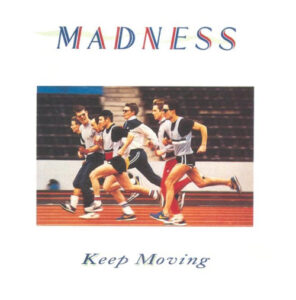
MADNESS – Keep Moving


Although primarily thought of as a ska outfit (and often dismissed as a “bit of fun” and a novelty band), over the course of six album releases between 1979 and 1985, Madness showed their musical palette was far broader than that of their early ska revival peers. In fact, from their third album (‘7’) onward, Camden’s favourite sons all but ditched their ska roots and continually moved forward, crafting a unique brand of pop music along the way. With each passing album, it’s possible to hear the band becoming more comfortable in their shoes as pop’s master craftsmen, and parts of their fifth album, ‘Keep Moving’ (released in 1984), arguably captures the post-ska Madness at their finest.

Continue reading

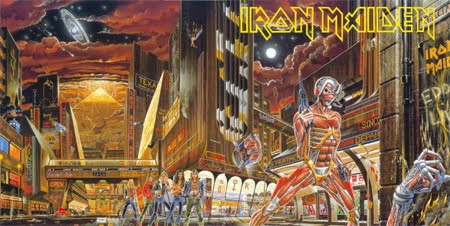
IRON MAIDEN – Somewhere In Time

Iron Maiden arguably hit a peak in the mid-eighties with their most adventurous release ‘Powerslave’.  In many ways, the follow up album, ‘Somewhere In Time’ seemed like a step backwards, at least in terms of musical arrangements.  Its release marked the first time where Maiden seemed to be on musical autopilot, firmly believing the old adage ‘if it ain’t broke…’ despite including guitar synths in an attempt to modernise the band’s sound.

Once ‘Caught Somewhere In Time’ has finished its opening gambit of twin guitar leads touched up with the newly found guitar synths, the band power full pace into Steve Harris’s trademark galloping basslines, while Adrian Smith and Dave Murray trade top-notch guitar lines, both turning in impressive solos.  It’s business as usual here and you’d be forgiven initially for thinking Maiden were following ‘Powerslave’ with an equally impressive work.  The quality remains high with the appearance of Adrian Smith’s ‘Wasted Years’, featuring the band at their most brazenly commercial.  As with some of his previous songs written with Maiden, Adrian Smith proved, yet again, he had a great ear for melody and a knack for a great chorus.  At this mid-pace, Maiden get to stretch out a little; there’s more separation between the instruments and the band seem well suited to the more commercial style.  Despite a decent lead guitar arrangement, it was – and always will be – the chorus that’s the real draw here. The more I’ve heard this song over the years, the more I find it a shame that Adrian Smith didn’t get more songs featured per album.  Granted, his songwriting style may be less grandiose than that of Steve Harris’s, but anything Smith has written is always preferable to Harris’s one line choruses.  If only they could have reached a compromise…


‘Sea of Madness’ (another track written by Smith) features the band at probably their heaviest.  The opening riff absolutely thunders as Steve Harris’s bass strings take a pounding.  While not as instantly memorable as the couple of preceding tracks, this one features the energy usually present behind classic Maiden, but once again, brings in another decent chorus, adding plenty of weight to the first half of the album.   The opening of ‘Heaven Can Wait’ shows a brief flirtation with spaciousness and melody, before the band launch into a piece of hard rock which sounds like Maiden on auto-pilot; there’s a decent guitar solo here and lots of other hallmarks from classic Maiden, and yes, the occasional usage of the guitar synths provide a nice touch (I may be one of the only people who thinks the guitar synths are a good idea), but despite those hallmarks, this song runs out of steam mid way, as crowd vocals chant ‘whoah’ in what sounds like a contrived attempt at creating something for the live audiences to look forward to…and by the time the main thrust of the song returns, it only seems to replay everything we’ve heard previously.  It’s here that the first cracks in the album appear and no matter how good bits of the second half are, it feels like an album always playing catch-up to its first three numbers.


‘The Loneliness of the Long Distance Runner’ features lyrics based upon Alan Sillitoe’s short story of the same name.  Lyrically it’s the first of two songs which, dare I say, try too hard to be intelligent.  The twin lead guitars during this song are among the best the album has to offer, but that doesn’t seem to be enough to save something which isn’t particularly song driven.  There’s literally no hook – and its one attempt at a chorus type refrain is delivered rather gratingly.  ‘Stranger In a Strange Land’ is far simpler driving itself along effortlessly via a mid paced bass riff.  Vocally, Bruce Dickinson sounds more at ease and while it’s not as memorable as ‘Wasted Years’, it’s a track which provides the album with another fairly commercial number.  Adrian Smith adds some real class to this track via a brief atmospheric section before the main guitar solo, which takes things up a notch.  Once again, it’s another number written by Adrian Smith: it’s clearly his work which stands out as the strong links on this album.  Sadly, the return to form doesn’t last…


‘Déjà-Vu’ finds the album at a critical low point.  While it provides a great trademark dual-guitar riff, musically it finds Maiden going through the motions; things aren’t helped any by a one line chorus (‘Feel like I’ve been here before’).  By the song’s end, there is a feeling of déjà-vu, since you’ve heard Maiden do this kind of thing time and again…only much better.  Bringing things to a close, ‘Alexander The Great (356-323 BC)’ is marginally better, but not up to the band’s previous standard of closing epics.  Lyrically it’s a little pompous and sounds like Steve Harris wrote it in an afternoon with an old O-Level history textbook.  Parts of the vocal melody sound like they’ve been recycled from previous tunes; musically its first half sounds strong enough, but there’s a feeling of dissatisfaction, especially during a couple of twin guitar leads, which sound like they were lifted straight off of the ‘Powerslave’ LP.  A slower instrumental break during the second half restores some faith, but there’s still that nagging feeling that this has been cobbled together from other previously used musical themes.


In summary, the end package is noticeably weaker than each of their preceding works (except for ‘Killers’, perhaps, since that was half made up of material pre-dating the debut LP).   I think it’d be more than fair to say that ‘Somewhere In Time’ marked the end of a golden run for the band.  It’s certainly the first flawed offering since the arrival of Bruce Dickinson.   Despite half of the material not being quite up to scratch (let’s be honest, if the running order switched ‘Heaven Can Wait’ and ‘Stranger…’, you’d hardly play the second side, would you?), its good points still make it worth spinning once in a while. 


July 2010

JON MULLANE – Shift

mullane

Jon Mullane may be familiar to North American listeners since this album’s opening track, ‘Make You Move’, was used on NBC’s trailers for the 2008 Summer Olympics. Released two years later (talk about not cashing in on potential advertising), this album’s biggest interest lies in the fact that Mullane’s co-writer Creighton Doane – one time drummer with the mighty Canadian rock outfit Harem Scarem – is also in the producer’s chair and the drum stool…and what’s more, he’s bought Harem Scarem’s Pete Lesperance along to play guitar.

On Harem Scarem’s early albums, Pete Lesperance proved to be a decent guitarist (their first three albums are well worth checking out if you like melodic rock and haven’t already done so – their third, ‘Voice of Reason’ is particularly underrated by the melodic rock community). Then, about the time of Harem Scarem’s fifth album ‘Big Bang Theory’, Lesperance traded in his best styles for a more “modern” approach…and sadly, on Mullane’s ‘Shift’, he seems to favour a similar style – a slightly distorted rhythmic choppiness replaces his classic, medium range fretboard gymnastics. And so, the potential excitement surrounding Lesperance’s contribution to this disc, for me, had all but vanished by the end of the second track.

With that, it’s down to Jon Mullane – whom, we shouldn’t forget is running the show here – and his songs to stand on their own. Overall, there are only flashes of greatness among a quagmire of dullness, I’m afraid. It suffers from the complaint that its songs are essentially 80s rockers, but they’ve been dressed up to appear more cool and alternative. I never understood that emperor’s new clothes thing and Jon Mullane is no exception.

‘Make You Move’ plods along predictably; a fuzzy edge to the guitars and a slightly gravelly approach to some of the vocals attempt to give the impression that the track is more modern, but at the heart lies something that is unashamedly 80s. Handclaps and woo-woo’s kick start ‘Got It Goin’ On’, which typifies driving music for those who never quite made it out of the 80s. Having half of Harem Scarem on hand really should have helped pick this up a gear, but as mentioned, Lesperance’s guitar tone has no shine and once you factor in Creighton Doane’s drum sound being quite weak (it appears to have been given some electronic oomph elsewhere on the album), it doesn’t fire up the listener in the way it really could have.

A couple of tracks try far too hard to be edgy: ‘Sin City’ has distorted keyboards providing its muscle – which irritate fairly quickly (interestingly though, Lesperance’s solo is half decent, though nowhere near as good as he’s capable of); ‘Missing Time’ utilises a similar mechanical, distorted sound, interspersed with a ticking effect to highlight the little meaning behind the song (like you were too stupid to get it…) There are occasional appearances of some eighties synth pop keyboards which sound like novelty doorbells, but generally, there’s nothing here to keep you coming back for more.

There are a couple of decent numbers, but those only really pull the album up to a middling standard, given the low batting average here. ‘The One That Got Away’ is a decent ballad, which, with a bigger set of boots could have fit snugly on a latter day Vertical Horizon disc, or maybe that overlooked sole album by Neve. With a bit of luck, it wouldn’t sound out of place on a montage scene in a hit US teen drama; ‘You Get What You Get’ provides some one-two marching on the spot punchiness and momentarily gives the impression that the album is about to pick up, while the gentle rock of ‘Change Your Life’ shows promise, despite its by numbers approach; the piano flourishes help lift it a little farther, but a weak chorus lets the side down.

To be honest, unless you’re a Harem Scarem completist, or else wondered what that music was on the Olympics trailer (although, since this album was delivered some two years after the event, it’s likely you’ve forgotten about it), you could probably live without this album.

July 2010