VANILLA ICE – Hard To Swallow

Yes, Vanilla Ice. You know him. In 1990, ‘Ice Ice Baby’ was huge and people loved him. He sold millions of records – though it’s unusual to meet anyone who’ll openly admit to having owned either ‘Ice Ice Baby’, or its parent album ‘To The Extreme’. He faded from the public eye some time after and a follow up album, 1994’s ‘Mind Blowin’, went largely un-noticed.

In 1998, Ice returned with ‘Hard To Swallow’, a rap-metal album produced by Ross Robinson, a producer then very much in vogue due to his work with KoЯn, Sepultura and Limp Bizkit. It’s likely you’ll meet more people who’ve heard about ‘Hard To Swallow’ rather than actually heard it. Of those people, most of them will probably tell you they’d like to hear it, y’know…just out of curiosity. After all, Vanilla Ice has been treated as a bit of a joke for so long, could he actually pull off a decent rap-metal/nu-metal album?

Well, curious folks, let Real Gone help you out: ‘Hard To Swallow’ is nowhere near as bad as anything you’re expecting from Vanilla Ice.Nor is it as good as you’re hoping for, from something which fits neatly into its particular niche…and let’s be honest, the metal aspect is why most of you curious folk have remained curious over the years.Being one of the curious myself, part of me hoped this album would be great; thus giving the finger to all those who’d written off the project before it’d even begun.

Ross Robinson’s input as producer is blindingly obvious. The album sounds like you’re expecting, although possibly with a stronger bias toward nu-metal. There’s stuff here which could be compared to early Limp Bizkit on their ‘Three Dollar Bill, Y’all’ album (although about three times heavier); in part that’d be thanks to Robinson, but there’s another connection here in the shape of keyboardist and bassist Scott Borland, whose brother Wes is best known as Limp Bizkit’s sometime guitarist. There’s also a fair amount of KoЯn influence in the downtuned guitars. Again, this is likely the influence of Robinson and the other band members, since Ice claimed he never listened to any nu-metal bands prior to making the record. The drum stool is filled by Shannon Larkin of Godsmack and the heavy guitar work is provided by Snot/Amen man Sonny Mayo. Looking at those musicians’ previous works, the Limp Bizkit debut was enjoyable, if a little disposable, Godsmack have released some decent albums (although their best work was released after this) and the Snot album is an absolute classic of the nu-metal genre, so ‘Hard To Swallow’ is fairly solid from that point of view. It clearly sounds like the product of all the musicians involved – more than just a bunch of guys hired to back Vanilla Ice. Add to that some guest spots from Casey Chaos (Amen), Cyco (Insane Poetry) and Jimmy Pop Ali (Bloodhound Gang), the album has potentially got a lot in its favour.

Ice’s performances here are loaded with arrogance, as he shouts down his detractors and reminds everyone he’s sold millions of albums (hey, Ice, so has David Hasselhoff) but ultimately, this album feels like dozens of albums of a similar ilk, especially during the moments when the raps give way to nu-metal shouting. I still enjoy a lot of late 90s nu-metal stuff and have nothing against shouting, but for approximately half of this album, something doesn’t quite click. Ross Robinson carries a lot of clout as a producer, so why then, does ‘Hard To Swallow’ sound so laboured and generic? There’s plenty of heaviness for sure (maybe a little too much) and Ice does what’s required from him about as well as he can manage – but still, it’s lacking something.

Sadly, there’s very little variation in the material and by about halfway through, the sludgy sound and heavy handed approach starts to become wearing and doesn’t really let up. This isn’t a fun record and I feel it really suffers for taking itself too seriously. Maybe combining heavy riffage with a more light-hearted approach (like ‘Injected’ by Phunk Junkeez, for example) could’ve been a better route for Ice.

That said, there are a few clear standout tracks: ‘A.D.D.’ finds Ice accompanied by a sheet of downtuned sludge where the verses feel like Snot (quite understandably) and there’s more than a sliver of KoЯn thrown into the mix; ‘Stompin’ Through The Bayou’ is the bastard child of KoЯn and Disturbed and ‘Too Cold’ (a metal version of ‘Ice Ice Baby’) proves that Ice isn’t embarrassed by his past, even though many people think he ought to be (he really ought to be embarrassed by this album’s poorest effort though: ‘The Horny Song’ is tacky and frankly provides no entertainment).

All the guys involved with making this album supposedly had a fantastic time in the studio, but that doesn’t really come across when listening to the end product. If you’re still curious, you really ought to hear this album, just to say you have. The best advice I can give you is to not shell out any money in doing so.

February 2010

30 SECONDS TO MARS – This Is War

I heard the second album by these guys back when it came out; despite lots of decent press, it didn’t impress me.  Their sound was solid enough, but none of the songs made any lasting impression.  I was told to forget about that, since this third outing for Jared Leto’s band was a vast improvement.

It’s a little worrying that this is supposed to be better. To be truthful, it’s so formulaic that it hurts.  30 Seconds to Mars are more than musically accomplished, this is true, but ‘This Is War’ offers very little in the way of variety, with one song blending into the next, almost indistinguishable from each other.

The album features 12 songs (okay, 11 songs and an intro) which, at best, are pleasant, but nothing more.  At worst, this album is the musical equivalent of queuing at the post office – nothing much exciting happens and by the end, you feel like it’s gone on forever.

Most of the songs follow a set pattern: quiet-ish verse building to louder chorus, where Leto changes his vocal pitch (or listening to this, a studio engineer helps change his pitch).  If you weren’t sure whether the band were trying to make their formulaic, safe, emo-influenced tunes sound like anthems, they force the issue by adding backing vocals of live audiences going ‘whoah’ on nearly every track.  ‘Hurricane’ is slightly different, in that they inflict their irritating qualities over the duration of six minutes instead of four – and yes, they use the crowd noise yet again.  There’s not even enough variety overall to warrant Real Gone’s usual detailed approach of breaking each track down to expose particular musical highlights.

The single ‘Kings & Queens’ is fine for what it does.  It’s certainly the best thing on the album, but that’s not saying much.

I wish 30 Seconds To Mars all the best, but ‘This Is War’ leaves me cold.  Sorry.  Go and buy an Angels & Airwaves album instead.

January 2010

NICKELBACK – Dark Horse

Most of Nickelback’s singles have been pretty lightweight. ‘How You Remind Me’ is a half-decent rock radio single, and ‘Rockstar’ is hugely unchallenging.  For those willing to not care about credibility and dig a little deeper,  Nickelback’s album tracks can occasionally offer something a little tougher, tunes that kick while retaining a certain level of user-friendliness.

‘Dark Horse’, their sixth album, has something instantly in its favour: it  is the first Nickelback album to be part-produced by Mutt Lange.  For the three of you who don’t know, Mutt Lange is a production legend. He’s worked with Def Leppard (‘Pyromania’, ‘Hysteria’), Bryan Adams (‘Waking Up The Neighbours’) and AC/DC (‘Highway To Hell’, ‘Back In Black’) and a whole bunch more. He has a trademark approach where he’ll beef up the sound and add lots of backing vocals (look no further than classic Def Leppard for the best examples); he’s even used that approach to some extent on Shania (ex-Mrs Mutt) Twain albums. I have a friend who has a theory: Mutt is a mad scientist. Bands knock on the door of his lab with their master tapes. He takes them and puts them into his special machine (the Mutt-o-tron™), shouts “Red light, yellow light, green light, GO!” and presto – everything comes out bigger, shinier and with extra Def Leppardy backing vocals.


And so it is with Nickelback’s ‘Dark Horse’. The album utilises all of Mutt Lange’s best tricks, and thanks to his partial presence, the band’s music has moved from tired sounding post-grunge, to more classic sounding hard rock. From the crunch of the opener it’s a good attempt at an attention grabber with a meaty riff in tow, but sadly, Chad Kroeger is an appalling lyricist and here he peddles out a bunch of smut that would make even Mötley Crüe cringe. This opening song is called ‘Something In Your Mouth’. I’m not gonna go into details, but let’s just say Kroeger sings about strippers – and not in a fun way.

Okay. With regard to the tunes which follow,‘Dark Horse’ there’s some enjoyable tunes, but excrutiating lyrics throughout spoil any chance of it ever being a decent record. During ‘Next Go Round’ Chad Kroeger sings (seemingly without irony) about doing it ‘until [he’s] good and sweaty until [he] can’t stand up’ and how he wants to be ridden ‘up and down the lawn’ (presumably like a tractor, since he name checks John Deere). Jesus Christ. During several other songs, Kroeger makes other lewd sexual references which spoil otherwise decent tunes.

‘Burn It To The Ground’ matches a hard driving riff with a huge chorus. The ‘hey’ vocal here is surely a sample (1000 Joe Elliotts?); overall, the end result is a winner. Sure, as expected, the lyrics are plain dumb, but at least this time Kroeger’s not thinking with his nob. Hmmm, a song about partying and drinking, on an album full of crass songs about girls? I sense a midlife crisis.

Mutt Lange’s work is the best thing about this record. Since with some help Nickelback can now present consistently decent tunes, maybe next time they’ll get someone clever in to help write the lyrics. I’m not sure Chad Kroeger can even spell shover chauver chauvinism.

Watch Chad talk about his house here! Could be better than the real thing.

January 2010

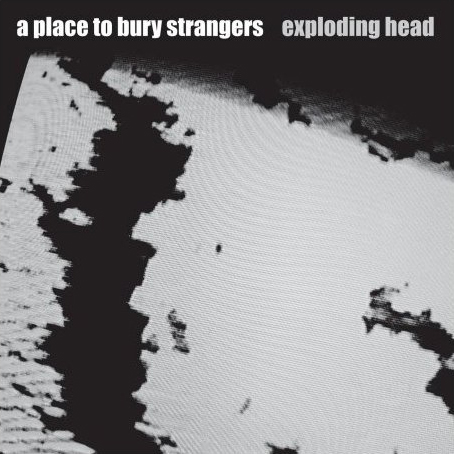
A PLACE TO BURY STRANGERS – Exploding Head

Released on Mute Records in 2008, this second album by New York’s A Place To Bury Strangers is a twisted, almost torturous ride. There are moments where the listener is beaten into submission by a barrage of multi-layered guitars, driven by distortion. Somewhere among the noise, inspired equally by Jesus and Mary Chain and My Bloody Valentine, Oliver Ackermann’s vocals waver in an out like a man drowning in sound. On most of the album, his voice remains buried below the music, his lyrics barely audible – but that voice is necessary as a point of aural focus. The blanket-of-noise approach is a key feature in the band’s sound, featuring on a number of songs, at least in part. In short, A Place To Bury Strangers are rarely easy to listen to. The opening track, ‘There Is Nothing’ sets the tone for most of the album, with vocals buried under guitars, but its pace makes it somehow captivating.

While the sheets of feedback and distortion are cranked up to ear-bleeding levels during parts of ‘Deadbeat’ and ‘I Used To Live My Life In The Shadow of Your Heart’, ‘Ego Death’ manages to temper the feedback-drenched squalls of the band’s noisier side (slightly) with a dark eighties, electronic feel. At times, Oliver is still using his effects pedals to levels which could be considered extreme, but despite this, there are signs of obvious songcraft bubbling just below the surface. These signs of musical ability are even more evident during ‘Smile When You Smile’ which features some sharp bass work (courtesy of Jono Mofo) somewhere in amongst the density.

It’s not all challenging though. At the centre of ‘In Your Heart’ and ‘Everything Always Goes Wrong’ there’s a mechanical bleakness carrying a spirit of Joy Division. The title track shows similar mechanical coolness and ‘Keep Slipping Away’ is a near-perfect piece of goth-pop. It’s a marriage of ‘Pornography’ era Cure and the lighter parts of ‘Psychocandy’ by Jesus and Mary Chain, which is played with so much love, you’d be forgiven for thinking it could be an unearthed obscurity from 1983.

These guys are likely to be met with open arms by MBV fans (particularly given Kevin Shields’s long periods of inactivity). The lighter gothy parts of their work are those with the most appeal – and as such could get the band a slightly broader audience, but on the whole, ‘Exploding Head’ is a record which requires patience and time.  Only then will the rewards begin to be reaped.

January 2010

THEM CROOKED VULTURES – Them Crooked Vultures

The idea of Josh Homme forming a supergroup with John Paul Jones and Dave Grohl, on paper at least, is a very exciting concept.  Imagine the energy of Grohl’s many previous works colliding with a wedge of Zeppelin fuelled goodness!  Surely that means that Them Crooked Vultures should have some big appeal?

And it does. …But only really to fans of Joshua Homme and particularly his band Queens of The Stone Age. Aside from an occasional obvious backing vocal from Dave Grohl and an occasional musical flourish (but seldom more) from Jones, a lot of Them Crooked Vultures’ material feels indistinguishable from Homme’s main band.

If viewed as the work of a supergroup, most of the album is unremarkable. Homme is clearly de facto band leader and most of the music takes his usual punchy but sludgy approach. Fine if you like Queens of the Stone Age, but of little interest to other people. ‘No One Loves Me & Neither Do I’ has a fantastic riff, but fails to back it up with a memorable hook. Lead single ‘New Fang’ has a decent drum groove, with stops on the what sounds like it ought to be a pre-chorus, but again there’s nothing too memorable about it. ‘Elephants’ is rather cumbersome and drags on far too long at nearly seven minutes (a common criticism of at least half of Homme’s work), despite a decent intro riff.

‘Scumbag Blues’, a Cream style power trio workout, is one of the only times that the potential behind Them Crooked Vultures can be seen. It’s also the first time Jones’s keyboard work makes an obvious appearance. Here, he occasionally breaks into some very welcome ‘Trampled Underfoot’ styled clavinet work. Although ‘Bandoliers’ features an old-style mellotron, it’s all but buried below the drums. Such a pity that Jones’s distinctive keyboard work (a la ‘No Quarter’, ‘Trampled Underfoot’ and ‘Your Time Is Gonna Come’) doesn’t have much place in Them Crooked Vultures. It could be argued that Jones’s keyboard is the key to ‘Interlude With Ludes’, but he’s not playing much of anything resembling a tune and the whole thing is a mess.

Since Jones would be a hero to both Homme and Grohl, it seems odd that his contributions to Them Crooked Vultures would be so underwhelming. He’s credited as playing bass, keyboards, keytar, piano, slide guitar and mandolin, but most of these get lost under Josh Homme’s trademark bluster. Aside from occasional keyboards, most of his clearly audible work is restricted to the bass. While his bass playing is solid, there are a number of Homme’s chums who could have filled the bass player’s spot as easily.

Some of the material here sounds solid, but little of it makes any lasting impact. Some good riffs for sure, but a repetitive sound and lack of hooks makes ‘Them Crooked Vultures’ a wasted opportunity, considering the musicians involved. Some of this material would’ve made a decent Queens of The Stone Age album, but if viewed as more than that, it’s one of the biggest musical disappointments of 2009.

January 2010