LLOYD DOBLER EFFECT – A Mute Reminder

Lloyd

For most of you of a certain age, the mention of the name Lloyd Dobler will raise a smile. If you’re smiling right now, you’ll know that this power pop outfit are named after John Cusack’s enthusiastic leading man in Cameron Crowe’s movie “Say Anything…”; Lloyd was a man with very specific goals. He didn’t want to “sell anything bought or processed, or buy anything sold or processed, or process anything sold, bought, or processed, or repair anything sold, bought, or processed”.

As far as the Lloyd Dobler Effect are concerned, like the original Lloyd Dobler, they mostly get it right, if not always (their small failing here being that the album can occasionally start to feel a little samey, but it’s really a minor complaint) but based on parts of ‘A Mute Reminder’, they get full marks for giving 100% every time. ‘A Mute Reminder’ is the second release from Lloyd Dobler Effect, but not their second album – 11 of the 12 songs here were originally issued on LDE’s self-financed eponymously titled disc. (This 12 song version actually works better, since that 15 track self-titled version felt a little long).

‘Meet Me In London’ is a fantastic piece of power pop. Its simplicity is key and its infectiousness is equal to the work by those mid-90s power pop geniuses The Loveless. The chorus is one of those stupidly catchy ones you’re in danger of breaking into while you’re in the supermarket. ‘Have Faith’ initially reminded me of Maroon 5, but with a harder edge. Repeated listens proved this reaction to be a bit glib, since although vocally there could be a comparison, the music has more complex elements. The guitars have just the right amount of drive to push the song far enough out of the pure pop field and indeed, the end of the track goes for full-on funkiness; listen closely – Patrick Hughes’s fluid basslines are superb. If it’s basslines you want, then the latin funk of ‘Might Be Love’ is a high point; it’s almost Santana-lite approach during the song’s verses provides plenty of bounce and as such provides plenty of contrast with the song’s simple but effective pop chorus.

Another stand-out, ‘Release Me’ finds LDE at their most aggressive; but naturally it’s a radio friendly aggression where Donnie Williams gets to hit his snare drums a little harder. Again, any comparisons to early Matchbox Twenty feel almost unavoidable; Phil Kominski’s slight Rob Thomas styled vocal affectation is stronger than ever and in short, it’s another track which pushes all the right buttons. There are plenty of moments during this album that evoke Matchbox Twenty, but that’s not to say it’s plagiarism. It’s yet another example of LDE’s knack of turning in a decent hook almost every time. I say almost since one of the weakest tracks, ‘Radio’ let down by a very lightweight and repetitive chorus. It could be argued that “My radio” repeated in an almost call-and-response fashion is a simple hook, but it’s just that little bit too simple and after tracks like ‘Meet Me In London’ et al, it ends up feeling weaker by default.

The slower ‘Sold Out’ makes decent use of vocal harmonies and a gentle lead guitar riff. ‘Fingertips’ tells the tale of an habitual law breaker; it’s slightly more serious lyrical tone is balanced out by plenty of jangly rhythm guitars and yet another funky bassline. The Santana influence first heard on ‘Might Be Love’ returns by the truckload on ‘Stranger’ where LDE go full-on Latin, giving percussionist Rusty Williams ample opportunity to show off his bongo prowess. The Latin shuffles are complimented by a Rob Thomas style vocal delivery (and surely Santana’s ‘Smooth’ would have been a big influence here) and a tastefully used horn arrangement.

I discovered Lloyd Dobler Effect almost by chance and am glad I did. You’ll find very little originality within the twelve songs on ‘A Mute Reminder’, but what the music lacks in originality is more than made up for with its charm and catchy hooks. If you’re into any of the bands mentioned here, you need to put this on your list of things to check out. You might be glad you heard them too.

June 2010

GODSTAR – Sleeper

It’s hard not to compare the predominantly Aussie band Godstar’s full length CD ‘Sleeper’ to the mighty Lemonheads.  There are too many connections for those comparisons to be avoided.  Godstar are led by Smudge founders Tom Morgan (co-writer of some of ‘Come On Feel The Lemonheads) and Nic Dalton (sometime Lemonheads bassist).  Those Lemonheads connections are cemented further here, as chief Lemonhead Dando guests on drums, alongside Alison Galloway of ‘Alison’s Starting To Happen’ fame.  So, with all that in mind, you’ll obviously approach this album with a pre-conceived idea of what you’ll get…and you wouldn’t be wrong.

Chiming power pop guitars are much in evidence through ‘Single’, a Teenage Fanclub styled pop song; ‘Everything You Give Me Breaks’ is harder, with a slightly more interesting arrangement, almost like ‘Lick’-era Lemonheads delivered with an Aussie accent.  ‘Bad Bad Implications’ sees Alison on lead vocals and again, proves decent guitar driven pop; ‘Every Now And Again’ is acoustic, but the crashing noises at the end always make me think this is unfinished somehow.  The acoustic also leads ‘Forgotten Night’ which has a simple but pleasing 60s style electric twang as counterpart.

If you’re looking for harder edged punky style tunes, you get those too in the shape of ‘Little Bit About’ and ‘Ersatz’.  ‘Lie Down Forever’, for me, is this album’s greatest achievement, though; although still recognisable as a Morgan/Dalton composition, the jangly guitars are slightly louder, more shoegaze rock than indie pop.

If you like this kind of thing, it’ll probably never replace ‘It’s A Shame About Ray’ or ‘Come On Feel The Lemonheads’ in your affections, but it’s certainly more consistent than Dalton’s other project, Sneeze.  If you think this is for you, I guarantee you won’t be disappointed.

October 2007

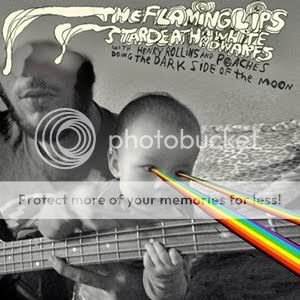
THE FLAMING LIPS w/STARDEATH AND WHITE DWARFS – The Dark Side of The Moon

Pink Floyd’s 1973 album ‘Dark Side of the Moon’ requires no introduction.  It’s one of the world’s best selling albums and a genuine rock classic.  In 2009, indie/psych-pop darlings The Flaming Lips teamed up with Stardeath And White Dwarfs (a band featuring the nephew of The Lips’ frontman Wayne Coyne) to pay tribute to ‘DSOTM’ with a re-imagining of the almost omnipresent album.   The album features three songs performed by The Flaming Lips, two performed by Stardeath And White Dwarfs and four performed by both bands together.  Initially I was sceptical; I love Pink Floyd and ‘Dark Side’ (although I will tell you I still think ‘Wish You Were Here’ and ‘Animals’ are superior) and wasn’t really keen on the idea of someone else having a bash at paying “tribute” to a classic.  However, as a fan of The Flaming Lips, I realised I couldn’t just ignore it – curiosity would certainly get the better of me.

If the idea of a couple of whacked-out Syd Barrett obsessed bands tackling this album with an equal measure of spacey oddness and distorted ugliness isn’t enough to pique your interest, then you should also take note that all the famous spoken passages found within the grooves of ‘DSOTM’ are reproduced verbatim here and read by Henry Rollins.  ROLLINS!

Floyd songs + Flaming Lips + Rollins was enough to make me sit up and take notice (unlike the live version by Dream Theater which has also done the rounds).  You could say that this kind of deconstruction of a classic is disrespectful, but essentially it’s an interesting listen.  After all, it had plenty of scope for being awful and, as it is, it only really loses its way for a couple of tracks in the middle – and surprisingly, those are two of the three numbers performed by The Flaming Lips alone.

After the all too familiar heartbeat pulse sends us on our journey, things are thrown into near chaos.  Instead of atmospheric guitars and smooth harmony vocals, the version of ‘Breathe’ here is distorted and spiky.  A bass riff leads the piece; a riff which sounds like it was inspired by part of ‘Echoes’ (from Floyd’s 1971 ‘Meddle’ LP).  This becomes a little more obvious once aggressive guitar work appears – again heavily influenced by the same section of ‘Echoes’.  The vocal melodies are similar to the original version of ‘Breathe’ in places, but the delivery is weary and slightly ugly – in keeping with the new musical arrangement.  I’m not sure how they got this to work, but somehow it does.  At this point, however, it’s easy to imagine that most of the Floyd fans who’ve actually bothered to listen to this have likely turned it off.  Fact is, this release is far more for Flaming Lips fans, but that’s how it should be.   Pink Floyd’s original version of ‘On The Run’ stands as one of the great early pieces of electronica and was so ahead of its time.  Here, the musicians involved have deconstructed it and given it an almost disco rhythm (possibly a backhanded compliment to Scissor Sisters and their disco reworking of ‘Comfortably Numb’?).  Whatever, it’s great – even though it’s ‘On The Run’ in name only.

In another piece of odd futurism, the medley of chiming clocks and alarm bells which open Floyd’s version of ‘Time’ have been replaced with even more extreme sounding alarms and a loop of a man coughing.   When the opening riff comes in, there’s something about it which is both discordant and sinister.  In contrast, the vocal sections are treated lightness and feature some rather pleasing semi-acoustic guitars and slightly reverbed drums.  This is the first of two numbers performed by Stardeath without any Flaming Lips input, but all the same, it’s not hard to spot the huge influence Wayne Coyne and co have had over them during making of this album. After the distorted riff of ‘Breathe’ makes its reprise, the members of Stardeath take a back seat and the Flaming Lips perform as a solo band for the next three numbers.

Although during the later Floyd live shows Sam Brown and Durga McBroom do a fantastic job with ‘The Great Gig In The Sky’, it’s Clare Torry’s original performance which remains the definitive one and the version here does nothing to change that.  The female wail is handled by Peaches and with the amount of distortion and studio trickery used, the performance is so masked the voice could belong to anyone.  Disappointing to say the least – and this marks the first of this album’s two drastic misfires.  Similarly, ‘Money’ goes for broke in the ugly vocal department; all vocals are heavily treated and run through keyboards and other stuff to make them sound like Sparky’s Magic Piano.  If you also consider that ‘Money’s classic riff has been slowed down just enough to make it an uninspiring plod, this one gets the firm thumbs down. Henry Rollins making a cameo at the end makes it a little better, but generally it’s bad.

‘Us and Them’ represents the moment this version of ‘Dark Side’ most closely represents the original album – and even then, there are so many differences.  The main part of the song is driven by a keyboard drone, creating a blanket of atmosphere.  Wayne Coyne’s nasal vocal isn’t a match for Rick Wright’s georgous original performance; of course, it still maintains its own charm.  It almost feels like an unreleased Lips performance, one which could’ve been slotted among the looser aspects of their ‘Clouds Taste Metallic’ album from ’96.  Rollins makes a timely appearance to deliver the ‘Short, sharp shock’ speech (rather more aggressively than the man on the original release naturally) and that in turn brings us to the track’s key difference: there are no saxophones; all smooth sax breaks are represented by a slightly distorted jazz guitar.  While the fairly sparse arrangement works fine enough, it might have been nice for the Lips to have created something multi-layered here (especially when you know they’re capable of it).

As the end notes of ‘Us and Them’ fade into the instrumental of ‘Any Colour You Like’, we are treated to what could be this release’s greatest moment.  The funky flow of the original Floyd instrumental is still there, but there’s a new ingredient – new for this track, perhaps, but yet it feels like an old friend.  A distorted bass riff cuts through the rhythm and all becomes clear: the bass part here, once again, bears an uncanny resemblance to Roger Waters’s bass part during the mid section of the previously mentioned ‘Echoes’.  It’s a nice touch and surprisingly one which here feels very natural.  The fuzz bass works well with the sharp guitar work and the whole thing is driven by a superb drum rhythm.

Performed solely by Stardeath And White Dwarfs, ‘Brain Damage’ seems a little empty in comparison to the jam feeling of ‘Any Colour’, although the vocal here is respectful to Roger’s original performance and Stardeath frontman Dennis Coyne has a far less quirky voice than his Uncle Wayne.  Closing proceedings, the version of ‘Eclipse’ captures the grandiosity of the original album’s closing statement but adds many layers of fuzz guitar.  It’s surprising how much of this really sounds like a (fairly noisy) Flaming Lips vehicle once they’ve got their hands on it.

This isn’t the first time an attempt has been made to recreate ‘DSOTM’, of course.  Aside from the aforementioned Dream Theater live version issued via their fan club, in 2003 The Easy Star All-Stars released ‘Dub Side of The Moon’, a reggae re-interptation and in the 1990’s the Magna Carta record label issued ‘The Moon Revisited’, a collection of progressive rock bands (including Shadow Gallery and Fates Warning among others) peddling out the album’s songs in an enjoyable but workmanlike fashion.  The Flaming Lips et al could take the crown here for the best ‘Dark Side’ tribute so far.  The bones of the songs are indeed there, yet they’ve been brazen enough to cast aside any pomposity associated with the original album and make it their own.

May 2010

TALLY HALL – Marvin’s Marvelous Mechanical Museum

Welcome, ladies and gents, to ‘Marvin’s Marvelous Mechanical Museum’, bought to you by a bunch guys better known for the colours of their skinny ties than their names. Collectively, the guys in ties are Tally Hall – a power pop/college rock ensemble from Michigan.

The opening number ‘Good Day’ (winner of the 2004 John Lennon Scholarship Competition) brings many classic power pop influences to the fore: take Ben Folds’s piano, Jellyfish’s knack for a catchy melody and Sugarbomb’s instant pop-friendliness, add a twisted barber-shop choir of multi-tracked vocals, and essentially, you’ve got what makes up the heart of this opening track and the main thrust what drives the handful of good tracks on the album. ‘Taken for a Ride’ recalls the stompy elements of ELO’s ‘Mr Blue Sky’ (as well as utilising the Sparky’s Magic Piano vocal noises) and despite my abject hatred of most of ELO’s work, have to concede that this works well. The slow section near the end of the song reminds me of The Polyphonic Spree, which is especially pleasing.

‘Greener’ makes excellent use of spiky rhythm guitars and occasional Cars-style keyboards; the chorus isn’t quite as hooky as some of the other material, but once again for power pop connoisseurs, it ticks enough of the boxes. The slower ‘Just Apathy’ is the album’s most mature piece of songwriting; its style of adult pop is far more in the Ben Folds camp, but even so, is still very much welcomed among the power pop elements here. Another great number, ‘Two Wuv’, features a riff that sounds like ‘Money (That’s What I Want)’ coupled with an arrangement which sounds like a Weezer cast-off. Bass-led verses with obsessive lyrics eventually give way to a chorus with multi tracked vocals. A sugary hook completes the picture during this slightly wrong ode to Mary Kate and Ashley Olsen. This tale of unrequited love with a major quirk brings me nicely onto the rest of the album’s tunes.

In addition to the bits of power pop goodness, the band have recorded another half a dozen songs which are so annoying I’m almost at a loss for words. It’s hard to know with the album’s quirkier stuff whether Tally Hall are playing things for laughs or not – and I really hope they are. ‘Welcome To Tally Hall’, mixes bad rap elements with a casio keyboard – think Barenaked Ladies meets Hot Action Cop and you might have some idea where we are. The multi tracked vocals on the chorus sections are quite pleasing, but it’s not enough to stop me reaching for the skip button most of the time. ‘Banana Man’ is a Harry Belafonte inspired calypso, complete with funny vocal (look, if it’s not Harry Shearer doing this on the soundtrack for A Mighty Wind, it’s not happening, okay? And you can keep your banana). The mid section goes a little Barenaked Ladies again, but if you haven’t tried to claw your ears off by that point I’d be surprised. ‘The Bidding’ offers one of the worst misfires, matching an R‘n’B style vocal (that’s the 21st century soul/dance rubbish ‘n’ bollocks, as opposed to rhythm and blues) with occasional bursts of rock guitar. I don’t want to talk about it. I don’t want to hear ‘Haiku’ ever again, either – Hawaiian inspired calypso music which sounds like a blatent Barenaked Ladies rip off was one of the last things this experience needed.

For those looking for excellent examples of power pop, ‘Marvin’ offers a handful of really great songs; likewise for those who like albums with surprises (I’m trying not to use the word novelty here) then it’s a museum of musical curios. This album has been likened to Brian Wilson’s ‘Smile’ elsewhere on the net. That’s a little bit of a lazy comparison; where ‘Smile’ acted as a musical soundtrack to one man’s well-documented breakdown, ‘Marvin’s’ is has far fewer sinister undertones. …But that’s not to say it’s necessarily fun.

A frustrating album, indeed: it’s novelty elements are sure to frustrate all but the most tolerant of power pop fans, and yet those who appreaciate Tally Hall purely on a quirky, superficial level probably won’t appreciate the quality of songcraft featured during the album’s two or three great tunes. What were they thinking? More importantly, what were Atlantic Records thinking when they picked this up three years after it was first released and then added new bits and smoothed out the edges? Surely a waste of time and resources…

I would have much preferred it if they’d concentrated on making more music in the vein of ‘Good Day’ and ‘Two Wuv’. If they had, this album could have been a power-pop classic.

April 2010

GREEN APPLE QUICK STEP – Reloaded

In 1993, as Grunge was beginning to fade a little, Green Apple Quick Step (presumably named after The Byrds song of the same name) released their debut album ‘Wonderful Virus’. It achieved moderate success, but musically its post-grunge approach was a little dull aside from a couple of tracks.

In 1995, they released their second album, ‘Reloaded’, produced by Pearl Jam’s Stone Gossard. Somewhere between the two albums, the bands songwriting moved away from their grungy earlier style and introduced a few more power pop influences. The variety of styles on this second album came as a huge surprise after ‘Wonderful Virus’ and as a result, ‘Reloaded’ became an album which was rarely far from my CD player for the next couple of years. The album finds GAQS stretching out and experimenting; a handful of tracks are fantastic and some of the musical ideas are interesting. Naturally, a couple of tracks miss the mark, but generally speaking, the fact that ‘Reloaded’ is a world away from the safe and formulaic nature of their debut should be applauded.

Things begin slowly with ‘Hotel Wisconsin’, a largely instrumental track. There’s plenty of atmosphere here with the organ sounds and reverbed guitars. It’s a far cry from the GAQS you knew from previously. The rhythmic pattern of the song never shifts far from Ty Willman’s organ, to the point where most of the lead guitar work is very low in the mix. It’s an interesting start to the album, incorporating a lot of moods you’d be unlikely to associate with a Seattle based band (except for maybe Screaming Trees). They change musical stance for the next couple of tracks: ‘Ed #5’ is a slab of fuzzy retro rock, heavy on the pedals and phasers and during the punky-edged ‘No Favors’, bassist Mari Ann Braden takes lead vocals for a track which has more in common with early L7 and Hole than GAQS’s more usual post-grunge and power pop. As a stand-alone track, its attitude and energy work very well, but as part of ‘Reloaded’ it feels very misplaced.

At three songs in, you may be forgiven for thinking this is a little directionless. After all, at this point, you’d be right…but you’ve got to give them credit for trying new things. ‘T.V. Girl’ offers the first truly great moment from ‘Reloaded’, with its mid-paced, guitar driven pop-rock. Ty Willman’s voice is at its strongest and has a passionate quality and once Mari Ann joins the chorus for harmony vocals, you get to hear the real potential behind GAQS, not heard much before now. ‘Alligator’ features another of Willman’s best vocal performances, with its mid-paced broodiness; it’s one of the key tracks for spotting how much the band has matured since their formulaic debut. The percussion-less ‘Underwater’ returns to a more atmospheric style with acoustic guitars accompanied by organ sounds; the song itself tinged with sadness and Willman’s voice being well suited to the more wistful nature of the material. The soft ‘Lazy’ works excellently, once again the call-and-response style vocals between Ty Willman and Mari Ann Braden providing its best feature.

The album’s best known cut ‘Dizzy’ (as featured in the movie The Basketball Diaries) is one of the album’s more positive moments. As far as this style of nineties power pop is concerned, this is a near-perfect example, with its great rhythm guitars and infectious chorus. Mari Ann’s backing vocals add something here – the combination of male and female voices matched with the feel-good nature of the song should have made this a sure fire hit. ‘Tangled’ has an interesting slightly retro edge – the ringing guitars occasionally have an Allman Brothers tone, even if the musical style doesn’t have anything else in common with Southern Rock. Despite the good arrangement, the song isn’t as memorable as it should be.

This album may arrive with a bunch of ideas and influences and seemingly no idea of which direction to go, but it certainly provides more than enough entertainment once it finds its feet. However, the momentum doesn’t last, as it ends in a rather disinterested fashion: ‘Space Cocksucker’ is a woozy funk based instrumental with the focus on rhythm guitar, punctuated by keyboard sounds; this is definitely filler material and ‘Halloween’ is an okay piece of jangle pop (largely based around a simple arrangement played by guitarists Steve Ross and Danny K) which features a good vocal but not much else.

It may feel rather hit and miss, but I love this album. Its relative lack of success – given its more commercial moments – is surprising and, as such, it’s unlikely to ever be thought of as more than a footnote in the Seattle family tree. The band recorded a follow-up three years later entitled ‘New Disaster’, which remains unreleased on a physical format apart from one track, ‘Kid’, appearing on the I Know What You Did Last Summer soundtrack. (However, part of the album can be heard courtesy of a legal stream via MySpace)

After the break-up of GAQS, Ty Willman went on to work with Devilhead (a band featuring Brian Wood of Hater and John McBain of Monster Magnet, Hater and Wellwater Conspiracy). He would also work with MariAnn Braden and Pearl Jam’s Mike McCready in a short-lived project, $10,000 Gold Chain. Steve Ross, meanwhile, joined punk band The Briefs, under the pseudonym Steve E Nix. As of March 2010, Willman made a return playing Green Apple Quick Step songs. He hopes that one day the much sought-after third GAQS album will get a proper release.


Read the interview with Willman here.
Listen to the online stream of ‘New Disaster’ here.


March 2010