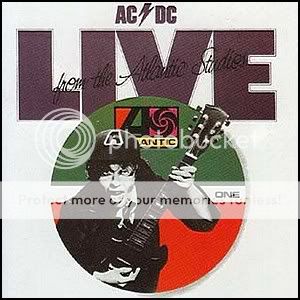
AC/DC – Live From The Atlantic Studios

Following 1980’s multi-million selling ‘Back In Black’, Brian Johnson helped steer AC/DC to uncharted heights.  The band have headlined festivals the world over, filled arenas and held an enduring popularity.

No matter how good or how popular the band became in the 80s and beyond, the material AC/DC released in the 70s is among their very best.  On recordings like ‘High Voltage’ and ‘Let There Be Rock’, their style is a little looser and the rock ‘n’ roll ethic hasn’t yet given way to the band’s slightly more metallic tendencies explored throughout Brian Johnson’s tenure fronting the band.

The studio albums are great, but it’s on the live albums where the early AC/DC really hit home. It’s often said that 1978’s ‘If You Want Blood’ is one of the great live albums of the age – that’s a theory with which it is hard to argue and the 2CD soundtrack to the ‘Let There Be Rock: Live In Paris’ film has some cracking performances.  However, it’s ‘Live From The Atlantic Studios’ which captures the band on most consistent, lean and mean form.  The intimate setting really gives the performance spark.

Bon’s voice is strong throughout the 40-odd minutes; he’s in good spirit, chatting with the small audience between numbers. ‘Live Wire’, ‘Problem Child’ and ‘High Voltage’ set the stage and the Aussie live wire sounds really focused; Phil Rudd and Cliff Williams are impeccably strong in their understated role as rhythm section.  What really works here, though, is the volume of the guitars; ‘Live At The Atlantic Studios’ has a feeling throughout of a studio run-through and as a result, the eight numbers don’t offer much difference to the band’s recordings in terms of performance, but that bit of extra volume means these tracks stomp over many of their studio equivalents.  Solid renditions of ‘Dog Eat Dog’ and ‘Hell Ain’t a Bad Place to Be’ maintain the spirit well, but it’s during the second half of the set that AC/DC relax a little and the fun really begins.

An extended version of the bluesy rocker ‘The Jack’ appears here in its best rendition, largely due to having retained the original album lyrics – much preferred over the sexually themed ones, full of schoolboy humour (pun intended) used on ‘If You Want Blood’ and other live performances.  An extended arrangement allows the band to really fall into a solid blues groove, with Angus turning in a fine solo en route. The band close their set with the double rock ‘n’ roll whammy of ‘Whole Lotta Rosie’ and ‘Rocker’.  Both numbers by this point had been established as crowd-pleasers, but during ‘Rocker’ especially, you can feel the sweaty atmosphere, as Angus and co tear it up.  It would have been fantastic to have been there: it’s such a great shame this set never filmed for posterity.

For those of you who have the studio albums and have loved them for many years, there’s little else to add, as you know exactly what you’re in for.  AC/DC at their most powerful, in front of a tiny audience?  If you want a snapshot of a hugely influential band at their most vital, ‘Live From The Atlantic Studios’ gives you what you need.

Bon Scott (09.07.46 – 19.02.80)

February 2010

*’Live At The Atlantic Studios’ is available as part of the AC/DC ‘Bonfire’ 5CD box set.

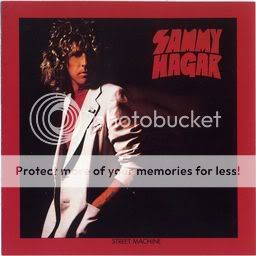
SAMMY HAGAR – Street Machine


Between leaving Montrose in 1975 and joining Van Halen a decade later, Sammy Hagar was a busy man. During that decade he embarked upon a solo career whereby he released eight studio albums and two live albums, as well as a collaboration with Neal Schon, Kenny Aaronson and Mike Shreive (released as HSAS: ‘Through The Fire’).

A great deal of this work represents quantity over quality as far as I’m concerned.Most of those studio albums contain three or four really great numbers, bolstered by approx half a dozen dispensable ones to bring things up to album length.1977’s ‘Musical Chairs’ doesn’t even stretch that far. After the opening good times of ‘Turn Up The Music’, most of what follows is lacklustre; even a deliberate attempt to rock during ‘Reckless’ feels a little flat, due to an over-reliance of Alan Fitzgerald’s organ, played like a limp Jon Lord. (It’s also worth mentioning that any decent material from fan favourite ‘Danger Zone’ [1980] is killed by a really flat production job from Geoff Workman).

Among Sammy’s pre-VH solo work though, you’ll find one genuine gem.1979’s ‘Street Machine’ is a solid offering which no fan of late 70s hard rock should be without.The Red Rocker and his band are firing on all six here right from the opening number, the simple boogie-rocker ‘Growing Pains’.The no-nonsense rock vibe carries through ‘Trans Am (Highway Wonderland)’, where the rhythm section of Chuck Ruff (drums) and bassist Bill Church (who’d previously worked with Hagar in Montrose) are the real stars.Chuck’s drumming style is very natural; he knows how to rock out, but never in a way which upstages Hagar.Bill Church’s bass style here – and throughout ‘Street Machine’ generally – is solid.He could be compared to a hard rock John McVie: you know the style, a firm anchor – plodding but never dull.

‘This Planet’s on Fire’ (one of the album’s better known numbers) is a full-on rocker, driven by Gary Pihl’s circular riff on lead guitar.He also gets to turn in a fairly hard edged solo – this will undoubtedly be one of the standout tracks for those wanting Sammy and co to rock in the way that Montrose’s ‘Bad Motor Scooter’ and ‘Space Station #5’ had previously.The ballad ‘Child to Man’ offers one of Hagar’s strongest performances, but it’s Gary Pihl’s guitar touches which makes it so memorable.Its subtle bluesy notes compliment Hagar’s voice perfectly.Also more reflective, ‘Never Say Die’ provides another standout.Here, Hagar and the whole band are at their absolute strongest: Sammy’s voice retains its hard rock qualities but he sings like a man who’s been let down, his voice showing a passionate side not quite so evident elsewhere.

Musically, ‘Plain Jane’ is a decent slice of 70s power pop, matching handclaps and a singalong element with hard rock guitars, reminiscent of work by Rick Derringer on his ‘Face To Face’ LP (recorded at a similar time).Hagar’s voice though remains hard and a little husky, so it’s likely this’ll always be far more associated with the hard rock tag.

The rest of the album’s material also passes muster. ‘Wounded In Love’ and ‘Feels Like Love’ both offer decent mid-paced rock stompers; ‘Falling In Love’, driven by ringing guitars features backing vocals by Boston members Brad Delp, Barry Goudreau and Sib Hashain giving it a slightly overblown late 70s vibe and ‘Straight To The Top’ is a fun workout with more than a nod to fifties style rock ‘n’ roll.

The difference in quality between ‘Street Machine’ and any of Sammy’s previous solo albums is astounding. Although Hagar’s best solo albums wouldn’t appear until sometime later (1987’s self-titled album, aka ‘I Never Said Goodbye’ and 1997’s ‘Marching To Mars’), ‘Street Machine’ – like the Montrose debut – does a decent job in highlighting why Hagar was a hero to US rock fans a long time before his alliance with Van Halen.

February 2010

NICKELBACK – Dark Horse

Most of Nickelback’s singles have been pretty lightweight. ‘How You Remind Me’ is a half-decent rock radio single, and ‘Rockstar’ is hugely unchallenging.  For those willing to not care about credibility and dig a little deeper,  Nickelback’s album tracks can occasionally offer something a little tougher, tunes that kick while retaining a certain level of user-friendliness.

‘Dark Horse’, their sixth album, has something instantly in its favour: it  is the first Nickelback album to be part-produced by Mutt Lange.  For the three of you who don’t know, Mutt Lange is a production legend. He’s worked with Def Leppard (‘Pyromania’, ‘Hysteria’), Bryan Adams (‘Waking Up The Neighbours’) and AC/DC (‘Highway To Hell’, ‘Back In Black’) and a whole bunch more. He has a trademark approach where he’ll beef up the sound and add lots of backing vocals (look no further than classic Def Leppard for the best examples); he’s even used that approach to some extent on Shania (ex-Mrs Mutt) Twain albums. I have a friend who has a theory: Mutt is a mad scientist. Bands knock on the door of his lab with their master tapes. He takes them and puts them into his special machine (the Mutt-o-tron™), shouts “Red light, yellow light, green light, GO!” and presto – everything comes out bigger, shinier and with extra Def Leppardy backing vocals.


And so it is with Nickelback’s ‘Dark Horse’. The album utilises all of Mutt Lange’s best tricks, and thanks to his partial presence, the band’s music has moved from tired sounding post-grunge, to more classic sounding hard rock. From the crunch of the opener it’s a good attempt at an attention grabber with a meaty riff in tow, but sadly, Chad Kroeger is an appalling lyricist and here he peddles out a bunch of smut that would make even Mötley Crüe cringe. This opening song is called ‘Something In Your Mouth’. I’m not gonna go into details, but let’s just say Kroeger sings about strippers – and not in a fun way.

Okay. With regard to the tunes which follow,‘Dark Horse’ there’s some enjoyable tunes, but excrutiating lyrics throughout spoil any chance of it ever being a decent record. During ‘Next Go Round’ Chad Kroeger sings (seemingly without irony) about doing it ‘until [he’s] good and sweaty until [he] can’t stand up’ and how he wants to be ridden ‘up and down the lawn’ (presumably like a tractor, since he name checks John Deere). Jesus Christ. During several other songs, Kroeger makes other lewd sexual references which spoil otherwise decent tunes.

‘Burn It To The Ground’ matches a hard driving riff with a huge chorus. The ‘hey’ vocal here is surely a sample (1000 Joe Elliotts?); overall, the end result is a winner. Sure, as expected, the lyrics are plain dumb, but at least this time Kroeger’s not thinking with his nob. Hmmm, a song about partying and drinking, on an album full of crass songs about girls? I sense a midlife crisis.

Mutt Lange’s work is the best thing about this record. Since with some help Nickelback can now present consistently decent tunes, maybe next time they’ll get someone clever in to help write the lyrics. I’m not sure Chad Kroeger can even spell shover chauver chauvinism.

Watch Chad talk about his house here! Could be better than the real thing.

January 2010