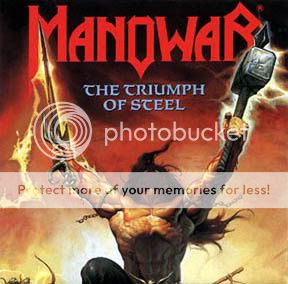
MANOWAR – The Triumph of Steel

Sometime around 2001, there existed a website, crested with Yahoo GeoCities, which claimed to be “the future of heavy metal”.  In the twenty-first century, the very notion of calling metal ‘heavy’ metal was at complete odds with any kind ofo “future”. The website also had a logo which dripped blood. The whole thing was laughable…and even more so, once you started to dig around enough to realise that these guys weren’t being ironic. They were still partying like it was 1982 and incapable of forward thinking. They probably loved this album by Manowar and were probably even naive enough to take it completely seriously.

As tight as they are musically, there’s no way Manowar aren’t playing their audience, with tongues firmly in-cheek.  ‘The Triumph of Steel’ – their sixth studio album – was released in 1992, in the middle of a very exciting time for alternative rock and metal. With that, they were outsiders – even more so than usual. With Soundgarden and Pearl Jam appearing regularly in Kerrang!, it was hardly likely Joey DeMaio and his gang were ever likely to be cover stars, with their battle songs and grimacing rock faces.

The album was released over a decade into the band’s career, so surely by then, their testosterone driven, Thor-hammered schtick should’ve worn a little thin?

They’ve thought of that.

In a move far braver than most weaklings would even consider, the album opens with a 28 minute epic ‘Achilles, Agony and Ecstasy In Eight Parts’. It takes their fascination with mythology and gods to whole new levels of pompousness. Over the course of nearly half an hour, Manowar churn out lyrics inspired by Homer’s ‘Iliad’, where the best bits are coupled with monster-sized guitar riffs, but there’s a lot of padding.  At worst, there are bits which sound like horrible musical theatre (think Jeff Wayne’s Musical Version of “Sparticus”, but even worse) and surely the four-and-a-half minute drum solo could’ve been edited out? Overall, while Manowar deserve points for pushing their brand of battle metal to new extremes, at almost half an hour, it was bound to fall on its arse somewhere.  Realistically, the best parts of ‘Achilles’ could have created a career-defining, brilliant ten-minuter.

The second half of the album returns to more tried and tested formulas, with Manowar tackling standard length tunes.  ‘Metal Warriors’ begins with the claim that ‘Every one of us has heard the call / Brothers of True Metal, proud and standing tall’. I’m still laughing inside, whenever I think about it. Musically though, it pays homage to everything that’s decent about old-school metal, so despite being ridiculous in the extreme, that’s just enough to make it stand up.  ‘Ride The Dragon’ ploughs ahead, 80s metal style, with double bass drumming (courtesy of Kenny Earl “Rhino” Edwards…not to be confused with Status Quo man, Rhino Edwards) and some flat-out hysterical lyrics: ‘Demon’s blood and dragon fire, falling on my wings / Racing to the battle in the sky / Ancient gods are calling me, I hear them when they sing / Of all the heroes who wait for me to die / Beneath the cloak of magic, I’ll meet them in the air / I am invisible, I move without a sound / They look but cannot find me, they think that I’m not there / With a spell I send them crashing to the ground’… Death to false metal, indeed!

Both ‘The Demon’s Whip’ and ‘Cherokee Horse of the Spirits’ are stomping, slower numbers – the former, rather worryingly, seems to have been recorded without any bass (maybe Joey DeMaio was off having an Ægirian sized piss) – but on the plus side, finds space enough for a belting guitar solo. By this point, though, things are in danger of flagging, with most of the material feeling like an afterthought to fill the second half of the disc.

Most of you will be approaching this album knowingly. Despite a reasonable amount of musical prowess, Manowar remain big, brash and utterly ridiculous. But then, since Manowar once featured Ross “The Boss” Friedman of Detroit garage punks The Dictators, they’re almost certainly having good-natured fun at the expense of eighties style metal.

Just don’t tell those guys at that website.

January 2010
THE BLACKOUT ARGUMENT – Remedies

Whilst browsing the internet, I stumbled upon a list of ‘obscure albums’ everyone should hear. At the top of that list,there was an album called ‘Your New Favorite Band’ by The Argument. No, me neither…so I guess their job was done (we’ll gloss over the inclusion of The Big Dish and the far better known Danny Wilson in their list). They likened The Argument to Ben Folds Five, so that piqued my interest. Next stop: I had a look on Spotify to see if I could hear something from it. No such luck, obviously.

 …What’s that at the top of Spotify’s list of bands with similar names? The Blackout Argument? No, never heard of them either. It seemed only natural therefore, that I’d hit the play button and see what they sound like.

It’s heavy. Hailing from Germany, The Blackout Argument specialise in a similar brand of hardcore metal/punk as Ignite and Shift. More metal than punk, for sure, but spiky around the edges. ‘Remedies’ is their second full-length album.

‘Tempest (Rescue Remedy)’ is a thirty second intro and sets the tone for the album with its pounding bass drums, before leading into ‘Broken Teeth (Agrimony)’ where The Blackout Argument marry heavy guitar riffs with shouty hardcore vocals, lightening to a singing voice for the choruses. Very little new in that approach, but as always, it’s whether they do it well or not that the real issue. ‘Treasure Chest Confidential (Gorse)’ is probably the closest the album gets to the punky hardcore (as opposed to metal) and may appeal to fans of The Sainte Catherines and recent Propagandhi – a definite highlight for me.

‘Kidnap Yourself (Aspen)’ is sludgy with the same sort of shouty vocals which dominate the album, more than reminicent of Glassjaw; again this utilises the more tuneful vocal for the chorus. I wish I could pinpoint whom that voice reminds me of – initially, I thought it was Jon Bunch from Sense Field, but it’s not soft enough. ‘Seven Tones of Grey (Pine)’ has slightly punchier verses leaning towards Sick of It All’s more metallic material, but it’s the more emo/screamo chorus that makes them feel more modern at the time of writing. ‘Dead But So Alive’ starts with a heavy, but tuneful guitar riff, but once vocalist Raphael starts shouting (or more specially alternating the shouting with the cleaner chorus vocals) it becomes very similar to previous tracks.

For melody, ‘Vampire Searching for Some Light (Larch)’, is a standout and probably the album’s best track, being more hardcore punk, recalling Strung Out and co, but there’s still more in common with metal than punk throughout. While The Blackout Argument are great musicians, ‘Remedies’ isn’t always the easiest album to listen to, as it’s so dense. With lots of hardcore punk and metal, though, it’s time that allows hooks to shine through, so I’ll certainly return to it and give it more listens at some point in the future.

There are a bunch of free mp3s up here: www.theblackoutargument.com/wordpress/music

December 2009


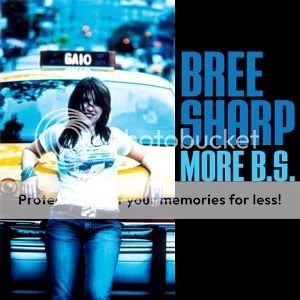
BREE SHARP – More B.S.

A few years ago, I picked up Bree Sharp’s debut album ‘A Cheap And Evil Girl’ on a whim. I’d not heard a note of it, but it was dirt cheap and allegedly both Bob Dylan and Elvis Costello had said they were fans, so I figured I ought to hear it. As it turned out, the album was good, alternative-rock singer-songwriter stuff. Bree’s voice may have been everyone’s cup of tea, being rather edgy…almost exactly like Jepp (about whom you’ll find next to nothing on the net – if anybody can help, send us an email!), but generally it was a solid debut.

This, her sophomore effort, (minus the title for its Japanese release) kind of takes up the baton where ‘Cheap…’ left off. There’s very little difference in the tone and as before, there are obvious stand out cuts, some solid moments and a couple of absolute clunkers. Of songs I’d rather forget, the cover of Don Henley’s ‘Boys Of Summer’ is misjudged and doesn’t really suit Bree’s vocal style at all. A definite skipper… ‘Sleep Forever’ also grates a little, as the hooks aren’t that obvious and the drum pattern isn’t so inspiring. Since that closes the album, it’s easy enough to turn off the CD early!‘Lazy Afternoon’ is very chorus driven and the backing vocals prepare the listener for what you think is going to be a killer chorus and then somehow, it falls a little flat. It’s not unpleasant, but it feels like filler.

With the album’s weak tracks out of the way, what of the rest? ‘Everything Feels Wrong’ has a big chorus though, so it follows ‘Lazy Afternoon’ very well. Like a fuzzy-rock Sheryl Crow, complete with between-verse ‘doo doo doo’ moments, this was very much meant for radio play. It’s the best track here, hands down. ‘Dirty Magazine’ is this album’s oddity. Musically, it’s at odds with the pop-rock style – it’s got a twangy rock ‘n’ roll edge, although it’s not at all rock ‘n’ roll. It has an old fashioned country twang too, but there’s no way you’d ever call it country…and the lyrics may hint at the edgier side of Bree’s debut, but somehow, it doesn’t quite work. ‘Morning In A Bar’ is gentler all round, more atmospheric and sounds like the album’s hangover cure – probably quite deliberately – although as penultimate track, it feels misplaced, as it’s more of a closing statement.

‘Galaxy Song’ – nursery rhyme la-la’s aside – represents the kind of thing Bree is best at. It’s mid paced, semi-acoustic and hints at KT Tunstall, although tougher sounding and recorded a few years before KT hit the big time. ‘The Last Of Me’ is also a high point – a song which takes typical post-break up themes and looks for strength, presents the listener with more semi-acoustic goodness. On the strength of this track alone, I’d like to know whether Bree has had much radio play in the US, aside from her debut’s ode to wanting David Duchovny. It’d be a shame if not, since she’s clearly written better, less throwaway songs.

Overall, ‘More B.S.’ is actually pretty decent. Maybe I only think of it as being not quite as good as the debut purely because ‘The Boys Of Summer’ makes me cringe. …And there’s nothing quite as edgy here as ‘Gutter Mouth’ or ‘Cheap And Evil Girl’. But then, as much as I like it, Bree’s debut was never perfect.

November 2007


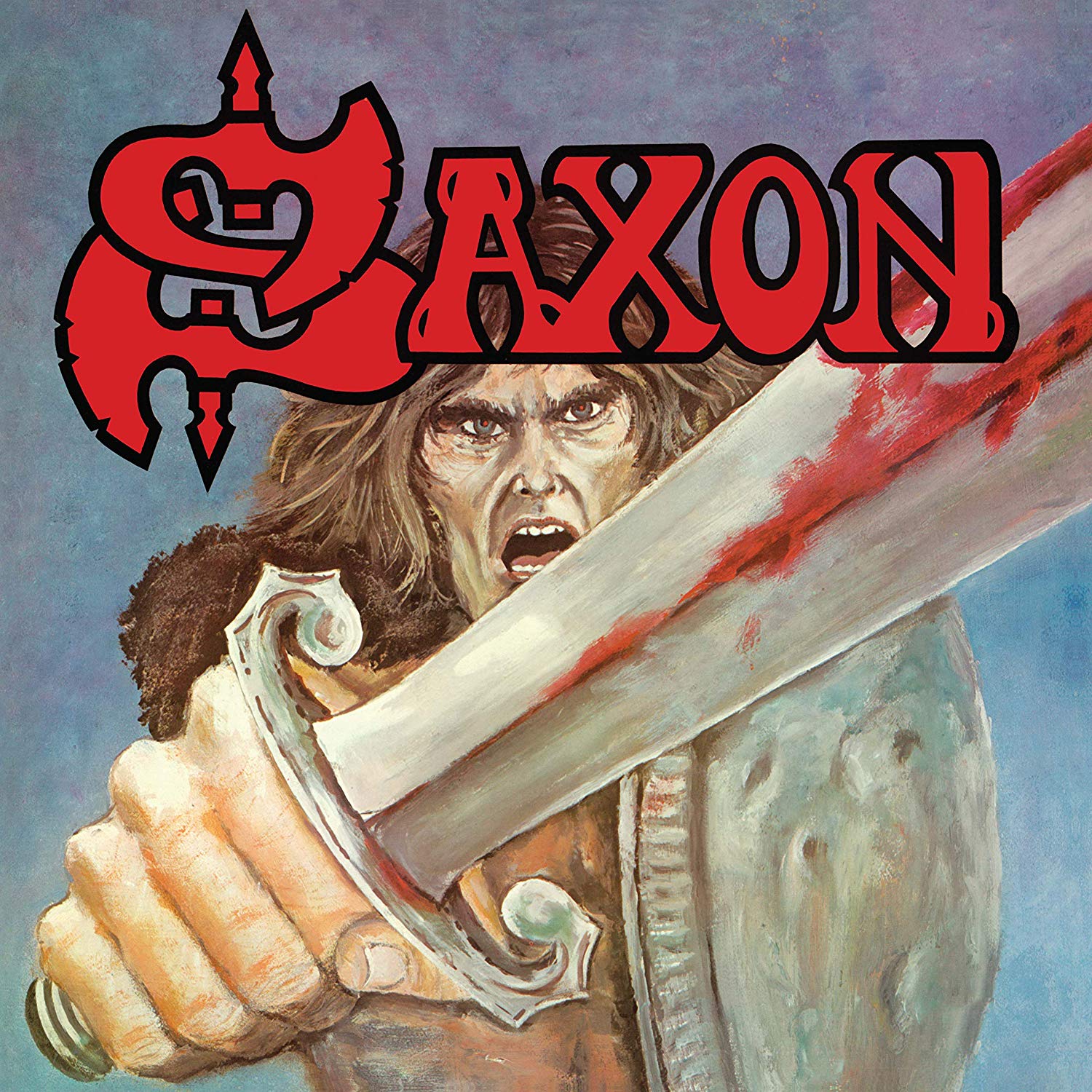
SAXON – Saxon


In the late 1970s, the New Wave of British Heavy Metal created a musical storm. Fusing the heavy edges of the 70s rock giants with the energy of punk (although as a sub-genre it owed little else to punk), a new musical scene was born. You couldn’t go a week without Sounds featuring someone NWOBHM related.  Obviously, Iron Maiden remain the best loved of all the bands associated with the scene (save for perhaps Def Leppard; though, due to the Americanisms of much of Leppard’s material, Iron Maiden have remained the most true to the roots of the NWOBHM), but this debut by Saxon is a key album in the scene’s breakthrough; it’s regarded by many as the first album released by one of the big NWOBHM bands.

In 2009 this debut celebrated its thirtieth anniversary…and one of the first things you notice are the rough edges. It was clearly recorded on a small budget and in a hurry. In fact, you could be left wondering what producer John Verity did at the sessions, since the whole thing sounds like a demo. Things are often a little muddy and occasionally Biff Byford’s vocals feel a little lost.

That aside though, there are some decent songs here. The opener ‘Rainbow Theme’ is a short instrumental which leads into ‘Frozen Rainbow’ which reprises the theme at the end. Beginning with an open stringed bass riff (something bassist Steve ‘Dobby’ Dawson would make his trademark at live shows, leaving him with a free hand to point with – allegedly the main influence for Spinal Tap’s Derek Smalls), the piece leads into the main guitar riff before settling into the song. It could be seen as an odd choice for an opener as it’s an epic, slow piece, rather than a stomping track to get things underway. The high point here is the guitar solo, a great howling and moody offering from Paul Quinn, nodding to his previous band Coast’s more progressive tendencies.  The track also allows an early insight into Biff’s vocal range – he’s a man with more to give than just a full rock belt.

Elsewhere, there are plenty of no nonsense rockers – ‘Backs To The Wall’ is based around a simple but effective guitar riff, coupled with ‘don’t let them get you’ themed lyrics; ‘Still Fit To Boogie’ is simple, but not as good as the lyrics are a little embarrassing now. Of the rockers, ‘Stallions of the Highway’ fares best, with it’s motorbike theme (which would recur throughout the band’s work over the next few years). If it’s complexity you’re after, the album’s rockers mightn’t do much for you. For those of you whom want something to get your teeth into, the album features a couple more brooding, epic style songs to keep ‘Rainbow Theme/Frozen Rainbow’ in good company. ‘Judgement Day’ (hands down, the best track on the album) thunders from the speakers and captures the band at full power. There’s a mid section where things get a bit gentle, again casting it’s musical net to include touches of 70s prog, but that’s just a build up to a climax, with twin lead guitar harmonies. For best results, check out the live b-side version of this track (included on the deluxe version of ‘Saxon’). Closing the album, ‘Militia Guard’ is the first of Saxon’s many war themed songs, and while the songwriting shows promise, it’s still the twin guitars which prove the high point.  An interesting piece, this is neither the straight metal that Saxon would perfect on their next two records, or seventies indulgence, but a cut and paste mix of both.  A huge closing statement, this sounds as if it were glued together from three or four musical ideas, but it’s to Saxon’s eternal credit that they make it work so well.

At just under half an hour, the original album and it’s eight songs fly by, with no messing. For those who want more, the 2009 reissue features 14 bonus tracks – including demos, BBC Session tracks and part of the band’s 1980 Donington Monsters of Rock appearance (the rest of which is featured on other Saxon reissues). It’s great to have the live tracks, as in most cases they’re superior to the studio versions. As for the demos, they’re presented here in a form which is almost identical to the finished album cuts, just a little rougher. The best of the bunch is ‘Big Teaser’, which features a guitar riff which gives a nod to Status Quo, something nowhere near as obvious on the finished album recording. The real gem among the bonus tracks is the BBC Session, where the band premier ‘Motorcyle Man’ and ‘747 (Strangers In The Night)’ – the latter being one of the band’s greatest achievements, and both tracks paving the way for the signature sound which made their next three LPs classics of the era.

‘Saxon’ might have a rough production, but most of the songs are rock solid.  While more geared towards fans – new listeners should hear ‘Wheels of Steel’, ‘Strong Arm of The Law’ and ‘Power and The Glory’ first – there’s plenty of interest here…and it’s best moments win out purely on the basis that Saxon never recorded anything quite like ‘Frozen Rainbow’ and the middle of ‘Judgement Day’ again.

The birth of 80s metal starts here.

December 2009/June 2018

Continue reading →