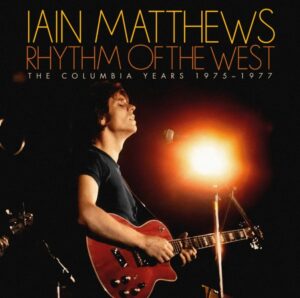
 In 1970, Iain Matthews formed band Matthews Southern Comfort, a top notch country rock band which would become his main musical vehicle following his departure from Fairport Convention. Formed essentially as a vehicle to promote Iain’s 1969 solo album of the same name while out on the road, they’ll always be remembered for their UK number 1 hit with a cover of Joni Mitchell’s ‘Woodstock’ – a recording very much modelled upon the Crosby, Stills, Nash & Young recording – but the band recorded a lot of strong material across two more rather fine albums. Over the next couple of years, Matthews barely rested; by the end of 1972, he’d recorded and toured with country rock band Plainsong and also recorded a brilliant solo album,‘If You Saw Thro’ My Eyes’. That would ultimately be the springboard for a run of great solo records over the next decade.
By the mid 70s, Matthews had already amassed an impressive body of work. His albums ‘Tigers Will Survive’ (1972), the marvellous ‘Valley Hi’ (1973), ‘Journeys From Gospel Oak’ and ‘Some Days You Eat The Bear’ (both released in 1974) shared a typical mix of folk, country and pop-rock tunes mixing covers with original material, but 1975’s ‘Go For Broke’ found Iain taking a dip into slightly more commercial waters. …And it’s with that album – a slightly overlooked entry in the Matthews canon – that ‘Rhythm of The West: The Columbia Years 1975-1977’ begins its look back at another prolific period for the singer-songwriter.
Measured against ‘If You Saw Thro’ My Eyes’ and ‘Some Days You Eat The Bear’, ‘Go For Broke’ isn’t exactly the best Iain Matthews album. It doesn’t have the focus of the former, and in terms of its chosen cover tunes, sometimes lacks the spark of the latter. For the bigger fan, though, it’s a record that still has enough of its own charm. That’s more than clear when listening to a trilogy of self-penned tracks (‘Rhythm of The West’, ‘Lonely Hunter’ and ‘Steamboat’) that show Iain moving forward as a songwriter.
The album’s highlight ‘Lonely Hunter’ opens with a pulsing bass and rigid drum line, hitting upon an almost proto-disco sound which works the band rather hard. The busy style is in contrast with a little harmonica creeping in, but that just keeps the adult pop interesting. There are also clean guitar sounds cutting through the incessant bass groove, but your ear will be constantly drawn to Iain himself, filling most of the number with long, flowing vocal notes that sound great when tackling big harmonies. This fusion of Americana and pop feels like a natural step for Matthews, and by following this immediately with ‘Steamboat’ – another 70s infused slice of adult pop that introduces reggae rhythms to offset Iain’s “yacht rock” vocal style – and a cover of Tim Moore’s ‘A Fool Like You’ which takes soulful vocals, light orchestration and a strident electric piano melody to evoke a mood that feels like an extension of Daryl Hall & John Oates debut ‘Whole Oats’ from ’72, ‘Go For Broke’ offers a trilogy of unmissable tracks. [‘Lonely Hunter’ would actually be revisited by Matthews in 1980 for his ‘Spot of Interference LP, in a superior arrangement, adding extra guitar parts and playing more to the power pop crowd.]
Hall & Oates actually provide a more definite link with this album, since Iain turns in an interesting cover of ‘When The Morning Comes’ (the original can be found on the duo’s second release, 1973’s ‘Abandoned Luncheonette’). It would have been easy for him to tackle it in the smooth manner of ‘A Fool Like You’ and it likely would have been perfect. Instead, it’s given a busier, funk oriented bassline and a world of steel drums that sound like they’re generated by a session keysman. If cod calypso is your bag, you’ll have a ball; although this isn’t terrible, it’s not ‘Go For Broke’s finest four minutes. It’s certainly of its time, and preferable to hearing Iain go through the motions on versions of Doris Troy’s ‘Just One Look’ (The Hollies’ version will always be the definitive), The Young Rascals’ ‘Groovin’ (nicely sung, but inessential) and Grumpy Van Morrison’s ‘Brown Eyed Girl’, which isn’t terrible, but Iain’s talents were always far better than resorting to this sort of light entertainment filler.
Another highlight from ‘Go For Broke’ is a brilliant version of ‘Darkness, Darkness’ which presents a westcoast influenced vocal and a warm musical arrangement that sounds like a throwback to Southern Comfort, but peppers the predictable with several then-futuristic sounding synths to add a sinister edge. When Iain chooses covers well, he ends up with something great; something he could be proud to call his own – and this is no exception. ‘Rhythm of The West’, meanwhile, allows Iain to share some great ringing guitar work, colouring some superb westcoast pop-rock providing a future echo of his next three albums [1996’s ‘Hit & Run’, 1978’s ‘Stealin’ Home’ and 1979’s ‘Siamese Friends’ – all Matthews essentials] and a Matthews original ‘I’ll Be Gone’, a slice of fairly predictable AM radio pop that borrows from Manfred Mann’s ‘Pretty Flamingo’ for a melodic hook fares very well indeed. Matthews would go on to record superior tunes in this style the following year, but for now, this provides an excellent stab at radio friendly 70s pop, with some great guitar work, and a smart sax break that wouldn’t have felt out of place on a Billy Joel album from the era.
The material can seem hit ‘n’ miss, but where this reissue comes into its own is through the sound quality. Previous editions of ‘Go For Broke’ – used for streaming services – sound really rough; the source was clearly obtained using a needle drop on an old slab of vinyl and the audio worsens towards the end of each side. Here, ‘Go For Broke’ can be heard once more from a clear source, allowing the material to breathe so much more easily. For the bigger fan, there are also a smattering of bonus tracks. A demo version of ‘Groovin’ provides little variation on the finished article, but that’s made up for by the presence of a demo of ‘So Sad’, a track that never appeared in final form. Fitting nicely with Iain’s ventures into AM radio pop-rock, the demo boasts a whole world of strummed acoustics, a smooth verse that allows his natural vocals to shine, and a hook that shares a piercing slide weaving in and out of a great harmony. If it were not for the main hook (“so sad / so bad”, repeat) feeling a bit underbaked, this could pass as a completed track, and stylistically, a few similarities to George Harrison’s work between 1979 and 1981 could make it a little broader in appeal. [This was previously issued on Iain’s ‘Orphans & Outcasts’ box set in 2019, but it feels far more at home here.]
In terms of bonuses, you’ll also find the obligatory live recordings fleshing out this first disc. A stripped down acoustic version of ‘Lonely Hunter’ (Tokyo 1991) takes on more of the melodic style of the ‘Spot of Interference’ version – something that’s very welcome – and finds Iain in excellent voice against some rather pleasing guitar work. It fades out rather unnaturally, unfortunately, and although this never spoils the performance, it leaves the listener hanging, wondering what happened next during what sounds like a marvellous show. A largely acoustic ‘Darkness, Darkness’ from New Jersey 2011 makes a hard to find recording with Jim Fogerty widely available, and the sparse take brings a suitably haunting edge to the piece, with spectral electric guitars soaring over fingerpicked, folky lines. There are lot of great live recordings in the Iain Matthews canon, but this is one of the very best. By comparison, a version of ‘Brown Eyed Girl’ could’ve seemed surplus, but by reducing everything to a gentle Americana arrangement where light acoustic guitar meets some tasteful banjo, this slowed down performance (captured in Heilbronn in 2004) gives the feeling of hearing the song anew.
In terms of overall quality, 1976’s ‘Hit and Run’ – the main feature of this set’s second disc – represents a sonic leap. Matthews fully embraces an American FM radio sound and delivers a selection of Westcoast AOR and adult pop tunes that are almost perfect. So much so, in fact, it feels as if this style – a pop music subgenre brimming with huge radio friendly hooks, but still smooth enough to allow for a little introspection – were invented expressly for him.
‘The Frame’ leads off a superb set of tracks, sharing a bass-led, very 70s groove with immediate effect. The harder edges are offset by some great, smooth sax and a world of harmonies that reach for the pinnacle of yacht rock. Allowing the more soulful edge of his vocal to glide over the groove, Matthews sounds like a forerunner of Christopher Cross meeting with The Stills-Young Band, giving his fans a great taste of what’s to be a superb LP. Better still, a perfect version of John Martyn’s ‘One Day Without You’ shares an AM radio friendly number loaded with ringing guitars, contrasted by strong harmony vocals and light sax, taking Iain further into the realms of yacht rock. A strong indicator of how Iain will sound covering Terence Boylan numbers on the following year’s ‘Stealin’ Home’, the recording is unashamedly MOR, but between a warm production and a band that truly believes in the material, it borders on essential listening. The equally brilliant ‘Times’ takes a similar AM radio sound and shakes it up with some busy piano work – supplied by Charlie Harwood – and a jazz toned guitar solo that comes straight from the world of Steely Dan. This shares something with a great energy, and yet still fits with Iain’s preference for a smooth vocal. If you love 70s adult pop-rock, it’s a must-hear.
Scaling things back, ‘I Can’t Fade Away’ is a piano-based ballad, all slow tempo and aching vocal. It’s less interesting musically, but a great production job, emotive vocal and light sax all come together to create something that comes close to peak 70s MOR. Despite being rather more low key, this track still manages to feel special, since Iain wrings out every drop of emotion from the lyric with a strong performance that compliments the light sax. In a sharp change of mood, a re-recorded ‘Tigers Will Survive’ takes a familiar melody and places it against a jazz tinged arrangement where piano and sax do battle, and a tight as hell rhythm section powers a great groove. Stylistically, it’s rooted firmly in the mid 70s, but absolutely runs rings around its 1972 counterpart.
Between ‘Tigers’ and ‘One Day Without You’, ‘Hit and Run’ would be a keeper, but the remainder of the original LP doesn’t slouch, with the busy pop of ‘Just One Look’ (not the Doris Troy number, but a Matthews original) sounding like various Steely Dan associates tackling a Billy Joel number that has a New York swagger and the air of an old TV theme, a cover of Richard Stekol’s ‘Help To Guide Me’ sharing an easy listening mood that makes great use of electric piano, sax and smooth vocals, sometimes sounding like an early deep cut from Marc Jordan, and the self-expanitory ‘Shuffle’ setting a jazzy feel in place, providing a great vehicle for rolling piano and some busy brass. In many ways, it’s ‘Hit And Run’s most frivolous workout, and although the influence from old swing numbers and shameless vocal scatting mightn’t be to everyone’s tastes, its great to hear a session band who are absolutely on fire. In closing, the title cut brings everything back down to earth with a slower jam that adds a jazzy swing to a soulful number that sounds like an early Hall & Oates deep cut. As you might expect, the vocals are especially on point, but full credit must be given to saxophone player Steven Hooks (a man with a devastatingly short CV) who wields a superb tone throughout, much as he does on this album’s other cuts. It feels a little long at six minutes, but that’s its only fault; it’s a great piece that gives the hired band plenty to work with, acting as a reminder that most of ‘Hit and Run’ feels like a hugely collaborative affair, despite Matthews taking sole credit on the front cover.
There aren’t a huge amount of bonus tracks appended to ‘Hit and Run’ here, but it’s a case of quality over quantity. ‘Just One Look’ sounds a little odd played as a solo acoustic number and stripped of a busy groove, but the sparse approach allows the song to shine, and Iain is in good voice during the Nottingham ’91 performance, but a stripped down version of ‘The Frame’ fares much better, with a dual guitar – one acoustic, one electric – and a slightly weathered vocal transforming it from 70s AOR/MOR into the realms of a light blues number. It’s another great example of how Matthews is a master of re-imagining his own works, and often for the better. [Fans will possibly already own the recording of ‘Just One Look’ on the ‘Live At The Bonnington Theatre’ CD, but should note that ‘The Frame’ isn’t the same as the version on the ‘Afterwords’ release, but a previously unavailable recording made the same year with Jim Fogerty.]
‘Hit and Run’ is easily Iain’s finest forty minutes since the release of ‘If You Saw Thro’ My Eyes’ half a decade earlier. For those yet to pick up a copy of the album on CD, it should make the purchase of this box set a no-brainer. Matthews would take an even more confident journey through similar sounding material on 1977’s ‘Stealin’ Home’ and 1978’s ‘Siamese Friends’ mixing original material with covers of Robert Palmer, Marc Jordan and Terence Boylan songs, but in the meantime, he’d issued the greatest album of his career. [‘Stealin’ Home’ and ‘Siamese Friends’ can be found in the absolutely unmissable 6CD box set ‘I Can’t Fade Away’, an extensive journey through Iain’s recordings made between 1977-1984 – a box set that’s really not to be missed.]
For the bigger Iain Matthews fan, it’s with the remaining discs that this box set creates a real interest. Two live sets from Ebbets Field – recorded in 1976 and 1977 respectively – are shared in decent audio quality. The first set is really clear overall, but Iain’s vocals are really loud, highlighting the intimacy of the venue. Nevertheless, the overall performance is great, and with a full band in tow – including brass players – he works through a selection of songs from both ‘Go For Broke’ and ‘Hit And Run’.
The opening ‘Steamboat’ showcases a tight band, and even though the saxes sound a little thin and reedy in relation to a very muscular rhythm section, they really highlight a very 70s quality to the performance. The always wonderful ‘Rhythm of The West’ fares better due to a slightly more scaled back sound, even though there are moments where it feels as if you’re actually standing next to the drummer, and the still new ‘Shuffle’ makes a great feature of the brass, dancing relentlessly across a great jazzy groove. This is one of those performances that’ll make you think it must’ve been really fun to have been there in person.
A couple of genuine set highlights come from a similarly enthused ‘Tigers Will Survive’ – all chopping guitars and confident sax – sounding superb in its still new, rockier arrangement, and a cover of country number ‘Truck Drivin’ Man’, allowing the band to explore some really tight bluegrass influences. It’s a song that has a place further back in Iain’s past, having been recorded for a John Peel session with Plainsong in 1972, but the energy captured here could easily make this the definitive take. The title cut from ‘Hit And Run’ loses the set a little momentum early on, but the crowd seem really enthused, so it must have suited being there much better than hearing it decades after the fact, but this is more than made up for by the presence of the 70s pop rock of ‘Payday’, a previously unrecorded tune that sounds like something the young John Mellencamp might have tacked onto the end of an album circa 1978. In terms of a snapshot of a band who are on form and having fun, this is an essential listen. [Four tracks from this show were appended to the 2007 CD reissue of ‘Go For Broke’, but it’s great to hear the full set.]
The set from 1977 is even better. There’s a better balance between the instruments and although the drums sound a little less “live”, this allows the vocal to come through more naturally, and in the intervening year, Iain’s delivery has become a little less shrill, and sounds far closer to the voice present on the wealth of excellent live recordings from between 1978-1980 that are available in the 1978-1984 box set. The jazzy shuffles from his Falling Rock Band are perfect here, and the sax work throughout an opening ‘Just One Look’ is especially impressive. The jazzier influences cutting through the centre of a great rendition of ‘Lonely Hunter’, in particular, sound like the work of a crack session band, capable of reproducing anything from the already vast Iain Matthews catalogue.
Song wise, there’s a fair amount of repetition from the previous year’s gig, but the Falling Rock lads are especially confident on versions of ‘Shuffle’, ‘Rhythm of The West’ and ‘Tigers Will Survive’. Even dropping a cover of ‘Brown Eyed Girl’ – naturally, in the same smooth arrangement explored on ‘Go For Broke’ – into the set doesn’t derail the overall excitement here, and with Matthews in an especially talky mood, the feeling of atmosphere from this small club show really comes across. Along with ‘Hit And Run’, this makes the asking price for this box utterly worth it.
Complimenting the second Ebbet’s Field show, a full rehearsal tape – again, recorded with the Falling Rock Band – allows for an even closer listen to Iain and friends honing some superb material. As you might expect, the audio isn’t exactly pristine, but given its source and age, it sounds good enough. Here, you’ll experience ‘The Frame’ played with a prominent electric piano, the always brilliant ‘One Day Without You’ with a slightly looser feel, allowing for a slightly busier guitar in places but without drawing away from Iain’s smooth vocal, and ‘Tigers Will Survive’ showcasing some great drums. On these highlights, fans will hear what a strong unit the Falling Rock Band are before hitting the road, but this tape isn’t necessarily dominated by those tracks. The enjoyable ‘Faith To Arise’ – a Terry Reid number that never appeared in completed studio form on any Matthews discs – shares echoes of The Band, and following a couple of false starts, finds everyone in a pleasingly mellow vibe, and although it’s much rawer than the studio take, the Matthews penned ‘Just One Look’ unveils a really punchy bassline that’s sometimes hidden by a broader sax and guitar sound on the album version. With a run through of a ten song selection, this unearthed tape gives a great insight into a band at work, even if it doesn’t represent the full show that Iain would soon take on the road.
On the remainder of disc five and spread across disc six, you’ll find a variety of other live recordings. Although the songs themselves tie in with the two studio albums, many of the sources are out of period. In some ways, this gives a welcome insight into how the songs have endured over time, and in some cases, how Iain has chosen to reinterpret them to fit each era. Some fans will, naturally, find this broader approach a little frustrating in a box set supposedly devoted to work dating between 1975-1977, but for those who invested in the previous 1970-1974 set, this artistic decision will certainly come as no surprise.
A four song selection from Paul’s Mall, Boston in 1976 (sourced from a radio broadcast) offers a really funky take on ‘Tigers Will Survive’ which pushes a superb keyboard part to the fore, creating something even busier than the already busy album cut, ‘Faith To Arise’ sounds a little uneasy on the falsetto vocal moments, but is musically brilliant, with some great interplay between sax and keys, while ‘Shuffle’ sounds like a rehearsal in an empty venue, but with that comes a great drum sound. Rounding out the set, a version of ‘Darkness, Darkness’ has a sparse quality that brings out the sadness in its already maudlin arrangement. Again, you’ll find Iain in great voice, and although the audio quality feels a little too “bright” in places and it’s annoying to have a radio DJ talk over the intro of ‘Shuffle’, these four performances definitely come under the bracket of “nice to have”.
The first third of disc six actually gets off to a wobbly start. You’ll find a super-funky bass led version of ‘Just One Look’ (Matthews) sourced from the Lone Star Cafe, New York in 1979. The more natural home for this would have been as a bonus in the Rockburgh Years box, but it’s actually similar to the Brussels ‘79 performance found on that release’s fifth disc. Fans will already have heard this since the whole of the Lone Star Cafe gig was released in a digital only format in 2022. A groove laden ‘Tigers Will Survive’ represents the Amsterdam Paradiso show from the same year (again, the full show can be found elsewhere), and a pair of tracks from the aforementioned Brussels show (available in full on the Roxburgh box) are surplus to requirements. A 1984 recording of ‘Lonely Hunter’ from Milan is more welcome here since it’s actually one of the tracks from that show that wasn’t included among the seven songs drawn from that show when it appeared in partial form in the ‘Rockburgh Years’ box, so it makes its physical debut here.
From that point, the rest of the disc is more interesting, since it shares a wealth of recordings that are harder to find. A sparse, acoustic rendition of ‘Lonely Hunter’ from 1988 is absolutely gorgeous, capturing Iain at his most vulnerable, and from ten years later, ‘Just One Look’ sounds pleasingly intimate, despite being played with a full band. The sound quality on these recordings is absolutely stunning. Although the nature of this collection relies on repetition, fans shouldn’t feel short changed: the version of ‘The Frame’ from an Amen, Netherlands gig in 2008 is based around acoustic guitar and electric piano; the version from Bergen three years on is a full band affair, but played in a wonderfully relaxed manner allowing a late night piano vibe to take the reins. It could be the best version of the track ever. Even when things do lean towards the similar (as with two acoustic takes of ‘Brown Eyed Girl’ taken from 2004 and 2016, respectively), the difference in audio quality can provide just enough variety for this compilational approach to work. The disc brings the listener up to the relative present at the time of its release too, closing with a version of ‘Darkness, Darkness’ sourced from the 2022 Cropredy Festival, bringing Iain full circle and back into the Fairport Convention family. Performed with a twin guitar set up (a finger picked acoustic and soaring electric lead) and with Matthews in great voice, it’s another must-hear for fans.
For those who’ve already picked up Cherry Red’s previous Iain Matthews box sets, this will be considered an essential item, even if the two studio albums are already owned. Between some well curated extras and a couple of superb live sets, there’s plenty of gold here. Looking back, it’s amazing to think the live materials from the 70s have existed in such great quality and can be enjoyed so many years later, and arguably sounding better than ever. Fans also lucky that Iain – or at least someone close to him – is such a keen archivist, since this transforms a couple of well circulated releases into something that feels rather special. In short, ‘Rhythm of The West: The Columbia Years’ is a highly recommended box set.
Buy the box set here.
March/April 2026