
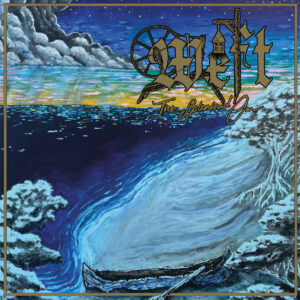
 The brainchild of multi-instrumentalist Charlie Anderson, Weft’s album ‘The Splintered Oar’ isn’t a record that’s easily categorised. Across five fairly lengthy, mostly instrumental numbers, the Panopticon violinist takes in elements of folk metal, melodic black metal, dark folk, prog metal and even an element of alternative country to create a musical journey that’s full of twists. It is a record that won’t be loved by a mass audience, but it’s ultimately one that feels very rewarding in terms of depth and variety.
‘Leaves’ kicks off an interesting forty minutes with a quiet, atmospheric piece, where a droning violin underscores a haunting acoustic guitar melody. The contrast of long, soaring notes and sparsely fingerpicked elements (recorded “as live”, allowing for the sound of fingers sliding on frets to add a huge amount of character) creates something simple, but almost soundtrack-like. The downbeat melody is also rather simple at first, but builds really effectively; first with an extra underscoring of strings, then with the arrival of some harder guitar chords. Then, sinking back into something evoking the original melody, even more strings aim to pull the listener into a dark and mournful place, suggesting this album will be quite low-key. It’s a ruse; once this soft melody has put the audience at a relative ease, ‘False Kingdom’ arrives with an opening rhythm based around something much closer to funereal doom, before crisp sounding violin strings lend a contrasting melody. Tribal drumming cements everything more within a folk metal sphere, and from there, busy rhythms and almost prog-like accompaniments suggest something bigger is about to arrive. Sure enough, an explosion of heavy electric guitar and crashing drums delivers a classic folk metal riff, but peppered with pneumatics, there’s immediately a hint of something heavier lurking beneath the surface. A guttural vocal – far more of a black metal persuasion – will send the more melodically inclined listener on edge, but the way Anderson quickly drops a huge, melodic violin against the heaviness creates something superb. Not content to leave things there, the middle of the track shares a folk/black metal blend that’s absolutely furious, before an even heavier riff introduces a jig that’s just as intense but a little more accessible. If you can make it through these nine minutes, the rest of ‘The Splintered Oar’ should bring a lot of entertainment.
Clinging onto the pneumatics, but stoking up the violin, the busy opening of ‘The Hull’ leans further into an extreme folk metal sound, but as before, it’s immediately obvious that Anderson is approaching this with a clarity of vision. Realising that much more intensity might lose a few listeners, the number takes a quick detour into ambient sounds that capture the mood of ‘Stratosfear’ era Tangerine Dream, before settling into a blend of doom and folk metal which allows a slower tempo to share bigger melodies. That’s “relatively speaking”, of course; over the classic, doomy riffs, there are more melodic death and black metal vocals that are likely to be of an acquired taste. It’s on the musical front that this track excels, though, and passages of classic sounding goth/doom and even a touch of melodic/trad metal fill the middle of this epic track in a way that acts as a reminder that this is a recording that’s full of surprises. The melodic interlude introduces a great twin lead guitar sound, which has the effect of making the folk/black metal blend sound even more confronting upon its inevitable return. There are some great elements here, but the best – and most exciting moments – come from a marriage of male and female vocals that aim to take the listener back centuries, and a quieter semi-acoustic passage that makes everything seem like Anderson has been listening to Mike Oldfield. At over ten minutes, ‘The Hull’ makes some great demands on the listener and there’s a lot to take in, but the more patient ear will certainly enjoy the journey.
‘Red Dawn’, by contrast, is much less interesting. The closest this album comes to offering “filler”, the number pitches itself far more squarely at the extreme metal crowd, with a six minute assault of death infused vocals and relentless pneumatic rhythms, only really calming occasionally to deliver a massive jig – which also pushes so far towards the extreme it makes most of Skyclad’s nearest equivalents sound like a bunch of British northerners singing ‘All Around My Hat’. Perhaps realising that he’s taken the extreme elements as far as he can, Anderson ends the album with the biggest of musical curve-balls. ‘Dream of Oaks’ is a track that sounds like nothing else on ‘The Splintered Oar’. Casting aside the heavier sounds, the arrangement takes on more of a cosmic country vibe, filling the first four of its twelve minutes with a melodic riff with echoes of a semi-acoustic influence and an affected vocal that adopts a suitable twang. There are fleeting moments where this could be a deep cut from the Jay Farrar universe retooled by a jam band like Phish, despite not sounding too obviously like either. Even when the violin brings in a more folk-oriented sound and a female vocal adds a hint of welcome gothiness, this continues to stand out on its own. Eventually, the expected metallic edge arrives, but this too, shows off far more of Weft’s more melodically attuned ear, blending trad elements with folk metal jigs more akin to Skyclad than Northern Oak, before a doom-laden coda allows the audience time enough to wind down. Or so it seems, until Anderson jolts everyone into life once again with a final blast of black/folk metal fusion that’s absolutely furious. You’ll either love it or hate it, but there’s no way you’ll come away from this closing track feeling indifferent.
It isn’t entirely clear who will get the most out of this, enjoyment wise. The black metal elements and extreme vocals will be offputting to some of the more conservative prog metal fans and even some of the folk metal buffs, and the lighter, folk derived bits aren’t necessarily going to click with those who want things to remain heavy. It’s a record that almost seems to exist in its own universe – a boundary bending, often inventive listen, of which Anderson should feel rather proud. It’s definitely the kind of album that should be approached with an open mind, and possibly no obvious expectations. That way, it will likely find a devoted audience in time.
November 2025