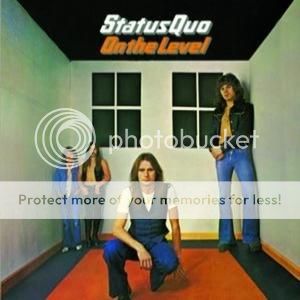
 In 1970, Status Quo found themselves in need of a change in direction. The psychedelic pop of their first two albums had all but become a musical irrelevance. Experimenting with blues and rock over their next few albums, they eventually settled upon a brand of boogie rock – a sound they would make their signature. By the time ‘On The Level’ was released in 1975, the ingredients of ‘classic’ Quo were all in place. The four-piece line up of Francis Rossi (guitar/vocals), Rick Parfitt (guitar/vocals), Alan Lancaster (bass/vocals) and John Coghlan (drums) were as tight as ever and this album, alongside the previous year’s ‘Hello!’, features their now easily-recognizable style in its purest form.
‘On The Level’ features Status Quo’s first number one single, the no-nonsense three-chorder ‘Down Down’ (released prior to the album in November 1974). In lots of ways, although it doesn’t appear until the beginning of side 2 (this is another of those albums which, for people over a certain age, is still thought of as a piece of two-sided black plastic), it’s the track which sets the tone. Much has been said of this track over the years, and as one of Quo’s signature pieces, it will be familiar to almost all, so in some ways very little else needs to be said. However, the album version differs slightly from the oft-heard single release: extended by over a minute and a half, the band builds tension and excitement via a couple of fake endings and reprises. It’s essential Quo, no question.
The same thoughts could easily be applied to the opening number, ‘Little Lady’: you know there are three chords, you know what they’ll do…it’s just a question of how well they’ll do it – and here, they do a top job. In terms of simple, no nonsense rock music, this is a real statement of intent; Rossi, Parfitt, Lancaster and Coghlan tear through the track as fast as they can muster. The chords come fast and the vocals (shared by Rossi, Parfitt and Lancaster) revel in what passes as harmony almost throughout. Particular high spots here include a riff used as interesting filler before the instrumental break and a softer edge enjoyed just before a furious solo. During this soft moment, Coghlan employs interesting drum and cymbal fills lending a relative complexity somewhat missing elsewhere, making up for his otherwise slightly thin sound. Also predictable, ‘What To Do’ is rhythmically tough and lyrically simple – so in many ways, quintessential Quo. Attempts at shared solo highlights the “minimum overdubs” approach, as playing wanders from fairly dextrous to a little wobbly, but that’s all part of the fun, once again.
After a jangly intro coupled with a slightly uneasy vocal, ‘Most of The Time’ comes in with a standard blues-rock punch. The power of the rhythm really shines, but it’s the lead guitar work – complete with a raw live in the studio edge – which leaves the biggest impression, with a decent amount of attitude combined with string-bending solos. It’s so good that it’s almost a disappointment once Rossi’s unfussy lead vocals re-emerge and the band revert of safe bluesy rhythms until the inevitable fade out. The formulaic three chord boogie of ‘I Saw The Light’ represents Quo on auto-pilot, yet still pleases – probably because of the predictable nature; the diddly-diddly (technical term) solo adds an extra element of joyousness. By the time Rossi, Parfitt and co hit their stride with this sort of thing, it’s so effortless for them – a fact even more obvious on ‘Over and Done’ which, although taking a similar approach, manages to up the stakes by adding a basic but easily memorable chorus. Bringing that chorus together with one of Rossi’s best vocal performances, there’s no doubt that ‘Over and Done’ is certainly one of the album’s best cuts. Factor in a heady mix of dirty and clean guitar tones and a cheeky lead fill creeping in occasionally over the top of its main chord structure, it’s a wonder why this track isn’t much better known outside the Quo fan base. Since ‘Down Down’ was the only track from ‘On The Level’ to be released as a single – and then, some months before the album appeared – ‘Over and Done’ should perhaps be seen as the great Quo single which never was. With such a good melody and chorus on hand, it’s easy to forgive a few dodgy notes in the guitar solo! ‘I Saw The Light’ and ‘Over & Done’ are so enjoyable, it’s easy to get swept along by the otherwise ordinary ‘Night Ride’, a tune where The Quo take three chords and stomp through three minutes without any of those previous offerings’ flourish. Three part harmony vocals flesh out the arrangement, while another string-bending solo just about manages to stay in tune. It may fall by the wayside – especially in comparison to Quo’s best – bust take another listen… Lancaster’s rock solid bass work is just lovely. High in the mix, he attacks the tune like a real pro, and that’s just enough to make ‘Nightride’ spinning semi-regularly, even if you don’t find yourself loving it.
There are a couple of tracks included where the band breaks from their tried and tested formula. The first of these, ‘Broken Man’, has a lighter, almost jangle-pop feel. There’s something in there that’s still unavoidably Quo, but feels a little quirkier; probably, in part, to a noticeably different lead vocal, courtesy of Alan Lancaster. Lancaster’s vocal here has come under fire in the past for being a little flat, but frankly it more than suits the task in hand and is a hundred times better than Rossi’s previous attempts at lightness during ‘Most of the Time’s somewhat unnecessary intro. The album’s ballad (if you can call it that), ‘Where I Am’, is really lightweight; in fact, the closest ‘On The Level’ gets to a dud. The guitars move from their dirty, boogie shuffling and adopt a clean toned, metallic and almost country-esque sound. It doesn’t achieve anything beyond its opening couple of lines, ambling along for just under three minutes. Even a background tinkling – from what could be a banjo, but likely is just more guitar overdubs – doesn’t add enough musical colour to make this change in pace interesting.
Luckily, although coming close to ending the second side, this flimsy experiment isn’t the last word regarding ‘On The Level’. In proper Quo tradition, they make sure the album reaches a fairly raucous climax. Their chosen cover tune – in this case, a stomping version of Chuck Berry’s ‘Bye Bye Johnny’ – may not bring anything new to the band’s repertoire (not even slightly), but it’s still a great showcase for this classic four man 70s line up. Lancaster steps up to the mic once more, and for anyone unsure of his contribution to ‘Broken Man’, this should set the record straight. His ragged vocal tears into this Chuck Berry number with a rawness it really deserves.
Like the single release of ‘Down Down’, ‘On The Level’ was a resounding commercial success, becoming the second of four Quo albums to reach the top spot on the UK album chart. Status Quo continued to release solid albums throughout the remainder of the seventies but few ever matched the quality or intensity of this 1975 disc. If you’re ever keen to step outside the comfort zone of those familiar hits and see what Quo’s best album fillers sound like, ‘On The Level’ is the album to get. It may not always be as adventurous as 1973’s ‘Quo’, or as intense as parts of ‘Hello!’, but It does every damn thing you’re expecting…occasionally a little more…and that’s more than enough!
January -March 2010/January 2012/May 2012