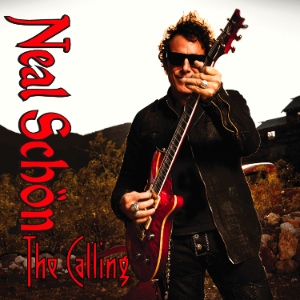
NEAL SCHON – The Calling

Although familiar to almost all as the ex-Santana guitarist and driving force behind melodic rock giants Journey, Neal Schon’s instrumental solo records are hugely overlooked in comparison.  Working within complex rock and jazz styles (often leaning farther towards jazz and jazz-fusion than rock), the instrumental approach on those releases has always allowed him to stretch his talents farther than on any recordings made with his regular band post-1978.

His seventh release ‘The Calling’ isn’t without its fusion inspired jams, but it comes with a stronger rock bias than some of his previous works.  One of the album’s rockiest tunes, ‘Back Smash’, finds Schon attacking with an incredibly hard riff, with suitably aggressive drum compliment from sometime Journey colleague Steve Smith.  The riff dominates almost throughout, but just at the point Schon feels it could start to sag, he changes tack and plays an acoustic solo with almost a gypsy guitar influence, just before his pal Jan Hammer wades in with a huge noodly keyboard solo.  Rock fans need not worry; despite a little bit of indulgence, it’s not long before the riff and melodic rock tendencies reassert themselves – the end result isn’t too far removed from something you may find lurking on a Derek Sherinian solo album. Slightly more accessible, the title track comes loaded with a groove-laden rhythm, while the lead work moves between long, soulful notes and quasi-aggressive soloing, both made more interesting by various multi-tracking techniques.  There’s a fine balance here between metallic riffs and almost bluesy leads, but whichever Schon chooses to play, the results are always wholly melodic.

Another of the album’s most jazz oriented pieces ‘Fifty Six (56)’ fools the listener into thinking it’s going to be very rock rooted via a slightly chuggy guitar riff and busy (almost circular) drum groove, but it’s not long before everything kicks off.  Schon throws in guitars with and Eastern flair while the keys sound like sitars; the drive behind the tune gathers pace quickly, and soon, everyone’s playing like they are trying to blow each other out of the studio.  It would be intense enough with its strong leaning towards jazz fusion as it is, but keyboard player Igor Len bashes out a piano solo that’s firmly in the improvised jazz category.  It kind of fits with the carefree abandon of parts of this tune, but it certainly won’t be to everyone’s tastes – especially not those approaching this album with the ears of a rock music fan.  In terms of fusion, though, bits of it sound fantastic.

‘The Calling’s two absolutely unmissable tunes are also two of its quietest.  The slow ‘Blue Rainbow Sky’ is simply lovely.  With a mid-pace, Smith’s drums joined by a blanket of organ, meaning Schon is given ample room to fill the space however he chooses, and wisely, after a slightly Hendrixy intro, he chooses to fill most of the three and a half minutes with long, soaring notes, its cinematic style leaning towards the epic.  In terms of brilliance, it’s up there with the intro to Gary Moore’s ‘Parisienne Walkways’, or any number of tunes of a similar elegance.  Soft and bluesy, with fantastic clean toned guitar work throughout, ‘Song of the Wind II’ has a very laid back and rather simple tune; this allows Schon scope to lay down a selection of atmospheric notes, while calming keys (leaning slightly towards the lounge) provide excellent accompaniment.  Schon’s playing is a world away from his Journey “day job” here, much closer in spirit to the more ambient side of Santana’s 70s jams (of which, this song’s title is partly in tribute).  Thankfully, on this gentle nod to his former employer, Neal chooses not to shift things into “samba mode” for a big finish…

A huge chunk of the album falls between these two extremes, with the guitarist sounding in fine form throughout, whichever mood or tempo takes his fancy. ‘Irish Field’ is a short piece, where in solo mode, Neal lays down a wistful, yet slightly clangy melody that’s evocative of solitude and expansive, rolling hills without ever being tempted to wander into any Celtic clichés, while ‘True Emotion’ captures a soft rock guitar performance set firmly in ballad mode…at least to begin with.  The overall tone of the latter brings to mind the best feelings of Gary Moore in slow blues mode (once again), with perhaps a touch of Jeff Beck creeping in, while it’s louder moments are unmistakeably the work of the Journey six-stringer.

The lengthy ‘Tumbleweeds’ is a heady mix of jazz-rock and funk, dished up with a slightly distorted guitar line. Reminiscent of some of Michael Landau’s recordings, the multi-tracking of clean-ish guitar rhythms, dirtier leads and occasional aggressive tendencies results in a busy arrangement that is perhaps this release’s most indulgent.  The eventual split between edgy guitar and another Hammer keyboard solo is very effective here and, surprisingly, the seven minutes seem to fly by – the tune busy enough to thrill the more muso-oriented, while staying (just about) accessible enough to entertain the more casual listener.  Schon’s guitar playing on this track is so full sounding and well arranged, it becomes easy to forget that ‘The Calling’ is an album recorded without the involvement of a bassist.

With most of its tunes impeccably crafted, if you are looking for a decent guitar instrumental record, then ‘The Calling’ should hit the spot. Its busy nature can mean it is possible to enjoy different aspects of the performances with each play, but that is potentially a good thing).  If you are happy enough to step a bit farther into the world of jazz fusion and are keen to find out more about his extra-curricular recordings, dig deeper and you’ll quickly find Schon has recorded material that’s potentially just as interesting than this.  If you’ve never heard it, seek out his 1997 double set ‘Electric World’; therein lies a whole world of great jazz based music often quite far removed from the Neal Schon most people know…

October 2012

IMPERA – Legacy Of Life

Headed by JK Impera, this eponymously named band brings together a few familiar melodic rock talents on their debut record. Joining the sometime Graham Bonnet/Brian Robertson drummer is Grand Design bassist Mats Vassfjord, ex-Jagged Edge vocalist Matti Alfonzetti and – perhaps of most interest to melodic rock afficionados – top session guitarist Tommy Denander.  Anything featuring Tommy Denander on guitar is always worth a listen…and this record is no exception.

This release doesn’t always push the much-loved guitarist’s talents to unchartered levels, but that’s understandable since some of his previous work has been pretty special.  As always, though, he knows where his strengths are and his melodic chug often brings out in Alfonzetti’s voice, who in turn, sounds as good here as he did over two decades previously.  Unsurprisingly, their combined talents go some way to make Impera’s debut, in the main, a very enjoyable offering.

The blistering, driving hard rock of ‘More Than Meets The Eye’ presents the band at their hardest, where the riffing is very much of the melodic Euro metal variety (just resting on the good side of Yngwie Malmsteen’s more soulless equivalent).  Over the riffs, Alfonzetti pushes his voice to the limit – though never sounding like he’s having to try that hard – and Mr Impera puts in one of his most energetic drumming performances, but it’s Denander’s solo which is the number’s best feature.  During that solo, he cuts loose on a fast break, with plenty of melodic metal picking topped off by a couple of squealy notes to finish – he’s capable of better (as evidenced elsewhere), but in terms of choosing the right solo to fit a space he proves to be one of the best, up there with Scorpions man Matthias Jabs.  ‘Shoot Me Down’ has a similar old-school musical attack, its verses carefully balancing a sharp rhythm guitar part with a strong lead vocal.  It fares a little better, though, thanks to a more melodic approach on a chorus.  While it’s a little “leather trousers” in its execution, Alfonzetti puts in a rousing vocal performance – that alone may be just enough to win you over and (hopefully) enough for you to pull out those long neglected Jagged Edge CDs.

That kind of upbeat rock is fun enough in the hands of Impera, but it’s when tackling material of a more mid-paced variety these guys often sound at their best.  ‘Dead End Street’ is such a number – while the very melodic vocal and pumping rhythm section hold their own throughout, it’s Denander who totally steals the show: his main riff is chock full of rhythmic tapping, while his lead break is nothing short of terrific, absolutely loaded with fretboard histrionics.  Adopting a meaty stomp, ‘Is This Love’ is a harmony driven rocker, akin to a heavier Whitesnake/Rainbow hybrid.  As expected, the lead performances are top notch, but it’s Vassfjord who plays the key role during this tune, his slow yet unmovable bassline providing the centre point from which Denander works his riffs and solos.  Given a slow and moody backdrop, Alfonzetti  stretches his voice in a very pleasing manner, the slight scratchiness on some notes adding further to a gritty but hugely melodic mood.  A touch faster, ‘Show Me The Money’ finds the whole band in fine form.  With a slightly funky groove, the cocky posturing driving this tune clearly comes naturally to these guys – and so it should, given their combined session pedigree.  Another combination of solid riff, good chorus and strong lead vocal make it stand up easily, but that said, this album has no obviously weak tracks.

The rest of the album’s material is built from similarly tried and tested melodic rock blueprints, but is none the worse for its “don’t fix what ain’t broken” mentality, especially given the great musicianship from each member.  Matti Alfonzetti sounds like the consummate professional throughout and with a voice that has stood up to the passing decades excellently, it’s somewhat of a mystery as to why he is not much better known, especially considering previous connections to Thin Lizzy’s Scott Gorham…

This release certainly doesn’t ever attempt to push any genre boundaries, but the combination of solid songs featuring both Afonzetti and Denander in fine form makes ‘Legacy of Life’ a disc which should certainly be enjoyed by many rock fans of a certain age.

October 2012

New video with Death Angel guitarist posted online

A new twenty-two minute video interview with Ted Aguilar has been posted on YouTube.

The Death Angel guitarist was interviewed by Robb’s MetalWorks and the chat covered a wide range of topics relating to the band’s quarter century history.

This year, the band have spent time on the road with Anthrax and Testament, as well as having re-issued their long out of print debut ‘The Ultra-Violence’ for it’s twenty fifth anniversary.

To view the clip, click the embedded box below. To view other interviews by Robb’s MetalWorks, click on the YouTube logo in the bottom right of the box.

New video from Swedish power poppers Rooni

In September 2011, singer-songwriter Gustav Nilsson released the ‘Makeup On, Letdowns Off’ EP, a mixed bag of pop and rock tunes.

He’s back, fronting a four-piece band named Rooni.

The band will release their first single ‘Run (Into My Arms)’ digitally on October 28th, although the band have also said that a very limited number of physical copies will be available for those daring enough to answer some personal questions.

Check out the animated video for ‘Run (Into My Arms) below.

TRUE HEARTS – True Hearts

Originally formed as The Flirt in 1979 but quickly renaming themselves True Hearts, this Texan band released a largely overlooked EP on Counterfeit Records in 1980. Eleven songs were recorded with the intent of releasing a full-length LP, but that never actually came to fruition.  Over the next couple of years, True Hearts suffered personnel instability and subsequently disbanded in 1982, leaving most of their recordings unheard.

Over thirty years on from the recording of that shelved LP, the eleven songs recorded by True Hearts’ original line-up were compiled for a belated CD release.  The result is a disc which shows a band who, with a better start and a little sharpening up, could have been peers with Pezband, Off Broadway and 20/20.

With a winning combination of an accessible melody and simple chorus hook, ‘Not Tonight’ captures the band’s sound well from a musical perspective.   Throughout this opening number, guitarist Manuel Martinez puts in maximum effort and subsequently steals the show with his mix of new-wavish rhythm work and ringing lead parts (the first of which dominates the intro).  Similarly, there’s some great stuff occurring behind the drum kit, as Rick Holeman throws in a few interesting fills and some unexpected bell sounds.  In theory, these great elements should have made a killer track.  On the rather more unfortunate side of things, lead vocalist Terry Carolan has a voice that isn’t always the easiest to like.  His poppy croon wavers a little off key, something not helped by backing vocals which seem equally slapdash.  Much better, ‘I Need You All The Time’ is a harmony driven pop-rocker which is good as any the early eighties offered; with the addition of a few keyboards, True Hearts sound more assured, while chorus-wise this tune really hits the spot.  In terms of influence, a little Raspberries, a little Cheap Trick and a whole lotta Pezband makes a winning formula.  The piano driven ‘If I’m Late’ shows a quirkier side to the band with stabbing rhythms, a wandering bass part and some pompy vocals providing plenty of bounce.  Given the lack of guitars on this number, you’d think that Carolan would falter vocally, but he sounds very natural – complimenting the music well, even – leaving you to wonder what had gone so wrong on ‘Not Tonight’…

‘Girl In a Men’s Magazine’, on the other hand, is bad both musically and lyrically.  Its stark musical arrangement presents a piano waltz underpinned by synth sounds.  Lacking in any bass, drums or guitars, this leaves everything sounding really twee.  While Carolan’s vocal holds its own, his lyrics concerning a pin up (and the teenage wanting thereof) are just cringe inducing.  A fuller musical arrangement may have helped disguise the bad subject matter, but it still would have been pretty bad.  Luckily, since this track is barely a minute and a half in duration, by the time you’ve realised how awful it is, it’s very nearly over.  What follows is one of the album’s best.  ‘Trust Me Candy’ cashes in on a great harmony filled chorus, chiming chords worthy of The Knack and a relatively decent guitar solo.  There are a few rough edges here (a couple of dodgy notes in the solo and a slightly flat sounding drum), but that’s all part of its overall charm.  Connoisseurs of power pop from between 1977-1980 are sure to find an instant familiarity, but then, that’s no bad thing.

Rather more upbeat than most of True Hearts’ songs, ‘Sleep Tight’ melds classic power pop with a slightly trashier rock ‘n’ roll aesthetic, allowing guitarist Martinez to cut loose on a couple of raggedy solos while Carolan pushes his voice to the limit.  Had the band given this to Cheap Trick instead, it wouldn’t have sounded too out of place on their earlier records.  A double whammy of enjoyment, ‘Hold Me Close/Don’t Stop’ at first mixes reasonable harmonies with a few power chords, resulting in a solid outing on which Carolan sounds better than usual.  As good as this is, it’s the track’s second part (‘Don’t Stop’) that’s the clincher. Holeman attacks his hi-hat and snare with the kind of vigour not always evident on the rest of the disc, while the rest of the chaps also appear a little more aggressive.   Overall, there are no huge surprises, but here – as with ‘Sleep Tight’ – you’ll get a brief glimpse into how great True Hearts could be if/when they really tried.

Despite a few iffy vocals – and the fact that these recordings have moments where all four band members seem almost incapable of achieving musical greatness at the same time – there was obviously a reasonable amount of talent within True Hearts.   Based on these songs, they aren’t quite as enjoyable as some of the similar bands from the period (especially Pezband or Tommy Tutone), but given a better chance, who knows what they would have achieved?  What we are left with is a curio that captures an emerging talent which, for fans of late seventies power pop, is a fascinating look at what might have been.

October 2012