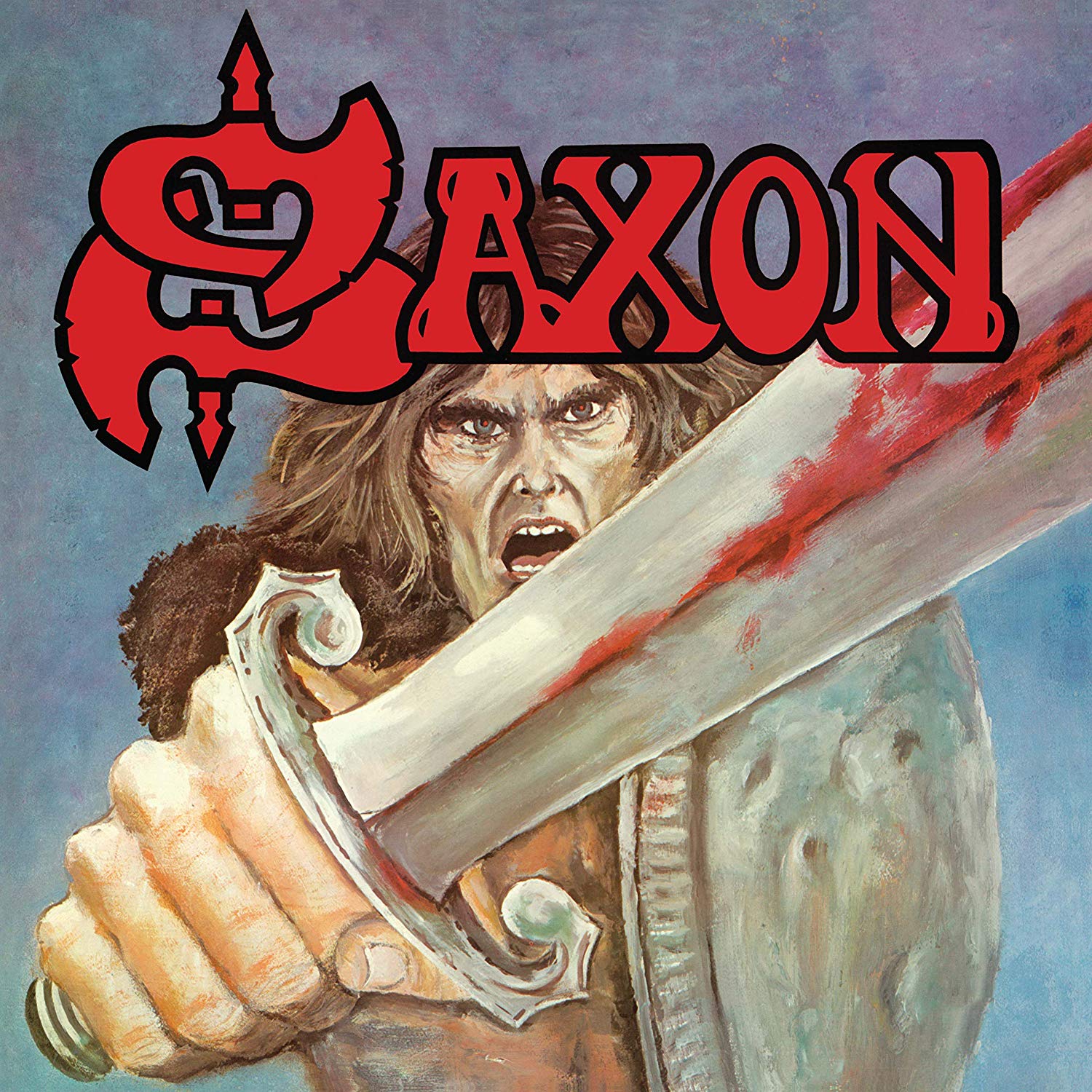
SAXON – Saxon


In the late 1970s, the New Wave of British Heavy Metal created a musical storm. Fusing the heavy edges of the 70s rock giants with the energy of punk (although as a sub-genre it owed little else to punk), a new musical scene was born. You couldn’t go a week without Sounds featuring someone NWOBHM related.  Obviously, Iron Maiden remain the best loved of all the bands associated with the scene (save for perhaps Def Leppard; though, due to the Americanisms of much of Leppard’s material, Iron Maiden have remained the most true to the roots of the NWOBHM), but this debut by Saxon is a key album in the scene’s breakthrough; it’s regarded by many as the first album released by one of the big NWOBHM bands.

In 2009 this debut celebrated its thirtieth anniversary…and one of the first things you notice are the rough edges. It was clearly recorded on a small budget and in a hurry. In fact, you could be left wondering what producer John Verity did at the sessions, since the whole thing sounds like a demo. Things are often a little muddy and occasionally Biff Byford’s vocals feel a little lost.

That aside though, there are some decent songs here. The opener ‘Rainbow Theme’ is a short instrumental which leads into ‘Frozen Rainbow’ which reprises the theme at the end. Beginning with an open stringed bass riff (something bassist Steve ‘Dobby’ Dawson would make his trademark at live shows, leaving him with a free hand to point with – allegedly the main influence for Spinal Tap’s Derek Smalls), the piece leads into the main guitar riff before settling into the song. It could be seen as an odd choice for an opener as it’s an epic, slow piece, rather than a stomping track to get things underway. The high point here is the guitar solo, a great howling and moody offering from Paul Quinn, nodding to his previous band Coast’s more progressive tendencies.  The track also allows an early insight into Biff’s vocal range – he’s a man with more to give than just a full rock belt.

Elsewhere, there are plenty of no nonsense rockers – ‘Backs To The Wall’ is based around a simple but effective guitar riff, coupled with ‘don’t let them get you’ themed lyrics; ‘Still Fit To Boogie’ is simple, but not as good as the lyrics are a little embarrassing now. Of the rockers, ‘Stallions of the Highway’ fares best, with it’s motorbike theme (which would recur throughout the band’s work over the next few years). If it’s complexity you’re after, the album’s rockers mightn’t do much for you. For those of you whom want something to get your teeth into, the album features a couple more brooding, epic style songs to keep ‘Rainbow Theme/Frozen Rainbow’ in good company. ‘Judgement Day’ (hands down, the best track on the album) thunders from the speakers and captures the band at full power. There’s a mid section where things get a bit gentle, again casting it’s musical net to include touches of 70s prog, but that’s just a build up to a climax, with twin lead guitar harmonies. For best results, check out the live b-side version of this track (included on the deluxe version of ‘Saxon’). Closing the album, ‘Militia Guard’ is the first of Saxon’s many war themed songs, and while the songwriting shows promise, it’s still the twin guitars which prove the high point.  An interesting piece, this is neither the straight metal that Saxon would perfect on their next two records, or seventies indulgence, but a cut and paste mix of both.  A huge closing statement, this sounds as if it were glued together from three or four musical ideas, but it’s to Saxon’s eternal credit that they make it work so well.

At just under half an hour, the original album and it’s eight songs fly by, with no messing. For those who want more, the 2009 reissue features 14 bonus tracks – including demos, BBC Session tracks and part of the band’s 1980 Donington Monsters of Rock appearance (the rest of which is featured on other Saxon reissues). It’s great to have the live tracks, as in most cases they’re superior to the studio versions. As for the demos, they’re presented here in a form which is almost identical to the finished album cuts, just a little rougher. The best of the bunch is ‘Big Teaser’, which features a guitar riff which gives a nod to Status Quo, something nowhere near as obvious on the finished album recording. The real gem among the bonus tracks is the BBC Session, where the band premier ‘Motorcyle Man’ and ‘747 (Strangers In The Night)’ – the latter being one of the band’s greatest achievements, and both tracks paving the way for the signature sound which made their next three LPs classics of the era.

‘Saxon’ might have a rough production, but most of the songs are rock solid.  While more geared towards fans – new listeners should hear ‘Wheels of Steel’, ‘Strong Arm of The Law’ and ‘Power and The Glory’ first – there’s plenty of interest here…and it’s best moments win out purely on the basis that Saxon never recorded anything quite like ‘Frozen Rainbow’ and the middle of ‘Judgement Day’ again.

The birth of 80s metal starts here.

December 2009/June 2018

Continue reading →

BETTER THAN EZRA – How Does Your Garden Grow

Sitting rather comfortably alongside the Soul Asylum type bands, Better Than Ezra’s early albums are a solid mix of alternative rock and Americana stylings. ‘Deluxe’, particularly, may be a modern classic.

For ‘How Does Your Garden Grow?’ things don’t always feel as smooth. The band began to change direction on their third commercially available album, ‘Closer’, and by the time of this fourth release, for the most part, I’d say that the sound I most associate with Better Than Ezra isn’t really present. ‘Closer’ in many ways marked a definite shift, but for this album, the shift is more pronounced. The synths and electric pianos seem far more prominent and sometimes they seem to work, sometimes not. While some of the electric piano and keyboard led moments of ‘Closer’ had a smoothness (‘Get You In’ is lovely; ‘I Do’ is solid alternative pop-rock), moments which feel similar on this fourth outing are angrier, spikier and generally edgy. While some songs are obviously very good, it doesn’t have much in the way of user-friendliness. It may not even be the increased use of electronics; it may just be that for a good proportion of this album, the drums are way too loud. Maybe it’s because they’ve tried to follow up ‘Closer’ with something similar, to show how they’ve mostly moved on from the obvious Soul Asylum type sound, but the songwriting often lacks focus; that’s not to say it doesn’t have some notable moments – Better Than Ezra are, after all, a decent band.

On the opening track, ‘Je Ne M’en Souviens Pas’, the keyboards dominate so much of the arrangement. Combined with the vocals having a phased treatment and pretty much no guitar work, you could be forgiven that they’ve abandoned their past completely and gone synth-pop or electronica. It’s probably meant as a statement, but it’s a really poor choice of opening track and has little to make me want to listen to it more than once. They’ve attempted to be striking, but just about muddled through. ‘Live Again’is very drum led and clearly in the alternative rock bracket, but where guitars would normally be the focus, this song has nice electric piano flourishes. This could be a great song, but it’s not instantly obvious in the way that some of ‘Closer’ had been. ‘Under You’ is mellow and is much closer to old fashioned Ezra, but there’s something missing somehow. It’s not in the music; the music itself is as good as the band’s other pastel shaded moments. It seems to be lacking an obvious hook, which was something ‘Deluxe’ never really felt short of. It’s pleasant enough though. ‘At The Stars’ is definitely one of my favourite tracks; it sounds like a mix of older Ezra, with Our Lady Peace, but that may just be the drum pattern. Excellent.

‘Waxing Or Waning’ has a very relaxed feel, with brushes on the drums and twangy guitars. More Americana than much of the album, I wonder if anyone in the band is fond of the work of Howe Gelb? There’s a spaciousness which reminds me of him and his colleagues. He may well argue, of course. A mass of pre-programmed drums makes up the bulk of ‘Beautiful Mistake’ – a track which is nowhere near as focused or clever as it thinks it is. Largely forgettable at worst and casual indifference at best makes this track easily skippable. In total contrast, ‘Pull’ explores the band’s all-out alt-rock side, with big riffs and guitar solos. While their earlier work was only this rocky on occasion, personally, I’d much rather they went in this direction than the electronic one largely favoured on this album.

‘Particle’ matches pre-programmed drum loops with live drumming to good effect. Again, it’s the keyboard driven sounds here which carry the tune rather than the band’s previous Americana influenced styles. It’s hard not to think of Canada’s Our Lady Peace, although the vocals aren’t that striking. There’s a nice use of a mellotron sound during the last couple of minutes which more than fleshes out the arrangement, but still, at over six minutes, it feels slightly drawn out. Generally this succeeds in doing something ‘Beautiful Mistake’ failed spectacularly with. ‘Like It Like That’ somehow reminds me more of Third Eye Blind. It mixes slight samba rhythms, power pop chords and a repetitive hook that, while not brilliant, manages to stick in your head. The only thing here which doesn’t feel quite natural is the high pitched synth. After a handful of plays, it’s clear that this is one of the album’s high points.

Another of the album’s standouts is ‘How Wonderful You Are’. Again, while I’d struggle to recognise this being the same band who gave us the brilliant ‘Deluxe’, it’s kind of brilliant in its own right. Jangly guitars, a pure pop chorus and a nod to Lou Reed’s ‘Walk On The Wild Side’ make this recommended listening. Near the end of the album, ‘Everything In 2’s’ finally offers the listener something unmistakable. The soulful vocals, mid-paced arrangement, build up to the chorus and semi-acoustic stylings are very much in keeping with the old classic Better Than Ezra, so they’ve not completely abandoned the feel which drew me to them initially.

There’s very much an ‘experiement-not-quite-realised’ feeling about this album and on the whole, while ‘How Does Your Garden Grow’ is solid enough, it never quite hits the spot enough to match BTE’s earlier work. As good as some of it may be (‘Live Again’, ‘Everything In 2’s’ and ‘How Wonderful You Are’ particularly), its hard to imagine it being anyone’s favourite album by these guys.

November 2007


THE NETWORK – Money Money 2020

These guys can be seen scattered across the internet, but it seems every time you find something, it’s often the same snippets of information and speculation. Take five people, put them in disguise and throw in a bunch of new wave tunes with pop-punk edges and it’s widely believed that you have a collaboration between Green Day and Devo. The first half of this theory is certainly correct: Fink sounds like Billie Joe Armstrong and close ups of his eyes blow away any doubt. The same goes for their drummer, The Snoo, who is unmistakably Tre Cool. Of most interest, though, is bassist/vocalist Van Gogh (Mike Dirnt). He handles a majority of the vocals on this release, with a delivery rooted in the new wave.

As for the second guitarist and keyboard player, it remains unclear who they might be. One thing’s almost certain – despite what you may have heard, they’re not members of Devo, even though Devo are an obvious influence on these songs. Although there’s still no concrete proof, I’d hazard more than a guess they’re old friends and Green Day touring band members Jason White (Billie Joe’s band mate in Pinhead Gunpowder) and Jason Freese. It’s also certain that this release exists as an outlet for Mike Dirnt’s vocal and songwriting talents as well as giving White and Freese greater creative roles.

Enough of the speculation and hype – what about the songs? There’s plenty here to enjoy. ‘Reto’ is spiky pop-punk in delivery, but the guitars are turned town giving it more of a new wave feel. The lyrics are biting, about someone who uses internet technology for exciting teenagers with cyber-sex; this may or may not be a true story (again, check your Green Day ‘American Idiot’ CD single – it’s engineered by someone called Reto – yet another clue?). ‘Right Hand-A-Rama’ also explores the smuttier side of The Network’s little world, being a song about buying porn and beer to pass the time. It’s rather more obvious who is involved on this song, with Billie Joe taking lead vocals.

Again, ‘Roshambo’ is more obviously a Green Day number, but treated vocals give this a fuzzy sound and the music between verses gives it a very mechanical feel, which seems to be a recurring approach. ‘Love and Money’ exploits the new wave side of things completely, being nearly all droning keys, coupled with a quite spiteful sounding vocal delivery. ‘Supermodel Robots’ was one of the earliest tracks available from this album, available at one point as a free download before the album was released, so I’m told. It’s obvious why. The vocals are unmistakably Billie Joe’s; less of an attempt has been made to disguise the Green Day input here, and this track was a favourite of mine from pretty much the fist time I heard the album (I have to say, though, most of the other songs took repeated listens before they took hold). One of the weaker offerings, ‘Spastic Society’ perversely offers one of the strongest musical arrangements, but is let down somewhat by seemingly stream-of-consciousness words on the verses, coupled with a fairly obvious ‘society is screwed’ chorus.  (Great tune, though their choice of words is an absolute travesty.)

Another album high point, ‘Joe Robot’ nods towards Devo’s ‘Whip It’ musically. It has lyrical concerns with changing technology asking whether these changes are helping us or hindering human progression. It’s almost certainly deliberate that one of the songs here most influenced by Devo has a lyrical concern that’s almost the anti-Devo. Also balancing out the fun and smutty offerings, ‘Spike’ is a piece based around telephone calls by a teenage heroin addict desperate to get money to get a fix. Like Devo, concerns of human wrongs are strong within The Network. Closing the original twelve track version of the album, ‘X-Ray Hamburger’ is slow and brooding, showing obvious homage to Tubeway Army.

The UK issue of this album features two bonus tracks, ‘Hammer Of The Gods’ and a quirky cover of The Misfits’ ‘Teenagers From Mars’. Neither of these add anything special to the overall feel or quality of the release, but from a fans perspective, it’s good to have them if you can track them down. As for the actual album itself, after a quick buzz, it seemed to go largely un-noticed here in the UK and full price copies of it sat gathering dust in the racks at HMV. If only Green Day would stop pretending they had nothing to do with it and start shouting about it a bit more, so many other people would have discovered this great album.

August 2007

VARIOUS ARTISTS – Shake It Up!: American Power Pop II (1978-80)

There’s a whole world of power pop out there. For every band which made the big time, there are dozens of also-rans. Some of the first wave of power pop’s finest unsung heroes can be found on Rhino’s power pop anthologies. The first volume, ‘Come Out And Play’ features stuff from 1975-78, and as such, features some of the more famous names – Cheap Trick, Chris Bell, Flamin’ Groovies, The Real Kids, and more besides. This second volume catches the tail end of that wave, featuring an almost equal number of gems, even if some of the names aren’t quite as famous.

Kicking off this second anthology, The Cryers’ ‘Shake It Up (Ain’t It Time)’ is sugary, but all familiar with a strong hook. It has a solid arrangement with chiming guitars and handclaps. It’s all very much in the same mould as The Rubinoos and The Romantics, and as such, doesn’t break the mould, but provides some taut power pop that’s more than enjoyable. Things shift into a higher gear with Shoes, whose harmony driven ‘Tomorrow Night’ really shows why they were stars on US MTV in its formative years. Armed with a big chorus and music that rivals ‘Shake It Up’ era Cars, it is a  excellent tune, with the guitars a bit more to the fore. ‘Tell That Girl To Shut Up’ by Holly & The Italians will probably be familiar to most people reading this, as it was covered by Transvision Vamp in the late 80s. This original version is almost identical to that rather more familiar cover, save for perhaps a little more finesse in the vocal department. It would have been nice to hear something different by these guys – although with the album having had a CD reissue, it remains one of the easier things from this compilation to obtain.

Equally as good, The Rubinoos’ ‘I Wanna Be Your Boyfriend’ has plenty of harmony vocals, handclaps and a monster chorus. It ticks all the boxes and manages to be as infectious as most power pop should be when done this well. Pretty much unknown in the UK, people in the US will undoubted be familiar with this band and especially this song. The same goes for The Romantics, who’s ‘What I Like About You’ is a staple of some radio stations. Off Broadway drop in with ‘Stay In Time’, which is made from solid stuff, with more than a nod towards early Joe Jackson. Best of the bunch, though, is ‘You Got It (Release It)’ by Pearl Harbour and the Explosions. Worthy successors to the Cheap Trick throne, Armed with a sharp chorus and brilliant harmonies that draw from the post-punk and new wave, it’s a mystery how these guys got ignored. This is power pop gold. ‘I Thought You Wanted To Know’ by Chris Stamey & The Db’s, as you’d expect from a band with Mitch Easter connections, wear their Big Star influences proudly. Filling a couple of minutes with a huge retro jangle and equally sizable chorus, this track (alongside the Pearl Harbour) makes this CD a worthy addition to the power pop fans’ collection.

More so than the first volume, there’s stuff here that isn’t earth shattering too. ‘The First One’ by ex-Blondie man Gary Valentine shows Flamin’ Groovies influences (it’s when going through the many power pop compilations out there, it becomes obvious that they were seminal band), going for an older sound. It often manages to be likeable, but isn’t memorable in the long term. Both tracks by The Beat [aka Paul Collins’ Beat – not to be confused with the ska-pop band The (English) Beat] offer two songs which are above average power pop fare, but even with ‘Work A Day World’s sense of bounce, it never reaches the heights of the genre’s best. For power pop lovers in the US, Collins reached cult hero status, of course, so any feelings that his material on this comp is average will surely stem from it being up against stiff competition, as opposed to a reflection on his own talents.

‘I Like Girls’ by The Know (written by the aforementioned Gary Valentine) is appalling: relying on a thin sentiment, thrown together arrangement and truly bad lyrics. This is the epitome of really bad ‘good time’ music. There’s not even enough depth to embarrass the listener with a bunch of stuff about fast cars, which would usually be the thing. The track by Prix is pretty bad too. There’s not a lot wrong with the music, but the singer’s voice carries a rather irritating, odd whine. Also in the forgettable category are both tracks by Tulsa based 20/20; one of their songs sounds like a really terrible version of The Flamin’ Groovies, while the other nods towards The Cars but lacks any of that great band’s charm or song craft.

Despite being a little hit and miss, the great bits of this collection are strong enough to recommend the disc as a fine collection filler, but since this is out of print, it mightn’t be so easy to track down. For those willing to do the leg work, though, some enjoyment will be guaranteed, especially if played in tandem with the earlier (and superior) ‘Come Out And Play’.

August 2007

BIJOU PHILLIPS – I’d Rather Eat Glass

The daughter of John Phillips of the Mamas and Papas (about whom plenty could be said, given some past revelations, but now isn’t the time) Bijou Phillips is actress. At other times, she’s a model. When neither of these, she’s been a wild child and your average Google search would suggest she’s someone who’s keen on taking her clothes off. Lesser known facts about Bijou include her abilities as singer-songwriter, which so far have yielded just this one album. ‘I’d Rather Eat Glass’, produced by ex-Talking Heads man Jerry Harrison, is a mixed bag. As the title suggests, it’s quite spiky around the edges, though essentially most of it fits neatly into the rock-pop mould. …And yeah, I’m pretty sure you’re thinking a model/actresses album is some kind of vanity project, but don’t dismiss this, as Bijou has a really strong voice and more than enough talent to make this work.

The opening track ‘Hawaii’ instantly grabs your attention. The guitar riff is a little off centre and in a tuning which seems a step away from the norm. Sadly, I’m not a musician, so I can’t elaborate on that, but it’s a great way to get things started. The alternative pop-rock seems in keeping with a large chunk of the album’s material, but just when you think you know where it’s going, it breaks into an odd calypso-ish break.The guitars are turned up for ‘I Own You’, which is very chorus driven. You’ve heard this all so many times before, but somehow it still retains its charm. Similarly as rocky, but delivered with a quirky vocal, ‘I Never Shot The President’ starts with attitude and then refuses to let go. ‘Little Dipper’ is a stand-out ballad, with a piano led arrangement and probably one of the most heartfelt vocal deliveries this album has to offer, telling a tale of childhood visits to the protagonist’s mother’s house. It stands out, in part, due to a contrast with the spiteful edge present on most of these songs. ‘I Am A Mountain’ seems at first to be in a similar style to ‘I Own You’, but then during the between-verse breaks, the guitars are quite thrashy.

‘When I Hated Him (Don’t Tell Me)’ was the lead single and it’s not difficult to see why. Its radio-friendly angst fit the late 90s model of strong female singers, after Alanis Morissette’s ‘Jagged Little Pill’ took over the world and seemingly opened doors for dozens of people to bare their souls. At first listen, this may feel a little drawn out at over six minutes, but it’s a slow burner and the addition of gospel style backing vocals for the last couple of choruses is a nice touch. ‘Breakfast’ provides good closure, being acoustic based, allows the listener to wind down a little after some of the sharper edged stuff.

I’ve had this in my personal collection for a while now, having bought it purely on the strength of a couple of really positive reviews, without hearing a note. In short, I still can’t recommend it highly enough and most of the people I’ve played it to feel the same way. If you’re out there and those Natalie Imbruglia albums are just that little bit too sugary for you, you know where to look next. This could be a genuinely overlooked gem from the tail end of the last century.

September 2007/November 2009