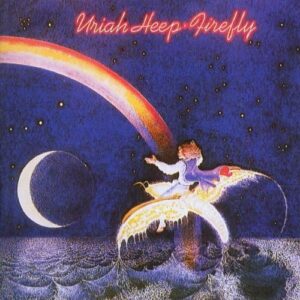
 When David Byron left Uriah Heep in 1976, the band’s fans figured he’d be irreplaceable. His dynamic vocal range was an essential part of the Heep sound, after all. Not long after his departure, the band found a replacement in ex-Lucifer’s Friend vocalist John Lawton and, joining him in the newly configured Heep, came another familiar face – ex-Bowie/Spiders bassist Trevor Bolder, replacing the departed John Wetton. Despite Heep now being the underdogs, the resulting album – 1977’s ‘Firefly’ – was not only enjoyable, but a big improvement over the workmanlike approach which dominated most of 1976’s ‘High and Mighty’.
The album’s opening number ‘The Hanging Tree’ has been described in the past as “heavy”. The passing decades have weakened its impact a little; with the changes in fashion over the years, this number isn’t heavy any more – perhaps “moody” better sums up its general feel. It’s a mid-paced stomper, dominated by pulsing keyboards during the verses, which become washes of synths during the chorus, and this immediately shows off one of the biggest changes for Heep, in that Ken Hensley’s signature Hammond sound is no longer at the forefront. This, in some ways, is just as striking as the change in voice, but Lawton appears comfortable in his new role, crashing into the number at full volume, even attempting a few more theatrical tones on the chorus. Looking deeper, this still shares a few Heep musical staples with the energies of a newly configured line-up: most importantly, there are huge backing vocals that tease with falsetto, and guitarist Mick Box’s gift for sharing a great riff remains unchallenged. As opening statements go, it’s hard to find fault. You’d think that stalwarts Hensley and Box – along with drummer Lee Kerslake – had been playing alongside Lawton and Bolder forever.
A little further into the album, ‘Do You Know’ shows the “new” Heep having a little more fun on a rock ‘n’ roll style workout. Lawton’s voice is more restrained and his cool, hard rock delivery is balanced by excellent, pompy harmony vocals from the other band members. The marriage between Hensley’s pumping keys and Box’s energetic guitar chops is perfect, and the old school energies presented here make it most obvious why 70s Heep are so often compared to Deep Purple. While Lawton is no match for the grade-A screamer Ian Gillan, he takes this track and hammers his vocal for all it’s worth, while the rest of the band play up an absolute storm. It isn’t essential Heep by any stretch, but on record it’s a great rocker that gives ‘Firefly’ a huge lift. It’s a number that almost certainly would’ve sounded so much more invigorating within the band’s live set.
‘Who Needs Me’ follows a similar musical path, and the circumstances in which it was written are interesting: allegedly, their record label boss had rejected everything the band had offered that wasn’t written by Ken Hensley, and drummer Lee Kerslake wrote the song in protest. If this story has any truth, it begs the question of Hensley in such strong favour, especially when the band was home to other other strong writers, and as bits of ‘Firefly’ show, Hensley’s signature sound wouldn’t be a huge part of the final product. Although musically throwaway, the track sits brilliantly in contrast to a couple of ‘Firefly’s more bombastic efforts. It features a great drum shuffle from Kerslake and a very strong vocal performance from Lawton, sounding very much like Head East’s John Schlitt in more than a few places. For those who have a pre-conceived idea of the 70s Heep “sound”, this might come as a surprise with its fun arrangement.
The bluesy ‘Rollin’ On’, meanwhile, is ‘Firefly’s strongest cut and all band members offer impressive performances. The interaction between Kerslake’s measured drumming and Hensley’s keyboards provide the real musical muscle and, musically, it has a similar vibe to Whitesnake’s strongest material from a similar period. The slow mid-section showcases some very assured guitar work from Mick Box, but despite his best efforts, it’s still John Lawton’s vocal which steals the show. Lawton isn’t perfect, though, as proven by the album’s lead single, ‘Wise Man’. Although a relatively accessible number, perhaps it wasn’t the best choice for single as the vocal melody is slightly grating, and during the closing moments, Lawton over-stretches himself to the point where it actually makes him hard to listen to. He was clearly proving a point, though – one which showed Uriah Heep’s new mouthpiece was no slouch, and could likely match David Byron in terms of pure histrionics, despite what the nay-sayers might have thought at the time.
Elsewhere, the stately sounding ‘Been Away Too Long’ begins with best foot forward, sharing bluesy guitar notes from Box placed over another wash of synths, before Kerslake gives everything a kick up the arse with a massive drum shuffle. This shows both extremes of the then new Heep’s sound within a few bars, and the next five minutes continue in a similar push and pull fashion. Not that the ever shifting backdrop fazes Lawton: whether he’s reaching inside himself for a soulful cry or reaching for a full scale rock wail, he sounds utterly unshakeable. The best moments of this lengthier workout are left in the hands of Box, however, who fills the instrumental section with a killer solo, accentuating Heep’s penchant for pomp, driven by a great rhythm section. A more bombastic affair, ‘Sympathy’ shows off some great multi-tracked guitar work, aiming straight for the hearts of the denim wearing rock fans of the age, against a galloping rhythm that, again, shows Kerslake and Bolder to be very effective together. Lawton unleashes a strong vocal throughout, and in places, he helps this to sound a little more like old school Heep with some massive wails, but even after taking everything into consideration, he’s not a match for this track’s fantastic riff.
Bringing things to a close, the epic title cut begins with another huge wash of synths. Over the keys, Lawton delivers an impassioned – yet really horribly sickly – vocal that sounds better suited to the stage than a rock band. Even the addition of a backing vocal does little to improve things. If you can make it past what feels like an eternity of such horribleness, however, things sound much better once Mick Box and the rest of the band appear. Box’s lead work has a great style, but as before, he doesn’t ever achieve the same level of brilliance as Trevor Bolder, who fills his role with aplomb here, Clearly a few years backing the legendary David Bowie had pushed him into the realms of almost unmatchable brilliance. As the band rock out, they offer a style that’s (again) easily comparable to US late 70s pomp-rockers Head East – a style that ought to be hugely enjoyable for those who like their rock with a huge seventies bent. The rockiest elements are relatively fleeting though, since before long, Box and co make a swift retreat, leaving Hensley and Lawton to return to their over-theatrical nastiness. A bold but ultimately uneven affair, those who like this track will undoubtedly love it, but it definitely ends this record with one of its more marginal offerings. Luckily, the journey up to this point has often been rather striking in a more positive way, giving the sense that – major line up changes or otherwise – Heep would certainly be able to journey forth knowing they’d given everything their best shot.
*
The remastered/expanded version of ‘Firefly’ featured in Cherry Red Records’ 2026 box set ‘Beautiful Dream: 1975-1977 includes a wealth of bonus cuts. ‘Crime of Passion’ (originally issued on the b-side of ‘Wise Man’) is a great track, full of bluesy swagger and macho intents, prefiguring David Coverdale’s Whitesnake circa 1979. It’s easy to hear why it mightn’t have fit within the ‘Firefly’ tracklisting comfortably: it’s bigger, more bombastic, and in some ways simpler, but it’s a great showcase for both Box and Lawton, who’ve clearly formed a musical bond that’s on the same level as Kerslake and Bolder.
Demo and alternate versions of ‘Do You Know’ and ‘Been Away Too Long’ lack the finesse of their album equivalents and, in places, lack the final selections’ polish, but are certainly nice to have if you’re a huge Heep fan, and the same can be said for a rousing live performance of ‘Who Needs Me’, which captures a vigorous sounding band promoting their then new LP.
Two album outtakes were outtakes for a reason. The disco rock crossover of ‘Dance Dance Dance’ now sounds incredibly dated, and clearly Heep weren’t sure of how credible it sounded in ’77 either. That said, if you can make it past the cheese factor, these four minutes feature some great interplay between Bolder and Kerslake, while ‘I Always Knew’ fuses 70s rock with an AM radio pop melody, resulting in something that’s a very awkward fit for Heep. Being generous, Lawton sounds the most comfortable on this mid tempo affair, and again, it shows off a very strong rhythm section, but Box gets to do little beyond sharing bright sounding chords. This sounds far more like something that should have ended up in the hands of a pre-Rainbow Graham Bonnet, whose two solo albums from this era (1977’s ‘Graham Bonnet’ and 1978’s ‘No Bad Habits’) provide a more credible showcase for this kind of pop-rock.
Best of all ‘A Far Better Way’ – a track appearing in demo form – should’ve been under serious consideration for the “A list” of album material. Stretching across almost six minutes, the track begins with a darkness in mood, as Hensley’s keys work a melody in a very understated way, with Lawton’s softer vocal seeming a perfect fit, while Bolder’s bass work is solid and structured and very high in the mix. His huge presence shows no signs of diminishing once the band crash into something rather rockier, as he approaches his instrument in a lead fashion. Things then drop from straight rock to an almost seventies funk groove to accompany a synth solo that’s a very acquired taste, one which was slightly out of step with the punk coming through in 1977, but still enjoyed by thousands of album buyers. If the sounds of Hensley’s keys – here. sounding like the theme to a 70s ‘Schools & Colleges’ programme – soon turn you off, focus on Trevor Bolder; he’s still there, absolutely determined to outdo his newly-found band mates. For the closing section, once Lawton starts screaming, it’s much harder to focus on Trev, but at least the screaming only spans the last verse… Honestly, as one of the best things to date from these sessions, it’s a travesty that ‘A Far Better Way’ wasn’t considered worthy of finishing and for inclusion on the original 1977 LP. Perversely, it’s about a hundred times better than the title track!
With or without bonus track’s ‘Firefly’ is an album that all fans of 70s rock should hear. For an album which could have been difficult, Uriah Heep make a major change in personnel seem like an easy thing to cope with, and since the end result – on the whole – is so strong, maybe a big shake-up was what was needed to get the blood pumping again? If you’ve never moved on from 1972’s ‘Demons and Wizards’, there’s enough first-rate material here to prove that there’s far more to Uriah Heep than mere wailing and Tolkein-esque prog rock theatrics. They would explore even more different musical terrain by the end of 1977 with ‘Innocent Victim’ (which would score them a masssive hit with ‘Free Me’ in Australia and New Zealand) supplying further proof that you can’t keep a good band down.
Buy the ‘Beautiful Dream 1975-1977 box set here.
February 2025