 After releasing three fantastic albums in ‘Demons and Wizards’, ‘Magician’s Birthday’ and ‘Sweet Freedom’ as well as a classic live document in a little over a year between May 1972 to September 1973, it’s no wonder Uriah Heep sounded less inspired on their 1974 LP ‘Wonderworld’. Although not a document from a creatively spent band, the album included absolutely nothing memorable in the long term. Bizarrely, the best track dating from those sessions,’Stone’s Throw’, was never completed. Released in demo form on an expanded reissue of ‘Wonderworld’ in 1996, it knocks the entire album into a cocked hat. Following bassist Gary Thain being electrocuted during a show in Texas on that tour, 1974 could very much be considered the end of the band’s “imperial phase”.
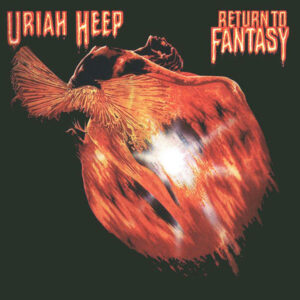
Since this was the mid-70s, taking time off was not necessarily an option – it’s best remembered that bands of this era were seldom left alone to be creative; instead, their record companies expected them to turn in an album a year…or more in some cases, and so Heep trucked on. Thain’s replacement came in the form of the superbly talented John Wetton, formerly of Roxy Music and King Crimson; soon to be a core member of UK prog band UK. Replacements rarely come in better form and Wetton’s distinctive style is one of many reasons why Uriah Heep’s eighth studio album, 1975’s ‘Return To Fantasy’, is somewhat of an unheralded beauty.
It doesn’t always have the all round appeal of ‘Demons And Wizards’; it isn’t as grandiose as 1971’s ‘Salisbury’, but it has a vital ingredient that ‘Wonderworld’ sorely lacked – the gift of songs. In a shade under six minutes, the title cut leads the charge in an especially rocky fashion. Driven by an incessant rhythm from Lee Kerslake’s drums, the tune thunders forth, sometimes sounding like a cousin of their earlier ‘Easy Livin’, even having future echoes of their later ‘Too Scared To Run’. New boy Wetton locks in with a suitably punchy bassline while Ken Hensley adds a swirling Hammond Organ throughout – his blanket style even threatening to smother the vocal melodies on occasion. In a performance that’s one of his career bests, David Byron offers a vocal that’s one part classic Gillan and three parts on loan from a rock musical, but in so many ways it’s a fantastic example of the style he’s come close to making his own since the late 60s. Chorus-wise, it’s all a little comic book-esque, but by drawing a strong hook from the title, it definitely gives the album something very memorable. With a couple of solos centred around the organ and a bombastic intro that draws a tiny bit of influence from early King Crimson and early Genesis, it’s a fine, fine, classic rock/prog/pomp hybrid.
The album’s first side closes with something just as huge, when ‘Beautiful Dream’ allows Byron plenty of space to reach for falsetto on a suitably silly hook. While the show tune-meets-prog aspects move from faintly ridiculous to absolutely pompous and are certainly of their time, the number stands up due to some great music throughout. At the outset, a dual keyboard drone weaves in and out of a busy high hat, leaving no doubt as to the pomp intentions. After a minute or so, the rest of the band awakens from their slumber and counterbalances Hensley’s squealing and aggressive keyboard stabs with a strong rock melody that utilises many of the more groove laden elements of the era. There are traces of Deep Purple at play – as would befit something with such a dominant organ – but there are also flourishes of cleverer pop. Fuzzy synths outplay most of the guitars, but it all pales into insignificance upon reaching a chorus where Byron absolutely shrieks his way through each line against something that sounds like a blend of cop show theme and the forever frightening ‘Window’ by David Essex. It might just be the sign of the times in which this was recorded, but tracks like this definitely carry an influence from Jeff Wayne productions of a similar time. It’s the sort of thing that’ll divide listener opinion – almost as much as this overblown number itself – but if you can’t recognise this as one of the early Heep’s defining moments, you’re likely not ever going to be a fan. This is everything ‘Wonderworld’ wasn’t…and will never be.
Between the two prog-centic epics, the album’s first side is filled by a couple of near perfect hard rockers. ‘Shady Lady’ sounds as if it’ll a bit of a step back towards Heep’s 1972 sound at first, but rather than being a retreat into a comfort zone, the elements of pomp are balanced out with a strident but radio friendly guitar sound. Box drives the verse with a simple boogie oriented riff, over which Byron sounds at ease. His lyrical approach is somewhat Gillan-esque, but this far from being a Purple rehash. In fact, between the boogie edge and a howling solo dominated by loud slide guitar work, broader minded listeners may even hear a few parallels with the more underrated Edgar Winter Group recordings from a similar time. If anything really stands out, though, it’s Wetton’s aggressive yet melodic bass work; playing in a lead style from the very beginning, he very much puts his stamp on what could’ve been a very ordinary number. The better of the two rockers, ‘Devil’s Daughter’ retains the mid 70s vibes, often pushing Mick Box’s guitar work into the spotlight. Beneath his confident tones, Wetton truly dances with the bass once more, giving the tune a strong and deceptively complex counterpoint. The melding of the two moods occasionally drifts towards one of the funkier tunes from Deep Purple’s earlier ‘Fireball’, but Byron’s vocal style remains distinctive enough for this not to be confused with one of that decade’s much bigger acts. Of particular note here is the band’s natural affinity for pushing their hard rock towards a funk sound. This is something that seems instigated by Hensley, offering one of his best parts this time out, foreshadowing a sound perfected by Paice, Ashton & Lord two years later. Unlike ‘Shady Lady’, this tune also gives the prog fans a little more to sink their teeth into, since the lengthy instrumental break is awash with wayward keyboard swirls and squonks, firmly in battle with some finely played lead guitar work. A few plays of the album really helps this number to sink in – it’s one of Heep’s best rockers of the 70s, without question.
Flipping the record over, there are a couple more chorus driven numbers. The first of these, ‘Prima Donna’, presents a slight departure for Heep, but because of this, it gives the album one of its most fun and enjoyable tracks. Swathed in a world of upbeat 70s pop with rock overtones and capturing a few riffs that feel like a hangover of glam rock’s last party, Heep set about motoring through a great rocker. Accented with some fantastic horns, there are a few moments en route that feel closer to Pilot, Wizzard and their ilk than most typical 70s hard rock, but this only shows how Heep were able to really branch out when the mood took them. Throw in some shameless “doo doo doo” vocals and the kind of chorus that seems more in tune with Rick Derringer than typical Heep and it comes up winning at every turn. By contrast, ‘Your Turn To Remember’ is a bit of a stodgy old blues rocker, and is far less interesting. It features some decent playing, but its main problem is down to the album’s sequencing. Placed anywhere other than immediately after ‘Prima Donna’, it would certainly sound better: Box’s slide guitar work is tasteful; Kerslake’s drumming shows restraint and Byron’s voice carries a lot of soul. Underscored by another fine bassline from Wetton and home to a solid 70s styled hook, there’s certainly nothing wrong here. It’s stately, melodic and well put together – it’s just that you’ll find similar material performed better by other bands, and even Uriah Heep themselves.
With plenty of slide guitar and a great time signature that allows Kerslake to really explore his kit, ‘Showdown’ is another grand rocker. It isn’t exactly top tier Heep – not even looking at this album in isolation – but there’s something about it’s feel good nature that brings the best out in the musicians. The rhythm section is on fire throughout, but especially so when it comes to locking down a groove beneath a busy guitar solo or two. The use of stereo is great, highlighting one of those late 60s splits years after such things became unfashionable; Heep’s love of slightly falsetto-ed harmony vocals is in full flight throughout and, again, Wetton shows how he’s an indispensable addition to the band, playing as if he’s filled that role forever. Another track that really benefits from a few listens, ‘Why Did You Go’ shows off the band in a more thoughtful mood. Sequenced so close to the slow-ish ‘Your Turn To Remember’ it could get overlooked, but stylistically, it represents another interesting sidestep, as Heep show their talents for something that occasionally sounds more like The Moody Blues. There’s not a lot here in the way of a hook, but there’s a lovely steel guitar and quiet vocal in tandem, which alongside tasteful harmonies carry a track that can be appreciated more slowly over time.
Finally, returning to epic mode, ‘A Year or A Day’ concerns itself with having to face mortality and the possibility of meeting old Beelzebub. It makes no bones about its progginess, either, opening as it does with swirling and ominous organ sounds and a mood that feels like The Nice’s ‘Dawn’. Joining the haunting music with a hushed vocal, Byron really elevates the mood of unease, before a semi-rocky section brings some Heep-in-their-comfort-zone thrills.Adding acoustic guitar and loud Hammond, there’s a kitchen sink style to the arrangement, but never in a way that feels unnecessary. For those never completely enamoured with the band’s earlier works, Byron’s theatrical approach to a vocal might grate on occasion, but if you can make it past that, it’s a track full of fine music. Wetton’s bass is sometimes more understated than other parts of this disc, but his playing conveys character, while a selection of backing vocals reinforce the Heep gift for multi-layered melodies. Hensley drops a heavy sound in a few places and the push and pull between melodic flair and atmosphere makes for a brilliant closing number. This, of course, is all great…but the main lyric regarding being dead “in a year or a day” is the clincher. It has a haunting quality that really fits the music in hand, and it’s strangely prophetic, too, given that ex-bassist Gary Thain would depart the world in less than two years and even Byron himself would be gone long before his time.
*
The version of ‘Return To Fantasy’ issued in the Cherry Red Records/Hear No Evil 4CD box set ‘Beautiful Dream: 1975-77’ includes several bonus tracks, which serve the longtime Heep-head very well. An extended take of the title cut expands on the LP version’s sheer bombast by not captialising on the massive gallop at the end, but adding little pieces here and there throughout the track; the intro is a smidgeon longer, a couple of the bridge sections feel a little broader – although this might be smoke and mirrors. Whatever the tiny details, this rousing number suits the extra ninety seconds or so, and doesn’t outstay its welcome. Like the demos appended to the expanded ‘Firefly’ that’s also found within the ‘Beautiful Dream’ box, demo versions of ‘Showdown’, ‘Prima Donna’, ‘Beautiful Dream’ and ‘Why Did You Go’ are a welcome addition. ‘Showdown’ and ‘Prima Donna’ sound surprisingly complete, with ‘Showdown’ only lacking a little bass and ‘Prima Donna’ making the best of its glam rock-ish vibes, Wetton’s bass presented very clearly and with the band jamming on a great riff for an extra minute. By contrast, ‘Why Did You Go’ sounds far more like a demo since it lacks the final cut’s warmth, but it’s nice to hear Ken playing the main riff on piano. ‘Beautiful Dream’, meanwhile, sounds a touch echoey, but pretty much all of the important ingredients are in place, and at the point the audience are allowed to eavesdrop on the band’s progress, it already sounds like a Heep classic. A less prominent vocal from Byron actually allows for a closer listen to a great rhythm section hard at work, and that, in some ways, makes this demo the pick of the bunch.
More important are a pair of b-sides, included here to give a much broader view of the album sessions. ‘Shout It Out’ works a heavy-ish riff and a slow tempo, creating something that sounds like a throwback to the band’s early signature piece ‘Gypsy’. The interplay between Hensley and Box brings a brilliantly dark tone, despite the lyric not necessarily requiring such moodiness. It’s easy to hear why this wouldn’t have been considered top tier material destined for the original LP: while it’s certainly great for what it is, it mightn’t have sat comfortably with the more upbeat nature of ‘Return To Fantasy’ or ‘Prima Donna’, or even felt natural alongside the grandness of ‘Beautiful Dream’. ‘The Time Will Come’ is far less of a stodgy rocker and by focusing more on Hensley’s weighty Hammond, it sounds more like a Deep Purple cast off from 1970 with the backing vocals from Heep’s own ‘Bird of Prey’ added for colour. In many ways, it’s Heep by numbers and less interesting than most of the final album selections, but it’s fair to say fans of Heep’s 1970-75 output will love it.
After a massive blip with their previous LP, Uriah Heep got their mojo back with ‘Return To Fantasy’. Decades on, how it isn’t considered one of the band’s milestone works along with ‘Salisbury’ and ‘Demons And Wizards’ is a mystery. It’s perhaps a little too varied for some listeners; perhaps ‘Your Turn To Remember’ causes a little too much of a sag, but you can’t deny the album wasn’t made with a huge amount ofenthusiasm. This return to greatness was all too brief, though: although stronger than ‘Wonderworld’, 1976’s ‘High and Mighty’ was another uninspired effort that featured a great opening number (‘One Way Or Another’), a couple of really strong offerings in ‘Midnight’, and a rousing ‘You Can’t Keep A Good Band Down’, but not much else that was memorable in the longer term. That tour was marred by Byron’s alcoholism and by the end of the year, Uriah Heep found themselves without a vocalist – and also a bassist, since Wetton departed to (briefly) join the mighty Roxy Music.
Severely depleted, this was a situation that would have marked the end of a lesser band. Undeterred, Ken Hensley, Mick Box and Lee Kerslake soldiered on, and with the help of new vocalist John Lawton, the rejuvenated Heep released ‘Firefly’ in 1977. Against the odds and flying in the face of punk, the first album from Uriah Heep’s second major phase showcased a band in top form once more, proving that with new blood comes a new creative inspiration.
Buy the ‘Beautiful Dream 1975-1977’ box set here.
May-June 2019/February 2026