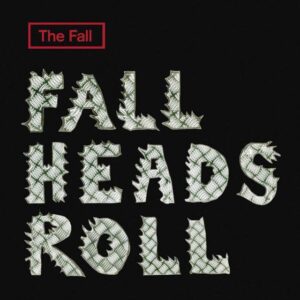
 On 2003’s ‘The Real New Fall LP’, Mark E. Smith and his band sounded somewhere near the top of their game. Some of their more critical fans might claim the record didn’t quite capture the fire of their early work, but the record boasted more than its fair share of memorable performances. It showed the now veteran act in a position of strength and would be a hard act to follow, if not impossible, especially considering Smith had a habit of shaking things up whenever he felt things might be going too well.
The band’s 24th studio release, 2025’s ‘Fall Heads Roll’ featured an entirely new rhythm section but, thankfully, managed to retain the rather crunchy sound that’d made the best bits of the previous album so appealing, along with a relative number of (relatively) accessible songs.
The mid tempo, bass led ‘Ride Away’ sets the tone musically for a couple of the album’s odder cuts, sharing something that feels a little atonal and not entirely focused. Over a steady rhythm, Elena Poulou adds some really ugly keyboard work that sounds like a sketch that’s she’s planning on improving later, and MES arrives with a half-arsed vocal that sounds like he’s taking the piss. It might be tolerable if it were a short piece, but this drags on, unchanging for a full five minutes. It could be one of the worst Fall songs post 1997, and the fact that this gets pride of place at the front of the album says so much about how belligerent Smith could be. Luckily, this is immediately followed by ‘Pacifying Joint’ which, although could split opinion on a lyrical level, thunders forth with a great arrangement where a repetitious keyboard riff and tight drums deliver some full throttle post punk sounds that could easily have slot into any of the best Fall albums over the previous ten years. With a vocal that really capitalises on Smith’s now trademark drawl, it’s a number that even a Fall novice would recognise as being The Fall tapping into their distinctive sound.
‘What About Us?’ follows with a surprisingly similar feel and energy, but by pushing Ben Pritchard’s guitar further forward in the mix, the number comes with an even sharper edge, even before Mark puts in an appearance. It’s another “typical” performance from him, but between wordless shouts delivered with the kind of enthusiasm that feels almost unnatural if compared to performances on other recent albums like ‘Are You Are Missing Winner’ and a focus on clear repetition, it’s one of his greatest vocals this time out. In fact, for those looking for a quick snapshot of how much fury this line up of The Fall could summon, this track and the grinding ‘Blindness’ – a groove laden, bass heavy ramble that brings more melody to the table, and a future live staple that would never be the same twice – provide the perfect examples of a band firing on all six.
Alongside ‘Blindness’ and ‘What About Us’, this album presents another cast-iron classic in ‘Assume’, a genuinely punchy piece of post punk that shows Pritchard throwing siren-like guitar lines against a distinctive MES vocal, and a superb cover of The Move’s ‘I Can Hear The Grass Grow’ which stands up surprisingly well when transformed from spritely 60s pop into a fuzzed up garage rocker helmed by a likely pissed up Salfordian. Then, top of all of that (mostly) good stuff, you’ll also find ‘Aspen’ a mix of post punk rhythms and almost shimmery, dreampop guitar lines set against a spoken vocal that’s almost more like an art piece than a rock track. For those who feel The Fall were not capable of truly thinking outside of their perceived boundaries, this could be a genuine ear-opener.
The last twenty minutes of ‘Fall Heads Roll’ aren’t quite as striking, but nestled within the album’s later run of songs, the rockabilly knockabout ‘Clasp Hands’ shows the band isn’t lacking inspiration or energy, and when working drummer Spencer Birtwistle a little harder, the music sounds really sharp against another sneering MES vocal, while the spiky post punk of ‘Breakin’ The Rules’ occasionally sounds like a welcome throwback to ‘Dragnet’ era Fall, which is rather surprising given how much MES valued looking forward rather than relying on easy nostalgia. Unfortunately, there’s also ‘The Last Days of Channel Fuhrer’, an obtuse, lo-fi waltz that seems intent on challenging even the most tolerant fan, but it wouldn’t be a Fall album without a couple of genuine curveballs…
‘Fall Heads Roll’ suffers a little from the era’s tendency for “CD bloat” – 56 minutes is a little on the long side, and the album would’ve definitely felt the benefit of a little streamlining – but its strongest tracks make it one of the best “later” Fall records.
Expanded to a 4CD set in 2026 by Cherry Red, the deluxe version makes up for the album’s few misfires by presenting an extensive range of bonus materials. Of the biggest interest to fans and collectors is the disc’s worth of demo recordings from Chapel Studios, presented with working titles. A couple of these will already be familiar: ‘Reformation TLC’ cut ‘Systematic Abuse’ appears in instrumental form, and in comparison to the final version, shows a little more of a rockabilly influence via the drums, and a Duane Eddy-ish instrumental ‘The Boss’ would make sporadic appearances at live shows over the next couple of years, despite the studio recording never progressing any farther. Beyond those, the complete tape features several other things of interest, and in a few cases, the recordings demonstrate how melodic this line up of The Fall could be when MES wasn’t actually present. The brilliant ‘Fuzz’ is an immediate case in point, with its huge jangling guitar lines that make the band sound like ‘Catholic Education’ era Teenage Fanclub; ‘Boil A Chicken’ provides a snapshot of a tight as hell garage band driven by a thunderous drum part, before descending into a wall of sound via a shrill guitar, and ‘Twang’ shows off this unit’s ability with more furious sounding rockabilly, at a time when the style wouldn’t have been of mass appeal. The brilliant ‘Spencer’s Cut’ also finds a Smith-free band really cutting loose on another great rockabilly riff, with Pritchard giving everything six-nowt with a busy rhythm guitar part that sounds as sharp as hell.
‘White Line’ stands out for different reasons. It hits upon a huge reggae groove, coupled with an array of post punk synths. The contrast between a fat as fuck sounding bass and a few shrill elements brings a Public Image-esque quality, and the live drums sound absolutely amazing. The five minute jam really captures a hard working band in full flow, and it’s hard to imagine what MES would have brought to the table. It obviously bares no relation to the completed ‘White Line Fever’ on ‘…TLC’ with its semi sloppy country vibes. That honour would go to ‘Brimstone’, a rough tune that works a hugely similar melody and a present MES is clearly using that for a dry run of the final album track. Like the final ‘White Line Fever’, this is still very much going to be an opinion-splitter.
Within the fourteen track selection, you’ll also find ‘Bennett’s Rocker’, a mid tempo, swaggering affair that shows off more 50s influences, ‘Wed Z’, a full scale crashy sounding rock number that utilises a riff that sounds as if it might have morphed into ‘My Door Is Never’ at a later date, and ‘The V One’, a riff that veers between perfect garage band vibes and post punk angularity without missing a step. There’s only one real skipper here: ‘Get Out’ contrasts programmed beats with garage rock guitar and a solid helping of fuzz bass. The riff itself is good – the grubby guitars have a real edge and the melody that emerges has all the makings of something that could have been interesting, but the programmed elements providing a dominant rhythmic edge grate fairly quickly.
For those interested in a different take on the album sessions and subsequent promotion for the record, a selection of alternate cuts and the obligatory Peel Session is also guaranteed to be well received. A “slow version” of ‘I Can Hear The Grass Grow’ provides an immediate stand out. A more leisurely approach allows for a bigger focus on the backing vocals, and this accentuates the 60s feel to the track, despite MES naturally making it sound like a Fall deep cut, while a single version of ‘Bo Demmick’ retitled ‘Bo Doodak’ reworks the track with a deeper bass sound and fills a lot of space with honking tones that could be the work of a baritone sax…but could just as easily be a weird keyboard loop. A fuller and less live sounding vocal, meanwhile, comes closer to the sound MES shares on most of ‘The Real New Fall LP’, adding to the slightly more commercial recoeding. Despite the many changes, though – arguably for the better –this wasn’t a hit…and was never likely to be.
The original demo of ‘Blindness’ (still titled ‘Blind Man’) shares a take that sounds all but finished from a musical standpoint, and its great to hear the bass riff without the harsher sound that adorned the final cut, but there are several different lyrical concerns – most notably stuff regarding “talking to Jane Seymour” which would still be present at the point the track was recorded for a Peel Session. For a slightly later “interim version” of the track, the bass groove is still firmly in place, but some of the lyrics feel even more free-form. This would still work, but most of the melodic elements are drowned out by an incessant melodica (the world’s most inaccurately named instrument), leading to something that only the most patient fan will get through, and almost no-one would consider the definitive version of a superb track. “Interim” versions of ‘Clasp Hands’ and ‘What About Us’ fare much better since they basically present The Fall running through the tracks in a rehearsal space, complete with live sound. There’s a genuine energy captured here, and strangely, they actually sound rougher than all of the Chapel Studios demos, despite “interim” implying “almost finished, but very much a place-holder”. An “alternate version” of ‘Blindness’ has a lot of elements that sound like the take used for the album, but a huge rockabilly intro – drums only – and a rougher sounding guitar during the latter part of the track give a very different feel. It isn’t as good as the album track, but, as with the other versions included here, it gives an important glimpse into how ‘Fall Heads Roll’s greatest cut came to life.
The best version of ‘Blindness’ was captured for the Peel Session in August 2004, over a year before ‘Fall Heads Roll’ was released. This embryonic take features a rambling vocal – almost certainly with a heavy element of improvisation – over a huge, grinding bass that would later become very familiar. Stripped of the album’s production values, that bass sounds bigger than ever – even bigger than at later live shows – and for a full six and a half minutes, listeners can be completely submerged in a recording where Smith’s rambling voice and Steve Trafford’s humongous riff sound like the greatest double act in the world. [This, rather fittingly, became the last ever thing John Peel played on his radio show before his untimely passing a couple of months later.]
The early take of ‘Clasp Hands’ feels a lot sharper than the eventual album cut, providing a superb example of The Fall’s 50s inspired riffery, before a semi-sloppy ‘What About Us’ drops the listener into a world that feels rather more like “traditional” Fall. If you’re a fan, of course, the slightly looser approach will not disappoint. A throwback to ‘Kurious Oranj’ via ‘Wrong Place, Right Time’ fits the loose vibe brilliantly, giving the older fan a brief glimmer of nostalgia, before everything slips into a really ugly version of ‘I Can Hear The Grass Grow’. By the time Mark has finished mauling that, the really sharp sounding band that shared the brand new ‘Blindness’ at the start of the session starts to feel like a fading memory. Recorded at for the session, but not broadcast, is a track named ‘Job Search’ which has also been included here for completeness. This was actually recorded as a birthday gift for Peel. It’s…ugly. Synth sounds set a rhythm in place that sounds like the basis for one of the band’s “dance-y” experiments for ‘Levitate’ meeting with the riff from ‘Pacifying Joint’, whilst Birtwistle throws out a really thin sounding, demo quality guitar riff. MES arrives with a really lax vocal and the track seems to do very little beyond that. It makes the most obtuse elements of ‘Fall Heads Roll’ sound like an old Nick Lowe record. Undoubtedly, Peel loved this gift, but it’s very much the kind of track that anyone bar the biggest Fall-head is likely to skip after a couple of spins…
Disc four brings the inevitable inclusion of live material from the period. While some previous Fall box sets have spoilt the fans with multiple gigs, this deluxe ‘Fall Heads Roll’ is limited to just the one show. The recording comes from the band’s appearance at the Leeds Festival in 2006, and since they appeared in the Radio 1 tent in the middle of the afternoon, it isn’t especially a long set, but it’s a great one. On the plus side, like a lot of festival shows from that period, it seems to have been sourced from a soundboard/semi official recording, so it sounds superb.
Not that the quality of the gig or recording are immediately obvious. The first half of ‘Bo Demmick’ sounds like a massive electrical fault accompanied by deafening bursts of bass, and it isn’t really until ‘Pacifying Joint’ kicks in, that everything feels right. ‘Pacifying Joint’ has a little more punch than its studio cut, and hearing MES shout his way through it for the pleasure of a tent of pissed up festival goers leads to a fairly exciting experience. He sounds really enthused; almost like he’s actually pleased to be there, which is a contrast to the Reading Festival performance just a few years earlier which played out as if The Fall were falling apart in front of their fans, so rough that some felt it might be the end. Ben Pritchard’s choppy guitar work sounds absolutely fierce; Elena’s atonal keys, positively threatening, also attack in a way that suggests that, even with this really not ranking among the band’s most classic tunes, this has the potential to be a great, and somewhat fiery gig.
That’s confirmed with the arrival of a really punchy ‘Theme From Sparta FC’ – a highlight of the superior previous album ‘The Real New Fall LP’ – with the guitar and bass hugely prominent in the mix, and MES sounding almost as sharp as his studio take. ‘What About Us’, naturally, doesn’t have the melodic edge, but the way MES slurs various phrases over an arrangement that sounds like a frightening collision between a post punk behemoth and a third division Krautrock act makes it classic Fall, and much like ‘Pacifying Joint’, there’s a genuine spark to this recording that gives the feeling of being there.
Smith’s insistence on looking forward rather than giving the crowd a nostalgia-fest is as clear as ever here when the middle of the short set introduces the yet to be released ‘Reformation!’, a track that doesn’t feel quite finished, but still gives a feeling of excitement for an album that’ll hit the shelves in six months time. The keys are really loud and the bass is almost non-existent at first, but the guitars chime through with more of a clarity, occasionally giving a sense of the power this number will ultimately have somewhere down the track, and MES shares various phrases that make the final cut, but in a way that feels markedly different. The sharpness of his studio take is absent, and in its place, he sometimes favours a deep slurring. As the performance gains momentum, it gains some focus, but never entirely, meaning that for the bigger Fall fan, it should be considered an essential live cut.
You’ll also hear ‘Mountain Energei’ played with plenty of swagger and the still new ‘Blindness’ capturing the band in good form, making the very best of one of the greatest bass grooves ever committed to tape. Although very much the highlight of this gig, it still sits somewhere in the mid-table of ‘Blindness’ performances, since it lacks the sheer punch of the Peel Session, but thankfully it’s not spoilt by MES shouting disability related slurs as per the ‘Last Night At The Palais’ show. For Fall obsessives, though, it offers another unique take, with Mark name-checking the festival weekend and someone who may or may not have been important in getting the band on the bill. This show’s one concession to the distant past comes in the shape of a raucous ‘Mr. Pharmacist’ which sounds a little out of place among a wealth of newer tracks, but surprisingly MES gives his all throughout. Despite only taking the stage for about forty minutes, this set actually ends with another preview of ‘Reformation’ when the band – dominated by bass and a razor sharp post-punk guitar sound – hammer through ‘My Door Is Open’. At this point, MES has already decided he’s put in enough work to entertain the grubby masses and already fucked off backstage… The tune more than works instrumentally, however, and supplies this show with something cool for the completists.
Pretty much anyone interested in adding this live set to their collection will own several dozen live shows already. That won’t stop anyone loving this; it’s a genuine thrill to have another Fall live gig that comes from a decent source. After years of wading through tapes that were recorded on dictaphones in peoples’ pockets – several of which have actually graced previous Cherry Red deluxe sets – this is the reward fans deserve. It’s reason enough to upgrade your original CD of ‘Fall Heads Roll’ with this four disc version.
Despite featuring just one disc of live material and featuring a wealth of demos that aren’t likely to grace your CD player too often, this is still a very strong set. Between the best bits of the album itself, two absolutely killer Peel Sessions and a fiery live show, it’s a reissue that covers a fair bit of important ground. Since it’s only really ‘Blindness’ that’s “well known”, this multi-disc set might be a little daunting for the Fall novice, but for the fan and collector, there’s more than enough gold to be uncovered here.
February/March 2026