 In 2023, Universal Music released the ultimate in Camel box sets. ‘Air Born: The Decca Recordings 1973-1984’ brought together all of the band’s official releases from their most commercially successful period, and combined them with a wealth of rare and unreleased material. For the fan who must have everything, it appeared to be a beautiful item – especially with new blu ray audio content and surround mixes bringing a new dimension to some much loved tunes.
As is often the case with such a set, a huge price tag would prove a sticking point for those fans without deep pockets. Consolation would soon come from Cherry Red Records, however, who reissued ‘Camel’, ‘Mirage’ and ‘Music Inspired By The Snow Goose’ as deluxe editions (complete with the blu ray content) a relatively short time later.
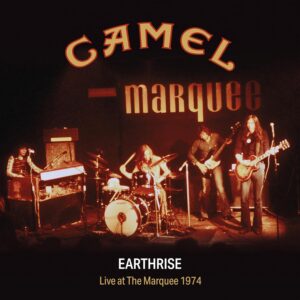
Another important release in the label’s Camel reissue campaign, ‘Live at The Marquee 1974’ reproduces discs 4 & 5 from the ‘Air Born’ set, making the previously unreleased show more widely available and far more of a cost effective purchase. The big question is, for those who’ll undoubtedly own several Camel live recordings already, is it worth the investment? The answer is a resounding yes. Not only is it a great representation of the early band in a live setting, but considering its age, the audio quality is absolutely stunning.
Following a fairly stilted spoken word introduction – the kind that went out of fashion around 1978 – Camel open what is to be a stunning set with ‘Earthrise’, a key number from their still recent ‘Mirage’ LP. Almost immediately, the warmth in Doug Ferguson’s bass takes centre stage, but the keys – courtesy of the legendary Peter Bardens – come very high in the mix. As the track gets underway and the melodies venture into a much busier arrangement dominated by the drums, some of the organ sounds get a little lost. This doesn’t hamper any of the enjoyment, however; it merely adds to the feeling of being there. Around the four minute mark, the whole band are absolutely cooking with a jazz fuelled arrangement that sounds a little more aggressive than its studio equivalent, and despite Andrew Lamiter’s distinctive guitar soaring, it’s actually really hard to tear your ears away from Andy Ward, who seems intent on absolutely decimating his drum kit. A similarly enthused approach is taken by the drummer during the even more jazz influenced ‘Six Ate’ a little later, but the more spacious arrangement allows for far more of a melody. This doesn’t especially deviate from the 1973 studio cut, but still sounds great, especially when played back with a little more volume applied.
Between those numbers, the ‘Nimrodel’ medley (introduced as ‘The White Rider’) gives the audience a little time for reflection due to its partially more sedate feel, but as with the other numbers, this recording shows the early Camel absolutely on fire in terms of how they play off each other. From the outset, Latimer’s guitar work is absolutely beautiful, and the live sound really brings out the emotion in his rather sad tones, while a deep and natural vocal floats above dominant keys. By the time Bardens takes centre stage for a solo, his shamelessly 70s tone and volume seem almost deafening; in places, it’s only the bass, keys and drums that can be heard, despite Latimer filling space with sharp rhythm work. It’s great to hear the number’s rocky coda delivered in a slightly heavier way, however, and even with a slightly uneven end mix, these ten minutes are a brilliant showcase for most of Camel’s musical traits at that time. In true early seventies style, the performance is treated with reverence by an attentive crowd who really aren’t a massive factor in whether this recording works or not, merely applying some polite applause when the time is right. If you’ve any kind of love for ‘Mirage’, this will certainly provide an early highlight from this show.
Returning to the ‘Mirage’ album, both ‘Mystic Queen’ and ‘Supertwister’ appear in very solid sounding renditions. Most Camel fans will be familiar with these takes already, as both appear on the expanded CD version of ‘Mirage’, along with ‘Arubaluba’ from this show. Hearing them in situ and in the correct sequence actually seems to make them feel much stronger, and in the case of the latter, hearing Latimer taking the opportunity to really “rock out” provides the first half of this set with a little more of a balance, before ‘Ligging At Louis’’ (as per the recording that appeared on the 1978 double set ‘A Live Record’) returns everyone to their preferred jazz rock sound. Although this recording will be more than familiar to fans, its worth noting that the final mix used for this recording sounds a bit louder than the one present on the ‘Live Record’ CD from 2022. Not in a “spoilt” loudness wars way, thankfully, but in a manner that helps the recording to sound a little more alive.
The whole show is great, but this set really comes into its own on the second disc, which kicks off with a medley of numbers from the yet to be released ‘Snow Goose’. While hearing these played in front of an unknowing audience doesn’t quite match the stunning effect of hearing the intro of the still unknown ‘Bridge Over Troubled Water’ greeted with a stony silence on Simon & Garfunkel’s ‘Live 1969’ release, this still gives a feeling of how special it must have been to be present, hearing these tunes for the first time. The punchy opening to ‘Rhyader Goes To Town’ feels like a natural companion to the end of ‘Arubaluba’ and the interplay between Ferguson and Ward is superb, even though your ear will likely be drawn to Latimer. The bridge between the fast and slow sections feels a tiny bit lumpy at this point – more notably on this riff’s second appearance when Bardens uses a different keyboard sound – but it’s great to hear something fresh, before everyone descends into silence to hear the quiet ‘Sanctuary’, allowing ‘The Snow Goose’ to act as a great showcase for Latimer’s guitar, again, capturing the quiet, more introspective side of this early band. Sound wise, these tracks are flawless, and although not quite as grand as the Royal Albert Hall recordings from ’75 with the Royal Symphony Orchestra, still add something of great importance to the band’s live canon.
The final part of the show is best described as epic, with a rousing ‘Freefall’ taking the 70s fusion chops of ‘Earthrise’ and cranking the gears further. As with many of the other tracks here, it’s never vastly different from the studio take, but the live setting allows for more of a natural feel. The fifteen minute ‘Lady Fantasy’ showcases a great guitar tone during the intro and at around the six minute mark, along with some of the gig’s best vocals. Much like the other previously released cuts on disc one, the final mix used for this release feels “bigger”, and that’s especially obvious regarding Ward’s drums, which finally come through with an impressive live sound, as opposed to merely sounding like a solid presence behind the keys and guitars. Closing with a cover of Peter’s own ‘Homage To The God of Light’ (a staple of the earliest Camel shows), the nineteen minute number finds the band really stretching out. This would be far more impressive if fans didn’t already own it on the 2002 CD edition of the debut (it was absent from the 2023 expanded edition), but as with a couple of the other tracks, hearing it in context and at the end of a superb gig makes a world of difference.
Between the release of ‘On The Road 1972’ and ‘73-75: Gods of Light’ it could be said that Camel were already well – or at least reasonably well – represented in terms of pre-‘Moonmadness’ live material, but this double set really raises the bar. First and foremost, it has the edge in that it actually represents a full show from a single source, but it also shows that in the run up to the release of the legendary ‘Snow Goose’, Camel were an insanely tight outfit. Take the audio quality of this set into consideration, and it becomes an essential purchase for the Camel fan who just couldn’t stretch to the cost of a massive box set.
November/December 2025