 The Cog Sinister label has been responsible for a huge number of Fall products over the decades. The label, founded by Mark E. Smith in 1987, was dissolved a few years later and the name was subsequently adopted by the Voiceprint group in 1997 for the purpose of reissuing various Fall items and sharing official bootlegs. These have ranged from the terrible (‘Live 1977’) to the average (the lop-sided sounding ‘Band On The Wall, 1982’), to the absolutely essential (gigs recorded at Cedar Ballroom, Birmingham in 1980 and Derby Assembly Rooms in 1994).
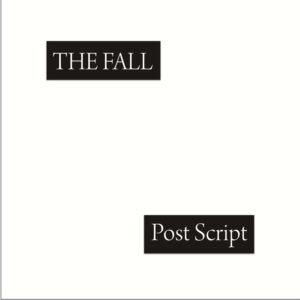
‘Post Script’, a collection of recordings credited to The Fall and issued by Cog Sinister in 2026, was initially pitched as being the last studio sessions. In truth, that was a fraudulent claim. It’s a grab-bag selection of Mark E. Smith’s unused/leftover vocals dating from between 2001-2014, coupled with newly recorded backing tracks from ex-manager Ed Blaney (guitar, vocals, production) and ex-Fall bassist Mark “Ding” Archer (bass, guitar, keys, production). The music that doesn’t always resemble genuine Fall works, and can easily be seen as Blaney and Archer muscling in on something they consider an easy win, since anything baring the Fall name will automatically generate interest among the faithful. Smith’s partner is scathing of this release, as is her right, having not given permission for its go-ahead.
‘Post Script’ is a somewhat questionable Frankenstein creation that sounds like musicians attempting something Fall-esque, but not always capturing – or even understanding – the right spirit. If you can make it past the grey-area nature of their coming into being, the nine tracks occasionally capture some good melodies, but given how they came together, the arrangements feel somewhat clinical in direct comparison to the brilliantly organic sound captured by the Imperial Wax band that backed Smith on the last decade of Fall recordings. It is a record that can only really be judged on its own terms. It is a Fall album in name only.
So, controversial creative process aside, what of the material? The opening number, ‘30 Degrees’ hits with a surprising amount of melody. Swirling keys find a space that’s dominant in the end mix, taking influence from strange new wave quirks and a world of Krautrock. Adding a layer of extreme contrast, a clean guitar drops in with descending melodies, sounding quite unlike anything from a “typical” Fall arrangement. There are moments where this almost dream-like melody gives way to a punchier riff, sounding as if it were meant for a completely different track entirely. The push and pull between these two ideas brings some interest whilst a sampled Smith growls and slurs his way through a set of inaudible words which lean upon the obtuse; setting the tone for things to come, this is more of a rambling narrative than a conventional song. It’s clear that the vocal was set down much earlier than some of the tracks found here. MES sounds younger and healthier than on most of the recordings issued between ‘Ersatz GB’ in 2011 and ‘New Facts Emerge’ in 2017, which is rather jarring if you arrive here expecting leftovers from “later Fall”, and leads to questions as to exactly where within the Fall timeline his voice was recorded. Nevertheless, it’s an interesting way to kick things off; while it isn’t classic Fall, it’s a more palatable listen than some of the later, deeper album cuts from the genuine band.
Also worth an ear, largely due to Smith being in perfect voice for a spoken narrative, ‘Colonel’s Retreat’ offers a superb post-punk bass groove and intermittently abrasive guitar sounds during slow moments. MES drops his fans into a world where Croydon and other places come into his thoughts, and (seemingly unrelated), someone “didn’t appreciate the mistake or the experience”, all whilst growling like a goblin who’s been chain-smoking. Aside from the fact that some of Smith’s vocals have been used as repeated cut ups as opposed to being presented as natural takes – something particularly notable on the “chorus” where the phrase “let’s get working” is delivered in exactly the same tone and meter every time – this has a reasonable of merit, if not as a Fall song, then as a musical project of its own. Even when the arrangement briefly shifts into a faster tempo, there’s a punchiness that’s commendable. ‘A Caveat’, meanwhile, shares one of the clearest vocal takes – again, sounding like something sourced from circa 2002/3 – against a militaristic drum beat and sparse guitar lines, creating a blend of post punk and dark, almost goth-tinged grooves. No matter where Blaney and Dink decide the music should go, chances are you’ll only really be focusing on a slurring Smith, sharing lyrical barbs. On this track, perhaps more so than the others, it’s clear that the music has been recorded posthumously, and possibly on the quick. At the point where the melody shifts from the moody and militaristic and into a faster groove for the coda, listening on headphones will uncover a clear splice in the source materials…which reinforces any negative thoughts about ‘Post Script’ only really existing because its creators and the label consider it an easy money-spinner.
‘So Long’ works a heavy-ish, chugging riff that sounds like an ‘Ersatz GB’ out-take, over which MES grumbles and mithers, half buried in and end mix, with his voice subjected to a world of distortion. Cutting through the noise, his phlegmy delivery fits firmly with later Fall fare, and statements like “you laugh now” coupled with incoherent mumbles about “cry-babies” and something possibly regarding estrogen play out with a typically obtuse manner, but a solid post-punk arrangement driven by some great bass work ensures this just about works on its own terms, even if the music sounds a little too crisp in places. With regards to a few of the other tracks, things slunk into the rather more pedestrian. At times, Blaney and Ding attempt to create a “Fall sound” seemingly by rote, with average results; at others, they trot out grubby rock riffs that bear no relation to any of the band’s many line ups, clearly hoping that the presence of a posthumous MES will sell the material. In terms of accessibility for the non-fan (not that many casual listeners will be approaching this disc), the hard rock edge from Blaney’s guitar that drives ‘Final Position’ will likely work well from first listen, despite sounding nothing like The Fall. It isn’t a great track, all told, but the various random statements from Smith – including shouts of “rouse, rouse”, a voice asking “what about the corporation?”, and other bits and bobs that appear to be sourced from recordings of studio banter, thdn subjected to a lot of trickery, presented in an aggressive stereo split between the left and right channels – are effective when heard via headphones.
In a sharp change of mood, ‘Dehydrated’ mixes grinding bass sounds with busy drums and ugly keys, creating something almost danceable. Again, it’s not very Fall-like, but the unearthed vocals resemble something much closer to what might be expected from a final MES take, and his presence drifts between the beats very effectively. It mightn’t be something fans will return to often, but it at least sounds more enthused than the slightly aggressive ‘Retro Song’ which attempts to couple something a little punky with drum parts that lean into MES’s love of old rockabilly. Another newly written vocal hook sounds forced (and averagely delivered by Blaney), but again, the sourced MES vocal has its own distinct charm, even if at this point, hearing bits of him, out of context from beyond the grave, repurposed in a way he wouldn’t have liked, has worn a little thin.
Likely to divide opinion more than anything else on this disc, the lengthy ‘Northern Irish Man’, in many ways, gives away the music’s inauthenticity on release. Adopting a slow, bass led groove topped with a blanket of synths, nothing sounds like The Fall. Even an occasional layer of distortion doesn’t tally with much in the band’s past, helping this to sound more like a post-rock band with dark, gothy tendencies. This isn’t helped by the “chorus” being driven by a cleanly sung vocal from Blaney. There’s always Mark, of course, and on parts of this rambling jam, he’s in incendiary form, barking about “censorship reverberation”, things “beyond the barbarian” and people that “can’t even stick up for their god-given rights”. You won’t have to listen too closely to discover that this is another cut-up affair, resembling nothing MES would have had in mind. Parts of his speech sound clear and studio based; other parts growl as per ‘Ersatz’, immediately suggesting two different sources. Then there are other parts that sound home-recorded, as if MES were speaking into a microphone in an empty room – possibly even out-takes from ‘The Post-Nearly Man’. This isn’t by any means terrible, but it isn’t The Fall. It might have fared better had it been shorn of the Blaney chorus and shared as a supposed MES solo recording.
Driven by drum machine, clean guitar and a very slow tempo, ‘The Book’ presents itself like a cross between a mid 80s Fall track and something from the Sisters of Mercy’s ‘First, Last and Always’. On its own merits, this is okay, but if Blaney thinks it fits neatly into the Fall canon, much like ‘Final Position’ and ‘Northern Irish Man’, he’ll likely fall foul of fan opinion. Nevertheless, the bits of MES that have been salvaged here bring some interest. His slow, laboured delivery fits the music well enough, creating something a bit more moody, but this is still unlikely to entertain in the longer term. This feels like little more than a weird curio; a fan-fiction type affair that believes it shares a love for MES, but just ends up feeling a little soulless.
There has been some debate online regarding the legitimacy of these recordings, and of whether they are genuinely deserving of a place within the Fall canon. It’s only fair. Semantics aside, however, ‘Post Script’ (very much not the real new Fall LP) is interesting to a point, but is a notably hit and miss affair; the kind of listen that’s geared towards the obsessive fans only. And some of those, understandably, have strong misgivings regarding ‘Post Script’s legitimacy. As a stand alone disc, it’s really a collection filler. These nine tracks – despite offering a couple of very bright sparks – would be much better served if only Blaney and Ding had been completely transparent regarding what ‘Post Script’ really entailed. As it is, there are times when this album feels like a strange, but rather uncomfortable tribute, and others when it has the air of a cynical cash grab. That said, as with all Fall product – and this is a case of presenting product above all else, scraps melded with new sounds then claimed as new art, against the wishes of others – there will still be fans who’ll want it. Some will even find a certain amount of merit within. For better or worse.
October 2026