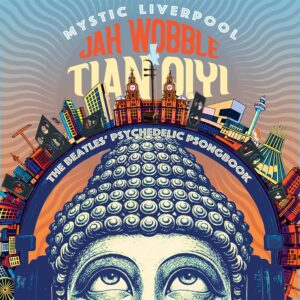
 For those old enough to have been keen record buyers and gig goers in the late 70s, Jah Wobble will need no introduction. His fat, dub-centric basslines were an integral part of the early Public Image sound and, as such, he was one of the most important and influential figures in the post-punk scene. His often tough, sometimes dark bass tones mightn’t seem a natural fit with the recordings of a little-known Liverpudlian quartet, but that makes this album an interesting proposition even before a note is heard.
As it turns out, ‘Mystic Liverpool: The Beatles’ Psychedelic Psongbook’ – recorded in collaboration with Wobble’s sons, musical duo Tian Qiyi – is great. Not only does the signature Wobble sound come through boldly, the Tian Qiyi sound allows the listener to experience some very familiar material in a new way. Although almost everything stands up in its own right. It might be a stretch to suggest that you don’t have to like The Beatles to glean enjoyment from the songs, but the tracks have definitely been rebuilt from the ground up, making everything sit closer to the musical world of Jah and family than to the pop-rock of Lennon and McCartney.
To begin, the musicians pull out the “big guns” with an absolutely cracking version of the once-groundbreaking ‘Tomorrow Never Knows’. Stripped of the backmasked sounds, their version feels far more organic. The drums quickly lock into a repetitive groove, loaded with loud cymbals, while extra layers of percussion build up a very busy rhythm, Against this, Wobble lays down a huge bass, partially distorted, bringing a heavier edge to a familiar melody which really comes into its own during an extended coda. Charlie’s vocals are treated to phased effects which bring an almost airy quality, building up the psychedelics, but the best moments come from a melody supplied by a yangkin, which uses a distinctive sound to bring a Chinese edge to a world of looping riffs. Although its contributions fit ‘Tomorrow Never Knows’, there’s also something within the chosen melody and bright sound that feels as much like it draws from Roy Budd’s famous score for ‘Get Carter’, which certainly adds an extra layer of interest.
Also providing an instant standout, ‘The Inner Light’ works some terrific percussion throughout. John T.’s drumming is really tight, and although huge swathes of this track lean upon an unchanging rhythm, the repetitious nature of the groove never becomes dull. The way the yangkin is used heavily throughout brings an extra layer of interest once more, and also an authentic “world music” mood that goes way beyond Harrison’s original musical sketch. At almost seven minutes long, there’s plenty here for the audience to lose themselves in, and as things reach their inevitable climax, the musical interplay between the droning erhu sounds and the sometimes dominant yangkin melody is stunning. By giving the bass a little more of a back seat, this also shows how this is very much a family collaboration with Charlie and John T. actually being in the driving seat from a creative perspective, even if Dad is likely to be the more obvious draw for many.
One of this collection’s biggest deviations from the source material comes via a version of ‘Flying’. The mellow George Harrison penned track now plays like a dub reggae deep cut with Wobble’s bass driving everything. For the first few bars, there’s barely any similarity to ‘Flying’ at all, and it isn’t until the wordless vocal melody from the original recording is replicated on an erhu that the pieces really fit together. It’s a really twisted take on a “deep cut”, but all the better for that, and the echoing drums are a particularly smart touch when giving this an authentic dub reggae twist. ‘Blue Jay Way’ isn’t quite as fortunate. The reggae oriented drums and grumbling basslines are very cool; the droning elements supplied by the erhu bring a welcome alternative to Harrison’s beloved sitar, but everything feels a little laboured. The sparser melody doesn’t hold up so well when taken in a direction that brings more of a drone aesthetic, but unfortunately, Charlie’s vocals are really hard going. He reworks the floatier melody into something that drifts in and out of the music even more, never completely sure of itself and never entirely tuneful. Thankfully, an instrumental coda brings some musical relief, with Wobble’s tight bass working in tandem with a superb drum groove, giving more of an insight into a track that clearly had a great core.
The opening melody of the classic ‘Strawberry Fields Forever’ sounds superb played on a yangkin, and the more psychedelic elements of the number hold firm when reworked with the erhu, which in this case, takes on a role that sounds like a wah-wahed guitar. Extra layers of sound are supplied by a sparsely approached guzheng, played by a guesting ZiLan Liao, a famous musician from the international concert circuit (and also Wobble’s wife). During the main the body of the track, Charlie’s drumming is superb, every bit a match for ‘Tomorrow Never Knows’, whilst Wobble’s bass work, although a little more understated than usual, adds plenty of colour via some punchy notes applied throughout. He even slips into a very different kind of 60s inspired riff on occasion, giving this slightly more of a jammed/experimental quality that really works.
The oldest Beatles tune offered comes in the shape of ‘Norwegian Wood’, which you might expect to replace the sitar with yangkin, but no… That honour goes to the erhu, which subjected to a lot of reverb ends up sounding more Moroccan than Chinese. In terms of riffs, it still holds up, but the best element of this drastic rebuilding comes from the bass. Throughout the track, Jah latches on to a relatively simple but fat sounding dub reggae groove, allowing it’s deep sound to contrast a wavering vocal. There’s a lot here that’s easily recognisable as being a Wobble/Tian Qiyi collab, and yet the heart of the original track still beats furiously, even when busier drums and layers of drone take centre stage for a lengthy instrumental workout. Although ‘Within You, Without You’ is played fairly straight on the surface, at least at first – Charlie sticks rigidly to Harrison’s melody, which provides this album with his best vocal performance – a much busier rhythm eventually gives the piece a dramatic lift during its second half when a familiar tune collides with a heady groove that feels as if it owes more to Fela Kuti than the Fab Four. With a very natural flow, an almost funky undercurrent and some pleasingly tight bass applied, this is another album highlight. Maybe even the highlight.
Pretty much nobody ever imagined that ‘Love You To’ would work with a dominant bassline that sounds like something inspired by the intro to ‘Dock of The Bay’, but this proves otherwise, with Wobble giving the Indian inspired melody a real punchiness that’s quite exciting. This recording promises a lot from the off, but really hits its stride once Charlie adds a drum part that vaguely mirrors ‘Tomorrow Never Knows’, applying a definite Tian Qiyi groove, that eventually stretches into a drum and bass jam (but not drum ‘n’ bass) that’s really satifying. Although this won’t necessarily please the purists or become the definitive version of the song, it provides a superb example of why this collaboration should be considered a great success. The marriage between the drums and bass also shines throughout ‘Rain’ where, deliberately or not, Jah and Charlie hit upon a mod friendly, very 60s groove that has faint echoes of tracks like The Champs’ ‘Beat Me Till I’m Blue’, before everything descends into a psychedelic haze for the track’s simple chorus. Providing a stronger link with some of this album’s other tracks, a truckload of reverb and a prominent use of the yangkin bring a very distinctive quality throughout. ‘Rain’ wasn’t always the greatest Beatles track – unless you ask Liam Gallager, but many other more sensible opinions are available – but this cover makes the track seem positively electrifying.
No collection of psychedelic Beatles tributes would be complete without ‘I Am The Walrus’, and the version here – although somewhat disorienting – doesn’t disappoint. Jah offers one of his heaviest basslines, steering a sloooow melody throughout, whilst echoed vocals and erhu stoke up the oddness. This sometimes feels like the audio equivalent of drowning. It lacks the cheekiness of the original recording, which tottered gleefully between a world of fun and being faintly disturbing, and instead plays squarely for something that’s genuinely dark. When approached in the right frame of mind, however, it’ll still offer plenty of musical interest, but probably won’t be something you’d want to listen to daily. Still, kudos must be given to Jah and the lads for thinking so far out of the box…goo goo ga joob.
In the main, Wobble’s fans are likely to love this, but if it provides an easy window into the world of Tian Qiyi’s own recordings and inspires listeners to backtrack and check out 2025’s ‘Songs For Workers’, then it’s been an even bigger success. Pretty much the only major criticism here is that just ten songs is not quite enough. It would have been really cool to hear this musical unit tackling something from ‘The White Album’ – maybe a dubby take on ‘Glass Onion’ or ‘Savoy Truffle’, even an experimental version of ‘Wild Honey Pie’ with the refrain shouted over something that sounds like an old PIL homage – but as it stands, ‘Mystic Liverpool’ has more than enough to recommend it, and it’s great to hear some of these tracks with a fresh ear.
July 2026