 By the beginning of 1974, Bryan Ferry had achieved star status in the UK. In two short years, he’d recorded two big selling albums with Roxy Music, appeared on both Top of The Pops and The Old Grey Whistle Test and even found time to record his own album of cover versions, the brilliantly inventive ‘These Foolish Things’. That solo debut reached a slightly broader audience than the artier Roxy Music and scored a top five place on the UK album chart.
Ferry was understandably keen to repeat its success and, armed with another broad selection of other peoples’ songs, he entered the studio in the spring of 1974 to record a follow up. While 1974’s ‘Another Time, Another Place’ has its share of interesting moments, it’s one of those records that shows how attempting to recapture a formula quickly and without any real pause for thought doesn’t always work. Approached in the right frame of mind, its carefree nature sounds almost brave in its own way – Ferry definitely gave no thought to what his fans might enjoy, it’s definitely a record he made for his own entertainment – but that alone makes it harder to love than its immediate predecessor.
The album’s best known cut, a cracking version of ‘The In Crowd’, presents Ferry’s take on the old R&B side which, obviously, comes out funkier and artier than the Ramsey Lewis Trio recording, or indeed, all others. Right from the off, by presenting a wavering electric piano against a punching bassline, it has all the hallmarks of Roxy’s more accessible material and sounds like the most natural successor to anything from ‘These Foolish Things’. Moving into the first verse, Bryan is in especially good voice, warbling like a cross between a frazzled glam rock hero and weird cabaret act, while guitarist Davy O’List (formerly of Roxy Music and The Nice) throws out huge power chords. Some more genuine magic comes from a well arranged horn section parping the familiar hook with intent, but looking more broadly, this version’s brilliance comes from Ferry’s insistence on fusing some old R&B traits with some of Roxy’s artiness, and indeed, as things progress, more of the Roxy influence comes through as the riffs intensify. Eventually, the lead guitar smothers everything with howling feedback and the kind of angular noises that show no regard for the rest of the tune. Also excellent, a take on Joe South’s ‘Walk A Mile In My Shoes’ is given a similar groove-laden treatment. From the outset, it sounds great, with jangling guitars and a fine rhythm section setting up something that never sounds a million miles away from a Delaney Bramlett work from 1970. Ferry’s vocals dart between an arty croon and a cheeky playfulness, as he’s punctuated by a full compliment of backing vocalists giving their all. Into the second verse, everything intensifies with the addition of parping trombones and an increased sense of urgency. By the last round of choruses, the female backing singers are going at the melody full pelt, a noodling trumpet recalls the multi-layed qualities of The Beatles’ recordings from ’67, a funky clavinet and wah-wahed guitars fill plenty of space, until handclaps bolster this kitchen sink arrangement. ‘Another Time, Another Place’ is far from a perfect record, but this track more than shows Ferry’s true mastery for reinvention when the inspiration truly hits.
Less interesting, although competently performed, ‘Funny How Time Slips Away’ – a tune written by Willie Nelson and brought to Ferry’s attention by Billy Walker – is another track where the horn section gets to shine, while Davy O’List gets to jam with John Porter in a twin guitar duel. Its mix of R&B and pop/rock places Ferry in the Joe Cocker mould and although his assembled band appear to be working far harder than the man himself, the vocals have a strength about them and, perhaps more than anywhere else on this album, a sense of fun is truly conveyed.
For fans of Ferry’s funk oriented material – as per his cover of The Beatles’ ‘You Won’t See Me’ and a soon to be recorded solo version of Roxy’s ‘Remake/Remodel’ – a recording of Sam Cooke’s ‘What A Wonderful World’ brings something of interest. It highlights Ferry’s undying love for old soul tunes, but more importantly, it shows how adept he became during the 1970s at putting his own spin on such things. Here, he retains the familiar vocal melody but attaches it to a light calypso arrangement. In the 60’s and 70s, British musicians had a fascination with calypso and that sometimes bought questionable results; thankfully, Ferry had the good taste to perform this in his natural voice and not some cod-Jamaican accent (as per Carly Simon’s offensively bad ‘De Bat Fly In Me Face’), but it’s fair to say that any calypso arrangements by rock performers tend to be of their time and this is no exception. It’s made more than palatable by the band being in great shape: bassist John Wetton (then a member of King Crimson) plays up a storm throughout, punching through with loud, funky notes, while Bryan’s Roxy Music bandmate Paul Thompson locks down a fine groove on the drums. There’s also an interesting use of brass, appearing occasionally in a very retro, but triumphant way, and while this would have worked perfectly well without a steel band, there’s one on hand anyway, merely to help with the atmosphere.
The obligatory Dylan cover comes in the shape of the much covered ‘It Ain’t Me Babe’. While this is neither as epic or adventurous as the previous year’s take on ‘A Hard Rain’s Gonna Fall’, it’s a great recording, shifting the tonal centre from folk balladry to aching soul, with an arrangement that’s sometimes closer to The Band’s reading of ‘I Shall Be Released’ crossed with something from the Stax stable. As with the Sam Cooke cover, Wetton shines through as a truly innovative player, but the presence of a Garth Hudson-esque organ (played by Ferry himself) and rising brass also go a long way to making this more interesting than it at first seems. Also strong is a punchy rendition of Ike Turner’s ‘Fingerpoppin’ that stokes up the brass to excitable levels, reintroduces funk derived clavichords and whips the backing vocals into a frenzy. By the time the saxophone launches into a busy solo and the whole band can be heard giving their all behind wandering trombone sounds, the arrangement really cooks… Ny the time everything fades, it’s clear this has been an exercise in showing off some great session players as opposed to Ferry demanding star status.
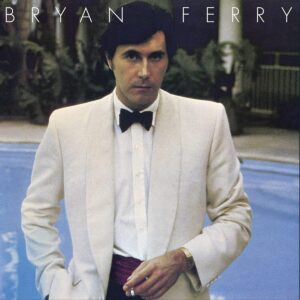
Unfortunately, when Ferry’s selections on this LP don’t work, they really don’t work. Such is the case with a run through of the old crooner’s tune ‘Smoke Gets In Your Eyes’, which has the unfortunate distinction of being the second track on side one, having the effect of derailing the album in record time. One of those love/hate tunes at the best of times, Ferry’s version is not especially good. Despite opening with a flowing piano and harpsichord arrangement, most interest dissipates once Ferry starts to sing. He chooses to approach everything in a fairly traditional way, crooning with intent, while strings swell and a bass and drums mark time. It’s only with an orchestral flourish for a middle eight – closer to ‘Be My Baby’ than anything from the handbook of old standards – and a subsequent change in pace, shifting from retro balladry to buoyant rock pop that things improve. Things improve, yes – John Wetton’s bass playing is taut; the drums are pleasingly high in the mix – but there’s no getting around it all being a massive cheese-fest. Every listen also conjures the same mental imagery of Ferry in full on lounge lizard mode, as depicted on the album’s desperately uncool sleeve.
The album’s best moments are in danger of being cancelled out entirely by a version of ‘You Are My Sunshine’. Already decades old and out of time by 1974, Ferry’s decision to cover this at the peak of glam rock’s coolness seems a particularly obtuse one. With the bulk of the song covered at a snail’s pace and with the mood of a deep south prisoner’s ballad – it’s genuinely depressing. Even the best efforts of Chris Pyne’s desperately sorrowful trombone and a semi-obtrusive sax don’t add anything interesting, while the troupe of backing vocalists – including Vicki Brown – sound half-bored. Covering this old dirge was surely a mistake, but choosing to drag it out to almost seven minutes makes it border on the torturous. It’s so offensively bad that even a maudlin recording of Kris Kristofferson’s ‘Help Me Make It Through The Night’ seems better than it is. In reality, this recording shows Ferry at his most uninspired as he puts in minimum vocal effort across four minutes, while the music blandly recycles bits of every version of the track you’ve ever heard. Quite often, even when Ferry’s covers don’t work, his reasoning behind them is clear, or his band will take something familiar in a new direction. Here, everyone involved just sets the controls to autopilot, as if recording for a post-1974 Rod Stewart elpee and thinking of the paycheck. It’s never terrible, but it’s not at all interesting; had it been recorded during the previous album’s sessions, it might not have made the cut.
Thankfully, at the tail end of a rather up and down forty minutes, ‘Another Time…’ delivers another absolute corker in the shape of the title cut. Perhaps its greatness comes from it not being a reinterpretation of something familiar, but an original piece. Ferry’s first self-penned number outside of Roxy Music, this actually has a lot about it which suggests it could have easily ended up in the pot for their ‘Country Life’, had it not found a home here. Across five minutes, the band are on fire: Ferry opens with a stately piano and higher register vocal that instantly recalls bits of the Roxy debut, before branching off to introduce a full arrangement where a funk bass underscores a taut, glammy groove. As Wetton plays up another storm, angry slide guitars develop future echoes of Roxy’s ‘All I Want Is You’; even the rhythm has moments that threaten to slide into ‘Out of The Blue’, as things progress. During the track’s second half, a slow and moody riff takes over, allowing Ferry to stretch his vocal, while a world of synths underscore an unsettling mood. The song itself isn’t memorable in terms of chorus or other obvious hooks; like the best Roxy stuff at the time, it lurks and twists before eventually making it under the skin, but when it finally gets there, it’ll be a favourite. It’s a dramatic shift from Sam Cooke and Bob Dylan covers, but ultimately essential in both elevating the album’s overall quality levels and finishing it off in a position of strength. Along with ‘Walk A Mile In My Shoes’, it makes it so much easier to forgive ‘Another Time…’s missteps.
Despite sounding too much like a rush-job in terms of song selection – or at least a case of a man striking while the iron is still very hot – and time being a bit less kind, ‘Another Time, Another Place’ was never the most essential Bryan Ferry album, and it’s hard to imagine that revisionist thinking will ever change that. However, it was a success upon release, reaching the top 5 of the UK album chart – actually peaking one place higher than ‘These Foolish Things’. It also scored Ferry two top twenty singles in ‘The In Crowd’ and ‘Smoke Gets In Your Eyes’ (there’s no accounting for taste, as the old saying goes). Decades on, it’s still very much a record for fans only, but between ‘The In Crowd’, the title track and the storming ‘Walk a Mile In My Shoes’, it features a trilogy of cast-iron classics, making it worthy of adding to your Roxy related collection.
February 2020