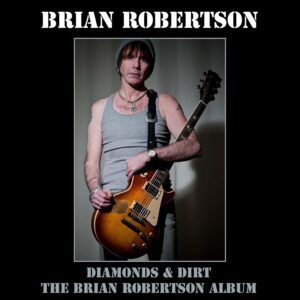
 For the classic rock fan, Brian Robertson is a man who’ll need no introduction. His years serving as one of Thin Lizzy’s guitarists has already earned him legendary status, and his short lived tenure with Motörhead saw him adding his considerable talents to 1983’s ‘Another Perfect Day’, one of the band’s most underrated discs. Then, there’s his own band, Wild Horses, a hard rock powerhouse whose rather scant output has been in danger of being overlooked since the 80s. Thankfully, the Cherry Red label set about getting the Wild Horses recordings back on the radars of keen music fans in 2025 with the help of a lovingly curated six disc set, bringing together the band’s complete output. This wasn’t really in the hope of having a massive seller on their hands – more a case of “public service”, and the same can be said for their 2026 expanded 2CD reissue of Robertson’s sole solo album ‘Diamonds & Dirt’, originally issued in 2011.
‘Diamonds & Dirt’ sometimes tries hard enough to earn the status of being a potentially good record, but it isn’t a classic. It certainly isn’t on the level you’d expect from a man with Robertson’s career highlights. At its best, you’ll discover glimmers of the musician’s past glories; at its worst – and when heard with a more critical ear – some of the material feels a little one paced, and in direct comparison with Robbo’s heyday, it’s somewhat workmanlike. That said, for the more committed Robertson fan, it’s a record that’s still worth hearing, and a few genuine gems make the journey just about worthwhile.
The wah-wah driven ‘Blues Boy’ is a clear standout, as Robbo gets the opportunity to stretch out a little. The main groove is a standard blues, heavy on deep tones, which means it sounds like a thousand other blues-rock jams recorded since the 70s, but it really comes into its own with the help of some solid lead guitar work. Between various vocal phrases, Robertson drops in some very melodic fills, allowing the crying edge of his lead work to do a lot of heavy lifting. The featured solos are similarly confident, sharing a dirty edge throughout, and although the end results are very much of the tried and tested variety, the whole track presents a performer who still summons a little fire when needed. When it comes to featured vocalist Leif Sundin, it’s a slightly different story. The sometime Michael Schenker collaborator has a pleasant and very melodic approach, which means he has nowhere near the kind of grit required for the performance in hand. Overall, it’s a good track, but with a powerhouse vocalist like Glenn Hughes or Paul Rodgers (just to give a couple of examples), it could have been truly great.
Another standout is ‘That’s All!’, a melodic rocker with blues overtones where a clean vocal pushes forth over a semi-acoustic backdrop, before exploding into a chorus where the blues rock gets an extra boost with the help of a melodic metal edge. Here, Robertson sounds like he’s in his element, dropping sizeable solos over a heavy chug. Although this has very little in common, musically, with any of the gigs in the performer’s high profile past, and again, the lead vocals feel a little too polite – and the shinier, female-led backing vocals are horribly out of place and dated – it works well overall, with the rhythm section (featuring Treat’s Nalle Pahlsson and Europe’s Ian Haughland, on bass and drums respectively) providing some solid clout. Although not a cast-iron classic, it’s certainly stronger than about fifty percent of ‘Diamonds’. By following this with the bluesy balladry of ‘Devil In My Soul’ – a number that occasionally sounds like a Tangier overspill – the album actually hits something of a roll, and with Robbo dropping grubby riffs against clean vocals on an effective but simple hook, and Sundin finding more of a soulful voice, everything works rather well in old school melodic rock terms.
For guitar chops ‘Texas Wind’ is also well worth an ear, with Robbo sharing lead guitar work that straddles the gulf between radio friendly 80s blues and melodic metal, driving a pleasingly rocky number where even Sundin’s vocals feel more enthused. Throw in a punchy bass and a descending melody between verses that sounds like something more fitting for an 80s film soundtrack, and the music shares a winning combination. That’s winning combination, 80s style, of course: compared to other rock wares released in 2011, this already sounds like a genuine relic. For those happy to attune a very retro ear, though, it should still provide ‘Diamonds’ with another highlight.
The original album also serves up some interest with the help of a couple of re-workings of old Thin Lizzy numbers. A recording of ‘It’s Only Money’, naturally, still comes with a commanding riff, but while Robbo’s performance is okay, the rest of the band falls short of Lizzy’s greatness. Naturally, a run-of-the-mill vocalist like Sundin is no match for Phil Lynott – and without Lynott’s Irish charm and unique delivery, this just doesn’t feel right somehow. Looking at the recording a little more broadly, it’s treated with respect and it’s still easy to hear how Robertson retains a love for one of ‘Night Life’s rockier tunes. A take on ‘Running Back’ (already one of the weaker numbers from Thin Lizzy’s classic ‘Jailbreak’ LP) settles into a pub-rock sound, ending up sounding a little like The Quireboys, but without any of the clout. Throughout the number, Robertson throws in a few decent slide guitar flourishes, but these are often sidelined in favour of boogie-rock piano moments which don’t quite fit. A second take on ‘Running Back’ fares rather better since it is presented as a swaggering blues, where Robertson’s lead performances are top-notch. His guitar work speaks for itself here, so it’s easier to overlook Sundin’s middling lead vocal or the obligatory female oohs.
Less interesting, the album’s title track weaves a mid-paced groove, with staccato rhythms, and occassionally dropping in a few big chords, but as opposed to delivering a classic seventies sound, the over-riding mood is one of mid/late 80s AOR, delivered decades too late. Still, accepting it for what it is, Sundin’s crying tones hold their own without feeling in any way exceptional, and a bright sounding chorus is solid enough for the style. Overall, this has the air of something that would suit Lou Gramm or Terry Brock far better than Brian Robertson, and had it not sat unloved on a shelf somewhere for decades, it would’ve sounded better still. The funk-rock groove at the heart of ‘Passion’ fares a little better, but musically it’s still nothing out of the ordinary, and as the early 90s style funk moments give way to a lightweight AOR chorus full of female backing harmonies, it all gets really fluffy. As with the title cut, it’s easy to hear that this was written decades before its eventual release, and by the time it reached the fans’ ears in 2011, it feels like any true potential it once had has long since passed, despite being nicely played by all concerned.
At the bottom of this barrel of tunes rescued from the past, a cover of Frankie Miller’s ‘Mail Box’ (from his 1973 album ‘Once In a Blue Moon’) begins with some chunky chords, which it then doesn’t really bother to follow up. Sundin’s vocal comes with a slightly huskier tone, but still none of the power needed; the female vocals flesh things out yet again, and while Robbo’s chords do their best to maintain interest, it’s just not quite enough. A cover of Miller’s ‘Do It Till We Drop’ is similarly uninspired, presenting a sizeable riff, a bluesy lead guitar and a world of predictable blues tinged rock that appears to value bombast over intricacy.
Elsewhere, ’10 Miles To Go On A 9 Mile Road’ (a number written and originally recorded by alt-rock/country musician Jim White) feels completely out of step with the safe rock heard on most of the other songs. While the use of an eastern musical motif or two provides some much needed variety and some of Robbo’s guitar playing more than passes muster, the American drawl on the partly spoken vocal sounds very unnatural. Once again, there’s some 1980s style female backing shoehorned in too… While it’s great that Robertson was brave enough to include this tune among the more predictable rock styles featured on ‘Diamonds and Dirt’, it doesn’t entirely work out for the best.
A cover of Frankie Miller’s ‘Ain’t Got No Money’ finishes off the original LP very well, though this has nothing to do with the predictable blues-rock plodding that’s shared throughout. The magic comes from the god-like Rob Lamothe (the sometime Riverdogs frontman) who steps up for a guest vocal and in doing so provides the number with something genuinely memorable. Rob’s confident tones work well in tandem with Robbo steering what ends up sounding like a 70s bar band with balls, and some smart slide guitar adds enough grit to make everything feel even more authentic. This makes up for ‘Mail Box’, but while it’s admirable that Robertson would choose to include three of his friend Miller’s songs on ‘Diamonds’, you sort of have to wonder if the album would have been improved by the addition of more original material. …But then, if you look at his discography, Robertson was never really “work-oriented”.
When the original ‘Diamonds’ album works, it works well…but four or five decent tunes doesn’t always feel like it’s enough to keep fans returning for repeated listens. Part of the problem here, of course, is that none of this was ever captured with the creation of complete album in mind. It’s actually a collection of ideas and songs which have been pulled together from different sources over a painfully long period and then rehashed at a later date. Despite having years and years worth of unused songs and ideas to draw from (not to mention years to actually write some new ones), ‘Diamonds and Dirt’ actually feels like a contractual rush job, since Robertson hasn’t even managed to put together twelve original compositions.
The 2026 reissue from Cherry Red appends the original album with two bonus tracks. The Robertson penned ‘Linger My Love’ is a ballad with strong country rock overtones. The slow, waltzing rhythm sets up an easy atmosphere in record time, and the blend of strummed acoustic guitars and crying electric leads is very effective. The lead vocal too, has a strong presence with a slightly world-weary tone that’s perfect for such a narrative where its easy to imagine a broken down protagonist looking for redemption. Despite drawing from some tried and tested stock in melodic rock and blues rock terms, this very much plays to Robbo and his band’s strengths, and its a pity it didn’t take pride of place on the original LP, replacing ‘Mail Box’ or the out of step ‘10 Miles’. An alternate take of ‘Blues Boy’ offers some studio chat, a live in the studio sound and a grittier vocal, resulting in something that runs rings around the version that was ultimately chosen, so this is a very welcome addition.
*
Joining the original ‘Diamonds’ is a second disc of recordings dubbed ‘The Brian Robertson Album’. These thirteen (mostly) instrumental cuts are in a very different style and none of them would have fit the flow of the released album at all comfortably. Most importantly, at least eight of these tunes represent the strongest material within this double CD set.
‘Fishers Love Birds’ kicks things off with a tune that works a funk bass, rock toned lead guitars and a pinch of jazz to share something that sounds like a dead ringer for something from an Eric Johnson LP, before ‘Hang ’Em Low’ shifts into something that sounds like a blend of Joe Satriani and Mike Stern. The melody is good, but the harsh sounding drums make everything sound really dated…but not as dated as the synth horns parping through on occasion. These, coupled with an unashamedly 80s sounding production make it impossible to believe that this was “recorded around the same time” as some of ‘Diamonds’, but there’s a retro charm here that just about works.
Resplendent with bluesy leads set over a slow, moody backdrop, ‘Sea View’ could pass as an outtake from Gary Moore’s ‘Wild Frontier’ sessions – especially with its obvious use of programmed drums – and in terms of tone, this is far superior to anything on this release’s first disc. There are moments here where its much clearer that Robertson’s hand is responsible, especially when the melody occasionally sounds like it could slip into Lizzy’s ‘Still In Love With You’, making it an essential listen for fans. Also brilliant, ‘Pillar To Post’ is a shameless Stevie Ray Vaughan knock-off, a swaggering slice of Texan blues that allows for plenty of confident lead guitar work. Although the results are predictable to the point of actually sounding like a demo from the sessions for SRV’s own ‘Couldn’t Stand The Weather’, it’s great to hear Robbo really cutting loose in a way that brings home exactly how flat the flat bits of the original ‘Diamonds’ sound.
In another change of mood, ‘The Edge’ sounds like a sketch for a film score with heavy orchestration present throughout and a dominant synth giving away some eighties origins. Brian doesn’t make any impact until quite a way in, and then, he just drops in a few bluesy fills in the manner of Clapton scoring the Lethal Weapon films. This sounds like demo quality filler, and especially so if compared to a few of this second disc’s stronger cuts. Another soundtrack-like piece, ‘Pilgrims’, works a strident piano and a world (likely synthesized) orchestration to the exclusion of any guitar work at all. It’s hard to imagine any fans listening to this more than once out of curiosity, but luckily, that’s followed by the more interesting ‘Peter’s Pans’, another jazz fusion workout where some fine guitar work nestles between funk bass grooves. Those hoping for a little Lizzy-esque swagger will likely be disappointed, but for the open-minded fan, this will offer a more than decent listen.
Throwing another couple of curveballs, ‘The Art of Poise’ presents huge lead guitar sounds over heavy breakbeats and blasts of synth that call back to The Art of Noise, owing far more to the experimental nature of Jeff Beck than anything from Robbo’s own past, and ‘Can’t Work, Can’t Eat, Can’t Sleep’ taps into an early 90s soul sound that’s as far removed from anything you’re expecting, placing a focus on a vocal that would be at home on a Brand New Heavies cut. Although Brian is present, stylistically speaking, he almost seems surplus here. What this was originally intended for, well, that’s anyone’s guess so many years down a well worn road.
With so much riding on a long overdue return from Robertson, the original ‘Diamonds And Dust’ was always going to feel a tad disappointing, but the vastly expanded double CD version from Cherry Red couples a patchy release with enough bonus materials to make everything feel worthwhile. It would be remiss to suggest ‘Diamonds’ has been elevated to essential status – for that, listeners should go back to Thin Lizzy’s 1974-76 output, the Wild Horses debut from 1980 and Motörhead’s ‘Another Perfect Day’ – but the double disc set now brings together the equivalent of a whole album’s worth of worthy recordings for the more committed fan, and should be even more enjoyable for those into guitar instrumentals with a genuinely retro heart.
April 2026