 When it comes to compilations, the UK rock scene of the late 1960s/early 1970s has been covered extensively – to the point of absolute overkill. It’s easy to feel that this is a part of musical history that no longer needs revisiting, just as many “new” articles on The Beatles, the Stones and Queen now border on being digital landfill. With that in mind, it’s always far more interesting when attentions are turned to overseas acts. Cherry Red’s rather excellent set ‘Living On The Hill’ promised “a Danish underground trip” upon its release in 2020 and subsequently did exactly what it said on the tin, giving the keener rock fan three discs’ worth of genuinely unfamiliar sounds from the North, with Blast Furnace being the compilation’s nearest to a “known” name.
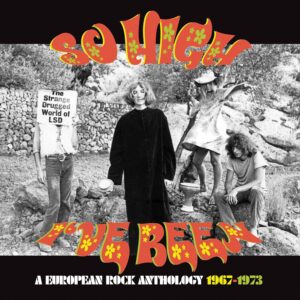
The 2026 release ‘So High I’ve Been: A European Rock Anthology 1967-1973’ makes a great companion to ‘Living On The Hill’. Not always necessarily in its tone, but more in the fact that very little of its material will be known to the UK based rock fan. In fact, there are only a handful of obviously familiar acts featured. Focus and Golden Earring are household names (and their respective 1973 UK hits ‘Sylvia’ and ‘Radar Love’ can be revisited on disc 3), along with Shocking Blue, the Dutch band whose ‘Venus’ became a much-loved hit, and reached a new generation in the 80s with the help of Bananarama. Realising that no-one necessarily needs to hear ‘Venus’ again, they are represented here by the fuzzy, bass led ‘Love Buzz’, a great garage rock jam which was later popularised by Seattle legends Nirvana. Prospective buyers will likely find it a genuine thrill to hear the original cut again – or perhaps for the first time – since the recording showcases Mariska Veres’s haunting vocals against a bendy arrangement that makes for an absolutely enthralling experience that makes the nearest Jefferson Airplane equivalent feel rather frivolous.
Also representing the “known” quotient are Tangerine Dream, although not in any familiar capacity. Years before they broke through and became beloved pioneers of electronica, the band were a dark sounding act, whose debut album ‘Electronic Meditiation’ was full of free form post-psych improvision. Taken from that disc, ‘Ashes To Ashes’ fills four minutes with clattering drums, fuzzy blues guitar work and ugly farfisa organ noises, all of which makes the worst excesses of Pink Floyd’s ‘Ummagumma’ seem rather pedestrian. It’s a track for the merely curious only. ‘Change The World’ from the mighty Gong fares better. Taken from the band’s overlooked ‘Magick Brother’ debut from 1970, the performance works a chopping garage rock riff that’s overlaid by strange, strained string sounds. Musically, it’s a far cry from the jazz and prog laden works on 1973’s classic Angel’s Egg, but even those more casual observers should recognise this as the work of partly the same band due to Daevid Allen’s slightly flat vocal carrying such a distinctive tone. Although Gong would go on to record much better works, this should inspire a few people to go back and revisit ‘Magick Brother’, making the track a worthy inclusion to this set.
Those deeper into prog and experimental sounds will be more than familiar with Faust, but in fairness, ‘It’s A Rainy Day, Sunshine Girl’ isn’t the kind of number that’ll encourage the casual listener to delve any more deeply into their catalogue. The bulk of its seven minutes are taken up with atonal electric guitar strums slapped over an incessant bass drum beat, creating something wilfully ugly, yet strangely suited to the flat vocals that add already outdated psychedelic thoughts to something quite threatening. Steve Davis’s favourites, Magma sound far more interesting on ‘Kobaia is de hundin’, a 1973 cut that finds the German band deep in a world of weird jazz fusion – all tight drumming, atonal brass, busy piano lines – colliding with the kind of neo-operatic vocals, similar to those later found in the ‘Bacchanale’ section of ‘Heaven & Hell’ by Vangelis. It’s deeply unsettling, at least until a coda drops into something a little more attuned with the more “mainstream” prog of the era, but those who manage to find a “way in” are likely to love it, before disappearing down a massive Magma rabbit hole, never to be heard from again.
One of this set’s finest tracks – likely to be a new discovery for many – comes from Norwegian band Oriental Sunshine. ‘Across Your Life’ blends electric sitar and upright bass to create a post-Woodstock, Shocking Blue meets Pentangle vibe which, on a musical level, rarely deviates from its opening riff, but is very strong. It isn’t as strong as Nina Johansen’s lead vocal, however, which adds a sometimes haunting tone that’s just perfect for the music, sounding like a distant relation to ‘Time & A Word’ era Jon Anderson, taking elements of prog and folk rock deeper into the realms of acid folk, while still sharing something that’ll likely still click with the more open minded rock fan. It sounds great from the off, but repeated listens share something that continues to impress, and should send some people in search of Oriental Sunshine’s only LP (‘Dedicated To The Bird We Love’, Philips 1970) which was issued after the band’s rather premature split.
An essential listen, ‘Halcyon Days’ by Tages (a Swedish 7” side from 1968) teases with piano notes in a Beatles mode and a darker melody clearly modelled on ‘I Am The Walrus’ before taking the biggest musical dogleg to introduce light entertainment horns and a melody that’s much closer to schlager. Thankfully, the marriage of the two styles works, and Tages end up with something that sounds like a rather grand variant on the British “toytown pop” sound. An absolutely amazing track. In a completely different vein, Brainbox meld folky flutes, blues vocals and sharp edged guitar on ‘Dark Rose’. Although you couldn’t call the track groundbreaking – unlike the work of Magma, for better or worse – the energy the band summon on this blues rock freakout is impressive, and by the time the flute takes centre stage for a lengthy solo, this shares a common tone with the busier numbers on Jethro Tull’s ‘This Was’ debut from the previous year. That’s soon outshone, though, by some brilliant lead guitar work courtesy of Jan Akkerman who would soon find genuine fame as a member of Focus. [A note for the Focus averse: this contains neither pointless falsetto vocals or yodeling.]
Presenting a little continuity with the aforementioned ‘Living On The Hill’ box set, Danish band Blast Furnace make a very welcome return here. Their 1971 jam ‘Long Distance’ kicks off with a sharp rhythm guitar that tips the hat to The Beatles’ ‘Get Back’ before exploding into an almost funky blues rock workout where a forthright bass powers against swirling organ, and a world of jazz flute and heavy blues guitar are shared with a welcome layer of fuzz. Musically, this is top drawer material – very much the kind of buried treasure that’s long overdue a re-appraisal. When it comes to tight musicianship, Blast Furnace are on a par with the far more celebrated Affinity, and even with a booming vocal that doesn’t quite fit, ‘Long Distance’ brings a genuine thrill, decades after its original release.
Digging deeper, another easy highlight comes from Circus 2000, whose ‘I Am The Witch’ belies a limited recording budget due to its near non-existent drum sound, but makes up for that with some really freaky keys and a pulsing bass. The end result sounds like Shocking Blue jamming in a cave, overseen by an ugly blues guru. Sure, it’s of its time – sounding very much like the death of the 60s – but between a bi-lingual vocal and a great energy, any production limitations can be easy forgiven. There’s a lot of great stuff here, but what this box set probably didn’t need was Group 1850 frightening the bejeebus out of everyone on ‘Mother No Head’, a quasi novelty tune fusing tribal drums, ugly choirs and a bass lead vocal in such a way they could easily be accused of trying far too hard, or Dutch proggers Ekseption hammering their way through ‘Sabre Dance’ at top speed with frighteningly loud keys. Again, this smacks of pure novelty, even though the playing is impressive. [As a sidenote, it’s worth mentioning that keyboard player Rick van der Linden later formed Trace, an impressive prog rock ensemble whose second album ‘Birds’ from 1978 is an overlooked gem, and features Marillion’s Ian Mosley on drums.]
Elsewhere, you’ll find a two-pronged arrangement ‘Answer To Life’ by Blues Section which, in the main, is home to a strong vocal and some great guitar sounds. The bulk of the track shares a slightly reverbed waltz, which played with a bluesy tone fits the Finland-based act’s name appropriately, but things take a twist midway when the band decide to drop into an upbeat melody that owes more to jaunty toytown pop. The lyrics here are anything but jaunty or celebratory, however. Attempting to rip the heart from the love generation, the song’s protagonist brags about hanging out with a gang called “The Vegetable Men” (likely a nod to a known Syd Barrett rarity) who delight in threatening the peace and love crowd and kicking policemen. Its angry stance makes it a genuine oddity for ’67. Taking a more trad approach to crowd pleasing, Dutch band Dragonfly deliver a fiery mod-friendly classic with ‘Celestial Empire’, a track that clings onto the Nederbeat origins of their Beat Five days, but melds the traditional beat elements with a superb fuzz guitar (of the peak 1968 variety, suggesting they’d been inspired by Cream’s ‘Tales of Brave Ulysses’) and a busy organ to give the listener something that still sounds great years later.
There’s also a strong beat group aesthetic cutting through ‘What You Gonna Say’ by Alan Jack Civilisation as well as a strong nod to the British blues boom, but the track goes a little further into psychedelia in places thanks to a wealth of effects applied to the guitar and through busier interludes where Jack’s vocal is in danger of being lost behind the drums. In so many ways, this is derivative of a lot of stuff filling the British underground at the time of release, but the playing is pleasingly tight, and there’s an energy here that should appeal to freakbeat fans everywhere. Those hoping to go deeper into a world of weird are likely to get a bigger kick out of the psychedelic blues rock of Ame Son’s ‘Je veux juste dire’ which pre-empts Focus in the flute stakes, throws everything into clattering rhythms worthy of Nick Mason’s work on ‘A Saucerful of Secrets’ and eventually finds a pleasing balance between the two. An aloof French vocal may also make UK based listeners feel as if they’re experiencing something that’s far more exotic than an obscure psych side from 1970.
Another treat for the Francophile, ‘Je voudrais habitier le soliel’ by Alice blends blues, psychedelia and a hint of proto metal on a prog-ish number that sounds like a weird echo of early Uriah Heep without the annoying falsetto. The familiar, chunky edge to the music creates something that hits right from first listen, and the solid arrangement is impressive enough to make this work even for non-French speakers. Veering off in a folkier direction, ‘Era Inverno’ by Le Orme sounds like a mix of blues tinged Moody Blues fare and a heartfelt rocker from the legendary Steve Hillage which, again, should be a favourite from first listen, even without an English vocal, due to featuring a massive prog wig-out as a centrepiece. It’s certainly the kind of track that makes a deep dive into sets such as this worthwhile.
Sandy Coast (a Dutch act that superceded The Sandy Coast Skiffle Band) have no such interests in exciting listeners discovering them many years down the line. Their ‘Capital Punishment (Death By Hanging)’ is a lengthy folk rock dirge that occasionally drifts into Incredible String Band territory, occasionally sounds like a strange Brian Protheroe narrative piece, and more often than not, meanders in mid tempo with a really dreary vocal. There feels as if light relief in on the horizon when a stabbed piano hints at a weird interlude – as per Thunderclap Newman’s ‘Something In The Air’ – but this ends up underscoring sounds of the advertised hanging! Almost everything about this self indulgent five minute piece is horrible, but luckily The Rippers quickly come to the rescue with ‘The Night At The Lagoon’, a shameless ‘Saucerful’ era Floyd rip off augmented with Moody Blues-esque harmony vocals. It’s one of those times when the end results are so derivative it’s actually impossible not to love the result. It’s also likely that many people will hear this, and then go digging to see if the rest of The Rippers’ material is as enjoyable.
The intro to ‘Rosalind’ by Aunt Mary inititally suggests a mid 70s Quo-like banger, but things quickly slide into something more groove-centric. Armed with a sound that fuses elements of glam with melodic hard rock, the core riffs sound like a mix of ‘Phenomenon’ era UFO colliding with ‘Ziggy’ era Bowie, and across an enjoyable three minutes, this Norwegian band really pack a punch. It may sound a little derivative of a few of the era’s major stars when heard decades on, but the playing is excellent, and the production values – pushing a busy bass to the fore – are even better. It’s likely that many will be hearing this for the first time here, and it’s a genuine gem. Going for a slightly more album-centric audience, the self titled number from Analogy takes elements of ‘Dawn’ by The Nice, a huge ‘Saucerful’ of early Floyd and a nod to drone to create an early prog masterpiece where dark atmospheres and moody organ work reigns and, again, although this is a little derivative, the overriding mood is superb. For those who remain unsold on the potential here by a couple of minutes in, a ghostly female vocal may summon a little more interest, as it’s genuinely interesting to hear something that sounds so, so familiar coupled with an unfamiliar voice in what’s still a male dominated scene. Somewhere near the very end of a very long journey, you’ll uncover a deep cut from Acqua Fragile, whose rather bold ‘Education Story’ throws bluesy electric leads against heavy prog-jazz grooves, finds time for semi-acoustic flourishes, and offsets a dark sound with some great harmonies. On this track, the Italian band occasionally sound like a heavier version of Family, and for those into Euro prog, is a must-hear. Following the band’s split, vocalist Bernardo Lanzetti joined PFM, who are also represented within this collection with the rather excellent ‘PFM’, a particularly busy jam that takes the guts of jazz rock, adds a dose of prog and some almost cheeky melodies to deliver something that, when approached in the right frame of mind, will always sound great, even if it is ultimately “of its time”.
This is one of those compilations that provides a pleasing journey through a very fertile period for the growth of pop and rock. The more patient ear might appreciate this chronologically, charting that growth, and almost approaching the material like a musical education. The experience isn’t always entirely consistent, though: for every couple of uncovered gems, there’s some genuinely ugly stuff lurking, meaning that ‘So High I’ve Been’ is a set that’s actually best cherry-picked. It’ll definitely offer greater entertainment value when dipping in and out, since there is pretty much something here to fit most moods: Be uplifted by Tages! Rock out with Brainbox! Be afraid of Magma!
A little patience is definitely required if you want to get the best out of this collection, but if you already consider yourself a keen buyer of Cherry Red’s compilation sets, this is worth the time and financial investment.
December 2025