THE CROSS – Shove It

cross

In the late 90s and throughout the 00s, Brian May and Roger Taylor seemed intent on squeezing every penny possible out of the name Queen and its branding. Via various hits collections, a lightweight sing-along musical and the despicable Queen + Paul Rodgers album and shows (surely the most expensive tribute/cabaret band ever), the name Queen has been continually dragged through the mud. With the latter, it would have been far less objectionable if they’d opted for a new start and a new band name – although I suspect May Rodgers Taylor wouldn’t have read very well on an album sleeve. Who knows what Freddie would have thought? I suspect he would have loved the idea of the camp musical – he may have even considered doing something similar himself had things turned out differently, but as for the Queen + Paul Rodgers thing, it’s anyone’s guess.

Anyway, all that aside, the original Queen recorded some brilliant music during their near twenty year reign. They had their off days (step forward ‘Hot Space’), but then every great band does. At their seventies best they recorded some of the most wonderfully grandiose music and throughout the eighties, some of their pop tendencies were unsurpassed. Three of the four members even had success with extra-curricular activities – although, rather unsurprisingly, Roger Taylor’s work often gets overlooked.

After a couple of lightweight solo outings – 1981’s ‘Fun In Space’ and 1984’s ‘Strange Frontier’, Taylor formed a pop-rock band, The Cross, featuring Rog on vocals and guitar as opposed to the drums. They would eventually record three albums, although it’s only their first – ‘Shove It’ – which has ever had a proper UK release.

The album’s title track combines the one two hard rock punch of Queen’s ‘Tear It Up’ with the Fairlight keyboard heart of ‘Radio Ga Ga’. While it shows great promise for attention grabbing and is littered with samples of old Queen songs, it is let down by a chanty vocal, a la ‘Guns In The Sky’ by INXS (featured on their ‘Kick’ masterpiece, also released in 1987). For those of you who are either too young to remember or otherwise have somehow blocked it from your memories, this edgy, technologically savvy approach seemed very much the fashion in the late eighties. Similarly ‘Love Lies Bleeding’ almost descends into a slightly cod rap delivery in places. It saves face by employing a brilliant sharply played rhythm guitar but ultimately there’s a feeling that it tries a little too hard.

The album’s lead single ‘Cowboys and Indians’ employs the softer edge of Taylor’s vocal at times, which combined with a very simple but effective rhythm guitar and female backing vocals makes the end result rather pleasing. Chances are you’ll wish Spike Edney would take his synthesized brass noises and parp off somewhere else. Although given the technology of the time it was easier to use synthesized horns than to hire a real brass section, there’s no substitute for the real thing. Also, like so much other stuff from the period, the bass is very low in the mix (as it is throughout most of the album) and it leaves the listener wondering how many of the bass parts aren’t provided by a keyboard somewhere, despite a real bass player being on board (one Peter Noone – not to be confused with the bloke who fronted Herman’s Hermits).

‘Stand Up For Love’ also shows a much better side of The Cross. While the electronic edges are still in place, Roger’s voice is given more clout by the use of female backing vocals in a soul/pop style and an appearance from some real horns. It aims for a punchy soul vibe, but still winds up sounding like 80s rock/pop due to the production sound and general approach. After one listen to the intro of ‘Love On a Tightrope’, you could be forgiven for thinking that it’s going to turn into ‘Radio Ga Ga’ at any given moment; it employs a similar Fairlight keyboard muscle – even going as far as using the same sounds in places (I’m sure with a very knowing wink from Roger). Another edgy, very 1987 guitar part is used here but used too sparingly; nearly all the good elements in this song are drowned by Spike Edney’s heavy handed synths. By the time it gets to a verse featuring lyrics from ‘When You Wish Upon a Star’ you know it’s barrel scraping time…

It shouldn’t work, but the spiky approach of ‘Rough Justice’ is fairly enjoyable – albeit in an eighties way. Roger and lead guitarist Clayton Moss lay down some sharp edges, while Peter Noone’s bass occasionally breaks into a funk slap between the simple rhythms (and it’s nice to actually be able to pick out something which sounds like a real bass here). Another stand out, ‘Contact’ employs a brilliant rhythm based guitar riff and a very mechanical approach all round, and from a songwriting perspective it’s strong also. There’s a clear definition between the verse and a well used pre-chorus; while for the chorus itself, the techy edge gives way to a gentler style of pop, not a million miles away from something Bowie could have offered during his overtly commercial 1983-87 period. The hard sax solo is something the track could have easily done without, though.

The big draw here is the early version of ‘Heaven For Everyone’. The Cross’s original single release featured Taylor on vocals, but for the album version, Freddie Mercury was bought in to perform the lead vocal. Listening to the album version from ‘Shove It’, it’s more than obvious that ‘Made In Heaven is a great song; however, the musical arrangement is in need of embellishment. The guitar work is fine and does the required job, but it’s lacking the grandiosity it deserves, while the drum sound sounds like a man bashing on a biscuit tin and the bass work is almost non existent, aside from occasional touches of not very well played fretless. As expected, Freddie’s vocal is totally professional and despite the music lacking in certain areas, he takes the job in hand and nails it. The version released by Queen in 1995 retains Freddie’s 1987 vocal, while Taylor, May and Deacon offer an arrangement far more suitable – far more Queen. The (unnecessary) spoken intro from The Cross’s recording is done away with and generally (as befits most great Queen arrangements) the music has a confidence – almost effortlessness – about it. Thanks to Queen’s 1995 re-creation, ‘Heaven For Everyone’ became known by all – not just the most die-hard of Queen fans. Although the Queen recording is arguably superior on every level, ‘Heaven For Everyone’ is still one of The Cross’s best songs.

‘Shove It’ is an album which could be best described using the well used phrase “of its time”. If approached as a totally eighties album, there’s not a lot wrong with most of it – and some of it is great at what it does. However, even at its mechanical best, you’ll find very little which comes close to the greatness of the Taylor penned ‘Radio Ga Ga’. Unless you’re a huge Queen fan with time on your hands, if you want no nonsense tunes driven by a Fairlight, it almost goes without saying you’re much better off sticking with your copy of ‘The Works’.

July 2010

TOM ALLALONE & THE 78s – Major Sins pt 1

78s

In February 2010, one of the finest bands of the previous couple of years broke up rather suddenly. Driven by an equal love of Brian Setzer, Elvis Costello and old Phil Spector discs, the 78s were set to bring rock ‘n’ roll music back to the people. The timing was right – after all, other bands like Baddies and the over-rated Vincent Vincent and the Villains were starting to make waves with sometimes similar types of retro cool. The band had even secured a deal with major label Nettwerk, who’d taken a gamble by making Tom Allalone & The 78’s their first UK signings. Sadly, the record company then showed less than no interest and give ‘Major Sins Pt 1’ no promotion whatsoever at its time of release.

Released in May 2009, their album showed a great deal of potential. Taking those aforementioned influences and trademark check shirts, the band deliver the album’s thirteen songs (many thinly veiled with references to their hometown and surrounding areas) with gusto – sure, there are slow numbers, but even those are brimming with self-confidence.

The album’s lead single ‘Hell Hath No Fury’ is a full throttle rock ‘n’ roll belter. A tale of being wronged by women, this track is largely driven by Richard Clarke’s twangy guitar riff and a shouty chorus. Similarly, ‘Gravesend Boys’ is chock-full of r ‘n’ r bluster and is another moment where the no-nonsense Stray Cats influence is at its most obvious. Combined with sexually charged lyrics regarding an unnamed local lass, it’s probably the track on the album I’m most likely to skip; it doesn’t make it bad – it was always an excellent live number – it’s more a case of ‘Hell Hath No Fury’ doing this kind of thing better. For simple, high energy rock ‘n’ roll, ‘The Jitterbug’ – an ode to sex on the dancefloor – is the album’s winner. Si Fawcett’s bass work is confident, Matt Evans’s drumming is suitably aggressive and the guitar riff is cutting. If you want to cut loose and listen to something that’ll make you want to jump up and down, look no further.

Despite the rock ‘n’ roll influences at the heart of the band’s core sound, it’s on a few of the album’s more complex tracks where the 78s really shine. ‘Casillero Del Diablo’ brings a Latin quality (not to mention a really memorable guitar part) and an excellent use of horns. Lyrically, it features some of Tom’s best work as he describes that nighclub where everyone seems to go, but nobody really should, since “the dance floor is a black hole” and the DJ swigs “petrol from an old hip flask”. Opting for a slightly more indie-rock feel and probably the track that’s most accessible to the widest audience (though always retaining their retro cool), ‘I’m Just The DJ’ explores the lonely world of the lonely man who spins the tunes while everyone around him has a good time. He provides the entertainment (in Tom’s world, this is provided while listening to ‘Gloomy Sunday’ on the earphones), but ultimately goes home alone. The album’s second single ‘Crashland’ is a fantastic soul inspired number with energetic use of brass. Trading in fifties rock for a sixties soul vibe is inspired and the band sounds equally comfortable here. The arrangement is faultless (this sounds like hype, but I honestly think it’s that good) and it features one of Tom’s greatest vocals. In short, it should have been a hit.

‘Wounded’ is another story of loneliness; this time it’s loneliness caused by a painful break-up. Musically, it’s one of the album’s simpler numbers, showing a big Chris Isaak style influence. Once again, it’s Tom’s knack with lyrics which makes it stand up. Lyrically, ‘Dogshit Street’ is Tom’s greatest achievement. Set to a gentle musical arrangement which makes great use of piano and slide guitar, this tells the heartbreaking tale of a girl subjected to a terrible upbringing, who in turn gives her kids a similar life (“Roach butts and roaches lie at your kids feet/You won’t change/ “You race home from Dover with goods you hand over to kids/A small girl that is sober is hard to win over”). When I first heard it, there was something in its frankness and downbeat nature which reminded me of Eels; musically, too, there’s a smidgeon of Mark Oliver Everett in there, though that’s most likely due to the piano and bells.

‘Sign On You Lazy Diamond’ provides another musical and lyrical high point. Its chorus is one of the album’s most memorable, while the story within regards a pushy mother and her insistence our protagonist should sign on and look for real work instead of looking at music for a career. But, as he says, “someday I’m gonna be somebody and prove that woman wrong”. The track is structured around a superb walking bassline from Si Fawcett and sharp rhythm guitar parts. It’s as good as anything you’ll ever hear in this style. ‘This Teenage Crush’ is an epic number with a strong Phil Spector vibe which evokes the sound of those classic girl bands and fifties doo wop. The rhythm section is used sparingly; the dramatic build up is provided by well arranged strings and an increased volume from the vocals and guitars until eventually the strings all but take over in this wall of sound.

Since the album lacked promotion, it seemed to be only the band’s die-hard followers and those who saw Tom and co supporting The Stereophonics or Imelda May (a tour the band got kicked off of for being too good) who took notice to any great level. Their future should have been so much brighter – and listening to the demos for the unfinished second album, the 78s sounded more confident in their approach than ever.

There’s something altogether familiar about the sole Tom Allalone & The 78s LP, ’the music has a timeless quality, largely due to their classic influences, but more than that, Tom’s lyrical ability and the band’s tendency to throw different influences into the mix makes great listening. Track down a copy of this album – you won’t regret it. Since it wasn’t a great hit at the time, it may eventually become a cult classic.

See the video for ‘Crashland’ here.
See an acoustic version of ‘Who’s Gonna Kiss Me at Midnight’ here.

June 2010

SIMPLE MINDS – Real To Real Cacophony

real

Released in 1979, Simple Minds’ debut album ‘Life In A Day’ was a largely unremarkable affair. Mostly made up of post-punk/new wave material (played by what sounds like a pub band), the only things which ever remain totally memorable are its two singles – the title track and ‘Chelsea Girl’.  Few people could have predicted that the band’s second album, ‘Real To Real Cacophony’ (released only seven months later) would feature an almost complete stylistic change. Gone are the straight ahead, pop-rock styled chorus songs. In their place, a collection of twisted art rock gems.

The spiky ‘Naked Eye’ weaves around a funky bass part from Derek Forbes and a slightly unhinged vocal; both this and ‘Citizen (Dance of Youth)’ show Wire influences. There’s a dark feeling at work during ‘Citizen’ which reminds me of Wire material (from ‘Chairs Missing’, particularly) meeting with a more lightweight offering from The Birthday Party. ‘Premonition’ creates a nice contrast, being one of the album’s more accessible tracks – stylistically, still a long way from the debut album, there’s an obvious early Roxy Music influence and here, seems to be where Jim Kerr is in strongest voice. In fact, it’s one of the only tracks where he’s recognisable as the Jim Kerr most people would know. Also more song-based is the album’s only single ‘Changeling’. It’s been said elsewhere that this track is weak. To be fair, it’s not weak – it just feels a little out of place here amongst the darker, arty stuff. Maybe the band had been told they needed a single and this was thrown in at the last minute; or maybe it was written before the sessions took a dramatic, experimental slant? I don’t know.

That said, ‘Calling Your Name’ could never be called experimental either. A bouncy new wave tune, this mightn’t have been out of place on XTC’s ‘Go2’, or ‘Drums and Wires’. John Leckie’s production is sharp and the band is in good shape, but generally speaking, it fits rather more into the ‘fun’ category. With it’s almost slow ska rhythms and carny-influenced keyboards, the obviously titled ‘Carnival (Shelter In A Suitcase)’ [It’s entirely possible ‘Carnival’ was its working title due to that keyboard riff], is in good company with ‘Calling…’, but even this slightly more commercial sounding material bares little in common with the Simple Minds with which most people are familiar.

The online music bible AMG claims that ‘Real To Real Cacophony’ wanders into directionless territory in the middle, but such claims are pretty wide of the mark. ‘Cacophony’ and ‘Veldt’ appear wilfully arty for the sake of it on the surface, but like the aptly named ‘Film Theme’ near the album’s end, these songs are wonderful, Eno-esque soundscapes and show a real appreciation for art rock. Charlie Burchill’s guitar work on the soundscape style tracks ranges from under-stated, to sharp and discordant. His guitar never feels out of place, despite most of the album sounding like an experiment in late seventies electronica. It should be noted, though, that while the various Roxy/Eno/Bowie and Wire influences over parts of the album are more than obvious, absolutely none of it sounds plagiarized. Each influence has been given a new slant, making ‘Real To Real Cacophony’ a captivating listen.

Although the album doesn’t feel traditionally coherent, there’s something about this ragbag of misfit songs which feels right when played as a whole. It’s dark, often challenging and sometimes even difficult listening. If you’re a casual fan looking for stadium pop hits, there’s nothing for you here. As far as Simple Minds are concerned, sometimes ‘Real To Real Cacophony’ sounds like their best record.

[The 2003 remastered version was erroneously retitled ‘Reel To Real Cacophony’]

January 2010

Posted in pop

THE POSTMARKS – Memoirs At The End Of The World

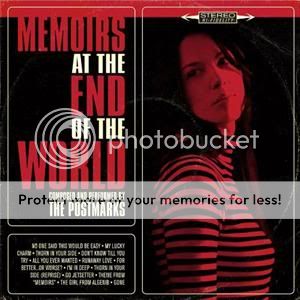
I was introduced to this album by The Postmarks by my friend Walt, a lover of Squeeze and kitschy sci-fi television.  Since we share so many tastes I had to check it out, even though the Belle and Sebastian-esque monochrome sleeve art sent alarm bells ringing.  My dislike of Belle and Sebastian (aside from the odd song) is well known amongst my internet chums, so I figured Walt would be unlikely to recommend my listening to something which would be too much like them.

There are a couple of twee moments which I imagine may appeal to Belle and Sebastian’s many devoted followers, but that doesn’t really mean The Postmarks share much in common with them.  The Manhattan based outfit have a degree of twee and kitsch values, but the majority of their music is borne from lush soundscapes evoking sixties film music, particularly that of John Barry.  This third outing sees Postmarks regulars Tim Yehezkely (vocals), Jonathan Wilkins (drums) and Christopher Moll (guitar) augmented by Brian Hill (bass) and Jeff Wagner (keys).

Despite the strong sixties feel, there’s something more modern, circa 1990s, in The Postmarks’ sound. Maybe it’s the Saint Etienne style pop element. Like Saint Etienne, with The Postmarks, plenty of sixties pop influences are present – and maybe even more so, since The Postmarks’ sound never employs any of the nineties dance-pop vibes which made Saint Etienne so difficult to pigeonhole.  It’s hard to say which of The Postmarks’ musical elements hold the key to their retro themed style.  The cinematic arrangements are vital, yet Yehezkely’s wistful voice – often more tuneful than Sarah Cracknell, but never as sultry as Beth Gibbons on Portishead’s ‘Dummy’ – is charming and perfect for the sound The Postmarks set out to achieve.

‘No One Said This Would Be Easy’ begins the album with an almost perfect snapshot of The Postmarks’ typical sound: lush strings come in waves; the guitars and keys add more depth and the sound of castanets adds a touch of extra drama.  Tim Yehezkely’s vocals could easy get lost if the music were overplayed; however, despite the overblown nature of the arrangement, somehow the music and light vocal manage to create a natural sounding union.  Staccato piano and a bouncing beat are at the centre of ‘My Lucky Charm’ which is closer to straight ahead pop.  A multi-tracked vocal is used to good effect and an infectious, upbeat chorus makes decent (but light) use of a sixties horn arrangement.

‘All You Ever Wanted’ provides another standout track.  The verses concentrate on woozy eastern drones combined with acoustic guitar – and you could be forgiven for thinking it’s not really going anywhere.  Then the chorus kicks in.  While it’s not instantly singalong, it’s a chorus with a more upbeat quality and the horn sounds give it a totally feel-good vibe.  ‘For Better…For Worse’ breaks continuity with most of the album, since its kitsch sixties elements are pushed aside completely.  This track is almost pure nineties pop – and while I’m not keen to mention Saint Etienne again for fear of labouring a point, they tend to be one of the bands (if not the band) huge chunks of this album’s sound recalls the most. (Walt had said it was like having Sarah Cracknell arranged by John Barry and if you’re looking for The Postmarks’ essence diluted to one sentence, that’d be it.)
In contrast to ‘For Better…For Worse’, ‘I’m In Deep’ is very gentle which allows the listener to slowly drown in its arrangement and the hushed vocals call to mind the softer work of the New York trio Ivy (a band with a strong connection to The Postmarks; The Postmarks were discovered by Ivy’s Andy Chase, who signed them to his Unfiltered Records label).

‘Go Jetsetter’ goes for broke in the pop stakes with its sixties soul beat driving the melody while Tim’s vocals add a summery air; the addition of brass sounds here help to reinforce the retro feel.  While it could do with a more memorable chorus, the other elements are strong enough to make this an almost perfect example of the kind of pop The Postmarks produce during their more upbeat moments.  In contrast, ‘Theme From “Memoirs”’ does exactly what it says on the tin – the sound of a film-less film theme. It’s an almost James Bond pastiche – imagine a cross between classic John Barry and Gene Pitney’s ‘Town Without Pity’; the twanging reverb of the guitars are complimented with string sounds and a breathy wordless vocal. ‘Si Tu Vieux Mon Couer’ represents the only time the album really misfires; the bigger elements of The Postmarks’ sound are played right down, the French vocal is just that little bit too twee and the whole thing comes off like mid-60’s cult singer songwriter Margo Guryan but without any real charm.

The album closes with a couple of reprises: Firstly, ‘Go Jetsetter’ appears in a more eighties guise.  With a bigger punch and stripped of most of the usual Postmarks sound, it ends up a sort of Cars/Black Box Recorder hybrid.  This harder edged arrangement allows a greater look at the pop songcraft which lies at the heart of the band’s work.  Closing the album, ‘My Lucky Charm’ (which appeared near the beginning with an upbeat arrangement) makes a second appearance, slowed right down to a chill-out vibe.  While this second look isn’t as good as it’s upbeat counterpart, on its own merits it holds up as a decent track – it’s best element being the sparingly used brass sound.

‘Memoirs at the End of The World’ is an album which is mostly pleasing and seems instantly familiar.  Since the musical arrangements have the feeling of John Barry and touches of Burt Bacharach for a postmodern generation, you’d be forgiven that the cracks could show before long, but thankfully, its cinematic approach provides just enough depth to stop it becoming too saccharine.

May 2010

Posted in pop

THE BIRD AND THE BEE – Interpreting The Masters Volume 1

Signed to the Metro Blue imprint of the legendary Blue Note label, The Bird And The Bee is a electronic pop duo comprising of Greg Kurstin and Inara George (daughter of Little Feat legend Lowell George).

The first couple of albums by the duo are fine as far as electronic based pop is concerned, but every once in a while, something comes along which you’re not expecting. Such is the case with The Bird And The Bee’s third release, ‘Interpreting The Masters, Vol. 1: A Tribute to Daryl Hall and John Oates’. It doesn’t really need to be said, but for years now Hall and Oates have been considered very uncool and it’s possible that, had any other electronic duo tackled this, it’d be with “ironic” smiles on their faces. However, given Inara’s parentage, there’s a fair chance this is done with a love of the original tunes – it’s even likely her father knew the velvety voiced one and his moustachioed companion. The end result is a mixed bag, but often interesting listening for those with more than a passing interest in Hall & Oates. There are a few excellent covers here, alongside some okay ones and, thankfully, nothing comes out terribly.

Firstly, why they bothered covering ‘Maneater’ and ‘I Can’t Go For That’ is the biggest mystery surrounding this release. The Bird & The Bee are a talented pair and it’s probable they could have put more of their own stamp on this pair of eighties tunes.  However, they choose to play things as straight as they can: ‘Maneater’, in particular, even sounds like it’s been created from the same drum loop… Inara’s voice is fine, but aside from a couple of interesting keyboard sounds, compared to some of the other stuff featured on this release, this is very workmanlike, despite a cameo vocal from Garbage’s Shirley Manson. Similarly, ‘I Can’t Go For That’ utilises a few unnecessarily harsh keyboard sounds as well as a few fills borrowed from 80s soul-pop. While Inara’s voice here is enjoyable, there’s something uninventive about the end result.‘Kiss On My List’ is a little better – that’s mainly due, once again, to Inara George’s performance. This is a decent cover, even though the stabbing keyboards which drive the original are completely absent and the closing guitar part has been replaced with a really nasty keyboard solo.

The best of the bunch here are the takes on the 70s Hall and Oates material, and arguably being better songs from the outset, so too are The Bird & The Bee’s take on them. The electronic nature of The Bird And The Bee’s music means that a couple of these have been given a proper re-imagining. ‘Sara Smile’ features Inara at her vocal best, a smooth voice which really pulls in the listener. Musically, the drum beat gives the song a good amount of depth, but never quite drops into full trip-hop mode. The classic ‘Rich Girl’ begins with noises which sound like they’re created for a children’s song, while the main thrust comes from a pre-programmed loop which is pure Casiotone. The hand-claps are a little unnecessary and some of the arrangement could’ve been a little more subtle, but somehow it has more than enough charm to make you forgive any shortcomings. Their version of ‘She’s Gone’ could well be one of the most perfect examples of electronic pop ever. Fantastic multilayered vocals are used against a well-crafted loop (I can even ignore the Casio samba elements); the bass sounds add a decent amount of bottom end despite not being very natural sounding. Granted, they had a belter of a song to work with, but this, alongside ‘Sara Smile’ could be reason enough to give this a listen.

The version of ‘One On One’ improves upon the original (if you’re a Hall and Oates fan yourself, you’ll understand this isn’t a claim to be made lightly). The version here is still a slow-burning, soulful affair, but this arrangement actually beats the drum programming from the original. It’s still all programmed, but most importantly, they’ve done away with that horrible Casio samba (they obviously realised having used one for ‘She’s Gone’, using another would have been extravagantly bad taste). The music concentrates on sporadically used chords against a heavily reverbed drum sound. During the instrumental breaks, the lead also employs some harder electronic treatments. Also, Inara’s voice is well suited to the song (far be it to suggest Daryl and John weren’t, there’s just something about ‘One On One’ which sounds like a weak link compared to most of their ‘H2O’ album).

This release also features one original composition: a single release, ‘Heard It On The Radio’ is supposedly designed to fit the mood of the rest of the disc and conjure an AM radio mood. It’s fairly successful in its attempt. While the verses have a slightly funky dance/pop vibe, slightly Moloko-esque, the guitars during the chorus are reminiscent of Rick Springfield and that style of feel-good 80s pop/rock – and this track more than makes up for a couple of the Hall and Oates numbers not quite hitting the spot.

If you liked The Bird and The Bee previously, their take on a selection of Hall and Oates’s tunes should leave you smiling. There’s something about this release which feels as if it were made for iPods and summer days; and for the rest of the year, file it under “quirky and fun”. However, it’s entirely possible that most Hall and Oates fans are not going to be very tolerant of this kind of meddling.

April 2010

Posted in pop