 In 1983, ‘Labour of Love’ scored UB40 their first number one album. While some of the band’s earliest supporters have poured scorn on the release and derided it for being lightweight, the well-chosen selection of covers earned the band an even bigger fan base. A further shift towards a smart blend of pop and reggae, along with the increased used of drum machines, gave UB40 another hit album with ‘Geffery Morgan’[sic] the following year, with its best known single ‘If It Happens Again’ scoring the band a top ten hit.
Then came a huge curve-ball: 1985’s ‘Bagariddim’ featured familiar backing tracks coupled with guest vocalists and toasters – including cult reggae man Dillinger and the then largely unknown Pato Banton. In term of heavy reggae, UB40 had never gone deeper. As well as giving cult recording artists an opportunity to be heard by a larger audience, the record could easily be seen as a giant two-finger salute to those who thought the UB’s had no real reggae credentials. Boosted by a simultaneous hit cover of ‘I Got You Babe’ with Chrissie Hynde, the album was another success, despite being their least accessible of the decade.
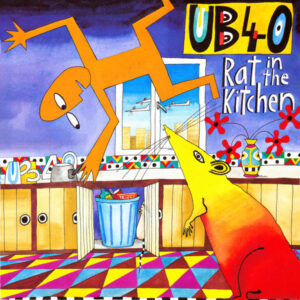
UB40’s assault on the British singles and album charts continued, and in the summer of 1986, they unleashed their eighth studio album, ‘Rat In The Kitchen’, a collection of very enjoyable material. Lead track ‘All I Want To Do’ (a relative flop single for UB40 reaching #41 on the UK chart) begins the release with a similar reggae-pop slant to that explored on ‘Geffery Morgan’. Throughout, drummer Jim Brown’s contributions are programmed – in keeping not only the rest of his work for the rest of the decade, but also the sound of commercial reggae as a whole for the second half of the 80s and beyond – but the beats are steady enough and are perfect for the contemporary sound sought by the band at that time. From this measured beat, the rest of the band spring into life: Earl Falconer’s bass line takes the bulk of the work, but much like the drums, there’s a mechanical quality to the bottom end, as if the record work is programmed. To counterbalance this, the vocals are sprightly – a multi-tracked Ali Campbell’s distinct tones being particularly welcoming, while the horn section – comprising Brian Travers on sax and Astro on trumpet – sound particularly sparky, their sharp edge providing a key musical hook. In terms of subject matter – the common feeling of not wanting to slave at the workplace – was handled in a more direct and arguably superior fashion on the band’s 1982 single ‘So Here I Am’, but even so, as a piece of pop influenced reggae, this acts as a fine enough opener.
Taking things down a notch, ‘You Could Meet Somebody’ is a universal tale of wanting and seeking a partner. While it could be viewed as lyrically trite on the surface, as the tale progresses, there’s a slightly darker overtone once the song starts to question whether the long sought relationship is the thing you wanted after all. Musically speaking, it’s an early highlight for the LP, a warm and heartfelt tribute to similar classic works from the 70s – tunes by The Melodians and their ilk from the Trojan stable – and in this case, this number, although self-penned, is a fine companion to the material on ‘Labour of Love’. Like ‘All I Want To Do’, it places the band in a strong musical position; Mickey Virtue’s synths lay a hefty rhythm, punctuated by synth drums. A gentle and distinctive melody (sounding as if play on a melodica) is the province of Mr. Travers, also responsible for a great brass arrangement on the chorus. As good as all of this is, it’s the harmony vocals shared between the Campbell brothers – and the increased focus on Robin’s often undervalued voice lurking in the back – that makes everything shine. Then, handing the microphone to resident toaster Astro, ‘Tell It Like It Is’ is a very upbeat affair musically, at odds with a pointed lyric, with our vocal hero, indeed, telling it like he sees it. A steady bassline from Earl Falconer is lifted by the solid percussion accompaniment from Norman Hassan throughout, leading to one of the album’s most infectious and danceable tunes. Despite the bouncy style, the lyrics deal with aspects of 80s culture and things rooted in British infrastructure of that moment, and Astro rallies against police heavy-handedness and the lies spewed by politicians on the television (pointing out he has “paid money for the licence fee”) amongst other things.While on the surface it might not seem as deep as the earlier ‘Don’t Let It Pass You By’, or as angry as the classic anti-Tory rant ‘You’re Not An Army’, it shows UB40 hadn’t completely lost their narrative chops in favour of ‘Red Red Wine’ and ‘Many Rivers To Cross’ even though those covers broke them to a wider – arguably less discerning – audience.
The next pair of tunes really up the ante and between them ensures ‘Rat In The Kitchen’ reaches classic status. Bringing the pace right down, ‘The Elevator’ weaves a classic 70s reggae bassline around a few shiny sounding, very 80s vocals. While the two styles seem at odds, this juxtaposition works, eventually once an incredibly assured call and response vocal courtesy of Ali and Robin takes the reins. It’s certainly one of the album’s meatier arrangements, and even though the metaphor of an elevator representing the movement of time may appear a bit clunky, the lyric reminds us of the need to grab opportunities. With a sprightly brass and surprisingly soulful vocal providing a strong heart, the classic style of ‘Watchdogs’ harks back to the influences that bought ‘Labour of Love’ to life, while still finding room for a lyric about big brother watching us, government eyes and an ominous feeling that we’re being guided by the powers that be at all times. Reaching just #39 on the UK album charts, ‘Watchdogs’ remains one of the most overlooked UB40 singles of the decade – a pity, since in terms of tune and strong vocal melody, it’s one of their finest offerings, sounding better with each passing year.
Dismissed by some as a stupid pop-reggae tune about rodent infestation, the album’s centrepiece ‘Rat In Mi Kitchen’ – a UK top twenty hit (narrowly missing out on a place in the top ten) — is wonderfully biting. Indeed, the title allegedly came from Astro during a domestic incident, but those with a cynical political eye may choose to observe a darker tone within the lyric. The rat, in this case, rumoured by some to be Margaret Thatcher and her ugly government stance, and while never totally confirmed as such, lines like “when you open your mouth you don’t talk you shout / and give everybody the blame” only helps fuel such theories further. Particularly so if we take the use of the word blame into consideration at the time of the song’s writing. Musically, things are tight throughout – a bouncing rhythm makes the lyric more accessible, Astro’s jubilant whoahs are really uplifting, while again, strong brass holds it all together. The brassy element becomes ever more important with regard to the extended album cut which includes a lengthy instrumental second half, helmed by guest trumpeter Mr. Herb Alpert – the jazz legend is a seemingly unlikely guest here – blowing some pretty mean and sharp notes. Despite what some of the detractors would have you believe, these six minutes are among the finest from UB40’s later 80s output, with a superb arrangement lifting one of the most enjoyable vocals to even bigger heights.
‘Looking Down At My Reflection’ brings a gentler mood and showcases a vocal by Norman Hassan, in turn joined by strong backing vocals courstesy of Mo Birch, Jaki Graham and Ruby Turner. In terms of arrangement, this number is totally owned by the brass section, throwing out strong riffs throughout, their hard sound complimenting Falconer’s punchy bassline. While the huge presence by the backing vocal trio lends this piece a strong plastic soul element, digging deeper, the lyric is typically thoughtful. Here, the protagonist looks in a puddle and at first everything appears as he wants it to appear, but closer inspection of his warped reflection shows not only himself but his place within the injustices of the global system; the evil men of big business, the widespread poverty, and the metaphorical thundercloud that hovers over the world. He doesn’t actually offer any solutions, but the message is clear: change starts with the individual. Taking everything into consideration – the lyric, the tune and the vocal – this is one of ‘Rat’s most underrated tracks, and it’s also one of Hassan’s best. Meanwhile, ‘Don’t Blame Me’ in many ways, is 80s UB40 by numbers. This tale of wanting to better oneself shares a harder rhythmic edge than the bulk of the album’s material; the programmed drums and hard keyboard sounds appear a little dated, but looking past that, the vocals are top notch, again capturing the Campbell brothers in great harmony. While this is arguably the album’s weakest offering, that itself is testament to the high quality of the rest of this long-player.
Closing the album is the release’s biggest hit and most pointed political message. Commenting on the state of South Africa in the mid-80s, ‘Sing Our Own Song’ – a UK top 5 hit – features a very distinctive brass and keyboard riff, one which carries the weight of the tune. In contrast to ‘Don’t Blame Me’, Jim Brown’s mechanised drums really suit the arrangement, their beats marking time against another buoyant bass part from Falconer. As with at least half of this record, it’s a case of a piece that shares a good tune but delivers an even greater lyric, with Ali taking the lead in this cry for freedom. As with ‘The Elevator’, the guest backing singers play a key role, here a gospel-influenced cry on the chorus before the extended playout carries the message Amandla Awethu (“power to the people!”). Alongside The Special AKA’s ‘Nelson Mandela’ from a few years previously, this remains one of the finest protest songs concerning the issues within South Africa. Even UB40’s harshest critics surely couldn’t argue against this being a huge step above most of the disposible pop filling the chart at the time of release. Unsurprisingly, this track received an instant ban in South Africa but went on to become a fan favourite. [A flawless performance of the track, featuring guest vocals from Chrissie Hynde, Lenny Henry and Richard Gere, provided a high point of the Nelson Mandela birthday celebrations at London’s Wembley Stadium in the summer of 1988.]
Although commercial, ‘Rat In The Kitchen’ is easily the most consistent of UB40’s albums released after 1981. Although having much less of the youthful anger and arrogance of 1981’s ‘Present Arms’, its mix of accessible music and thoughtful lyrics – politically charged or otherwise – results in one of the band’s most pleasurable listens. Unlike a few of the previous outings, there’s no instrumental filler, while the politics, although intermittent, are still plentiful for those who choose to hear the messages within. Several decades after its initial release, the production may sound a little thin, the drum machines very much a product of their environment, but the melodies and lyrics still stand proud as a timely reminder of why UB40 were one of the decade’s most important bands.
December 2013/April-May 2015