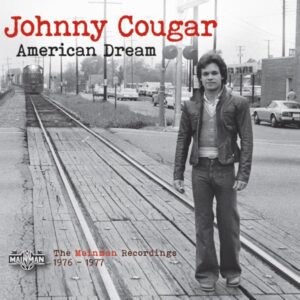
 As far as many people in the UK are concerned, John Mellencamp burst onto the music scene in 1982 with his radio hit ‘Jack & Diane’, but by the time that was loved by the masses and its parent album ‘American Fool’ was a success on both sides of the Atlantic, Bloomington’s most famous export had been building a career for several years. Previous albums ‘John Cougar’ (1979) and ‘Nothing Matters & What If It Did’ had seen some success stateside, but Mellencamp’s musical roots actually stretch back even further. In the mid 70s, he signed with the management company Mainman (a company who had David Bowie and Mick Ronson on their books) and recorded three albums’ worth of material in a very short period that, over the years, has been somewhat overlooked.
The two disc compilation from Cherry Red Records, ‘American Dream – The Mainman Years 1976-77’ seeks to redress the balance; to shine a light on the singer-songwriter’s earliest recordings, and create a package that feels complete; a collection that feels worthy of being more than an afterthought in the Mellencamp legacy. To call it “comprehensive” would certainly be an understatement.
Responsible for renaming John Mellencamp “Johnny Cougar” (a name they felt would aim to an all-American record buyer, and one that conjured excitement), Mainman branded the young musician as someone they felt would rival Bruce Springsteen – a man on his way to legendary status, having scored massive success in 1975 with ‘Born To Run’. Despite Mellencamp’s dislike of being promoted like a product manufactured by the record company, their goal wasn’t necessarily misjudged, as tunes like ‘American Dream’ ‘Dream Killing Town’ and ‘Chestnut Street’ – highlights from ‘Chestnut Street Incident’ (released in 1976) – more than demonstrate. Each of these blue collar, narrative pieces certainly share some strong DNA with the New Jersey hero. Although by 1976 Springsteen had far more of a focus, the best bits of ‘Chestnut Street Incident’ definitely set Mellencamp in place as a rough diamond; a talent that keen music fans should listen out for.
In fact, as debuts go, ‘Chestnut Street’, is far from perfect, but when the material hits, it’s actually really enjoyable. ‘American Dream’ leads everything off with a rocky number where chopping guitars and grumbling basslines owe more to The Bob Seger System than peak 80s Mellencamp, but the collision of bass and guitar sets a classic 70s sound in place that really suits a very familiar vocal. The storytelling aspect of Mellencamp’s later work is already in place too, and the way the melody rises and falls is very Springsteen-esque, providing something that Mainman very clearly hoped for. Better yet, ‘Dream Killing Town’ introduces a jaunty piano line and bass tone that work brilliantly in tandem from the off, and John finds space within a great melody for a wordy narrative covering the disappointment of growing up in a small town that’ll never let you reach full potential. Lyrically, it mightn’t have the sophistication of his ‘Uh-Huh’ and ‘Scarecrow’ era material, but the seeds of classic Mellencamp are certainly sown on this recording. A reedy sax makes this seem like even more of a shameless Springsteen pastiche – even though Wayne Hall is certainly no match for the mighty Clarence Clemons – but, overall, it’s definitely the kind of track that Mellencamp fans will enjoy.
The title cut is a lot more sophisticated, showcasing John in piano ballad mode. Sweeping lines from pianist Michael Kamen set a timeless melody in place, and when joined by sad violin and mandolin adding a genuine musical colour, it really shows what the young singer-songwriter is already capable of. Lyrics concerning feeling worn down by the world of work and having a master plan to take the wife and kids somewhere better sound like they come from the broken spirit of someone way beyond Mellencamp’s age at the time, the way he steers the vocal melody from sadness to pure anguish is absolutely perfect. As if uncovering an early Springsteen album cut sang by someone without a speech impediment, this captures the mournful side of America’s heartland almost perfectly. If you need just one reason to own ‘Chestnut Street Incident’, it’s right here. [A full electric ‘rock’ version performed with some great guitar work, titled ‘Chestnut Street Revisited’, appears somewhere near the end of the original LP. It’s testament to such a great song that this doesn’t feel like filler.]
Elsewhere, ‘Sad Lady’ returns to balladeer mode on a waltzing arrangement that’s less effective, even though the union between Mellencamp’s strong vocal and Kamen’s flowing piano feels very natural. The fact that ‘Chestnut Street’ is so perfect has the unfortunate effect of making this seem weaker, but heard as a stand-alone cut, it’s still one of the album’s strongest. ‘Super Girl’, on the other hand, provides a genuine skipper when a choppy guitar riff is adorned with some very 70s lyrics that appear to objectify teenagers. Aside from some dodgy lyrics, the arrangement is also flawed: a world of chatter supplied by guesting female voices appears to try and push something grubby into a realms of frivolous. Heard with a twenty first century ear, it just doesn’t work. Thankfully a mix of Thin Lizzy-esque twin leads, a little bluesy lead guitar and a stomping quality not far removed from an enthused Rick Derringer makes the rocky ‘Good Girls’ a much better proposition. Against the punchy arrangement, Mellencamp reaches inside himself for a full bodied vocal performance, and propping up the track, a fiery lead guitar break highlights the great musicians present at the album sessions [including Sparks drummer Hilly Michaels, Dylan sideman David Mansfield, and the legendary Mick Ronson, who obviously had his own personal ties with Mainman.]
The fact that this debut album is reliant on a handful of cover tunes to flesh it out (four covers is at least two too many on an eleven track LP), suggests Mainman ushered the young Mellencamp into the studio a little too prematurely, but for better or worse, the singer approaches each of these with gusto, even though none feel like an entirely natural fit. Roy Orbison’s ‘Oh Pretty Woman’ offers a great vocal take and a pleasingly retro guitar tone, and even though it feels a lot like album filler, it’s still preferable to Van Halen’s mauling of the track a few years later. A genuinely left-field choice, The Doors’ ‘Twentieth Century Fox’ boasts a strange arrangement that mixes light psych with garage rock chops which owes little to the original cut, whilst featuring a rather ill-at-ease sounding John. It’s likely to only work for those who are approaching the track cold, with no knowledge of Jim Morrison, and even then, it’s likely to play rather oddly when nestled next to this record’s self-penned blue collar pop rockers.
A cover of ‘Jailhouse Rock’ is spirited, and certainly driven by a half decent band, but naturally, not necessarily what you want from John Mellencamp. It sort of goes without saying that’s not a par on the Elvis original either in tone or in terms of delivering sheer excitement, but it still beats Motley Crue’s foolhardy stab at the number in the 80s. A rendition of The Lovin’ Spoonful’s ‘Do You Believe In Magic’ works so much better. Retooled from a dreamy 60s pop arrangement, the track takes on a 70s swagger, complete with guitar tone that fits with the rest of ‘Chestnut Street’. John approaches the music with an equally big vocal and, unlike the other covers, he actually sounds like he believes this one works for him. In many ways, it should have been the album’s only concession to other people’s material.
If Mellencamp had only managed to bring a couple more self-penned numbers to the sessions, ‘Chestnut Street Incident’ would have been a much stronger album. As it stands, there’s enough good material to make it an interesting (if a little naive) first effort. The record buying public were unconvinced, however, and the release was a flop, but since the 70s allowed a certain amount of leeway with unsuccessful artists, Mainman sent John back into the studio almost immediately to record a follow up. This would become 1977’s ‘The Kid Inside’, a record that sat in a record company vault until 1983, issued to cash in on the success of ‘American Fool’.
‘The Kid Inside’ – the main feature on disc two of this set – carries a similar sound to the debut, and although it still doesn’t scale the heights of “classic Mellencamp” can be seen as a step forward purely through its exclusive use of self-penned material. Following a bit of studio chatter, the title cut hints at a “later” Mellencamp sound with its combination of hard strummed guitar and semi-gritty vocal which, at this point, has started to make a bigger feature of the inflections that colour ‘John Cougar’ and the superior ‘Nothin’ Matters’. The punchier elements of the number – taking in pulsing basslines and a huge choir of vocals feel a little less natural – but when everything is heard together, it works, and with an explosive, speed-driven finish, any uneven qualities here can easily be forgiven. ‘Cheap Shot’ changes the mood to give prominence to a rawer sounding electric guitar, pushing John into Springsteen-esque territory once more and feels a tad predictable, but the marriage of solid riffs and narrative vocal quickly allow this to blossom into an album highlight. On a similar note, ‘Survive’ takes quite a grandiose stance that, in places, could be a Springsteen deep cut thanks to a wordy approach and bellowed vocal. Looking beyond the more obvious elements, there’s still a lot to enjoy here, particularly Larry Crane’s hard-edged guitar work, and even Tom Wince’s rather abrasive piano work. He’s certainly no Roy Bittan – few people are – but he definitely knows how to make his presence felt.
Taking a slightly more sophisticated route, the semi-acoustic ‘Gearhead’ applies a wordy lyric to a sedate tune where ringing guitar lines are punctuated by tight drum fills, and the presence of a fiddle hints at the artist’s future direction with the Americana tinged ‘Lonesome Jubilee’ (1987) and ‘Big Daddy’ (1989). If anything, this proves that the early Mellencamp material wasn’t always as far removed from his near-perfect, hit-making years as some fans would have you believe. In a complete contrast, ‘American Son’ plays like a strong blend of blue collar bar-room rock and retro glam, pushing a twin guitar sound to the fore, and placing a semi-aggressive vocal against a stabbed piano, to create something that works the band rather hard. It couldn’t be more different to ‘Gearhead’ if it tried, and the fact that they’re placed next to each other in the album’s running order really highlights that. However, it’s great to hear Mellencamp cutting loose whilst still feeling his way to a signature sound.
There’s even time here for a jaunty number that blends the blue collar rock with a bit of power pop jauntiness when ‘R. Gang’ places a familiar voice against a bouncing arrangement, big on thundering basslines, before switching gears to introduce another Springsteen-tinged sax solo. It’s a little more throwaway than most of ‘Kid Inside’, but still a massive step forward from hearing John tackle old numbers by Elvis and “The Big O”. Joining ‘Gearhead’ as ‘The Kid Inside’s essential cut, the piano based ballad ‘Young Genocides’ builds upon the blueprint set by the title track from ‘The Chestnut Street Incident’, capturing one of this sessions’ most emotive vocals, sounding very assured against Wince’s flowing piano lines.
There’s very little filler to be found within ‘The Kid Inside’s ten tracks, and for anyone without a copy of that record, it makes this set invaluable, but for the biggest Mellencamp fan, it’s via an extensive collection of rarities that this double disc collection comes into its own. A cash-in EP ‘US Male’ (issued by the independent Gulcher Records pretty much as soon as Mellencamp signed a deal with Riva Records, then the home of Rod Stewart, and a label that would bring John most of his huge success) makes its debut on CD; there are a run of songs that effectively make up what might have been John’s third LP for Mainman, and an array of demos and outtakes that make up an album’s worth of material in their own right.
With regards to ‘US Male’, it’s very much a mixed bag. ‘Lou-ser’ initially sounds like it might be rubbish, opening as it does with someone tinkling Scott Joplin’s ‘Entertainer’ on the piano. It soon grows into something more interesting, however: a sprawling, narrative track that takes bits of ‘Asbury Park’ era Springsteen, Graham Parker and Rick Derringer and throws them into a musical blender, allowing Mellencamp’s easily recognisable voice to take centre stage over a pumping bass and some very 70s sounding guitar lines. The extensive use of – rather averagely played – sax is very much of its time, but it doesn’t spoil an otherwise strong number. The recording date appears to have been forgotten in the mists of time, but the slightly flatter production makes it sound far more like a ‘Chestnut’ outtake than ‘Kid Inside’. If that is the case, it’s a pity this didn’t make the cut.
Aiming a little more for the rock crowd, ‘Hot Man’ finds Mellencamp recounting a tale of a hotshot musician over hard edged guitar chords that wouldn’t find much of a place in his classic 80s works. He’s in decent voice, but this honestly sounds more like an offcut from an early album by The Babys than anything you’d associate with the former John Cougar, while ‘Kicks’ – a cover of the Paul Revere & The Raiders classic – sounds like it would fit well with some of the ‘Chestnut’ tracks with its unashamedly 70s sound, and with John in surprisingly strong voice. It would have been a better choice than ‘Oh Pretty Woman’ assuming it had been available at that time. It’s impressive how well the melody actually translates here, taken from its garage rock origins and into a world where bits of the arrangement sound like something that you might find on ‘Chicago V’. [A second version of ‘Kicks’ – released on not entirely official ‘Skin It Back’ in the 90s simultaneously sounds more like a demo yet smoother at the same time. It’s nowhere near as interesting.]
On the negative side, it’s easy to hear why ‘2000 AD’ would’ve been left on the shelf. It fills a couple of minutes with John hammering through some very basic acoustic guitar chords, delivering some very simple rhymes, and offering nothing resembling a major hook. It sounds like a demo, and is possibly a half finished song. Overall, it would be fair to suggest that you wouldn’t consider ‘US Male’ essential Mellencamp in a million years, but the first version of ‘Kicks’ and ‘Lou-ser’ make its inclusion here very welcome.
Looking a little more deeply at the tracks that make up ‘Skin It Back’, it’s interesting to hear Mellencamp singing Bowie’s classic ‘The Man Who Sold The World’. The recording here comes just a year or two after Lulu’s version – the best cover, hands down – and takes a similar route, musically speaking. Vocally, things don’t work out quite as well; John has none of Lulu’s pure gusto or Dayyy-vid’s mystique; he merely sounds like a man giving things his best shot after finding out that recording the song was an obligation written into the small print of his Mainman contract. [Disclaimer: this probably isn’t true, but you get the idea.]
The title cut from the ‘Skin It Back’ sessions appears in two forms. The first is mislabelled “acoustic version”, and comes loaded with soaring electric guitar sounds, grandiose piano flourishes and a melody that typifies some of the more grandiose aspects of 70s singer-songwriter fare. Even with a world of unfinished lyrics, there’s a solid idea taking shape here, whilst an instrumental take allows for a greater insight into the track’s sense of melody. It’s still clear that it possibly stems from something that wasn’t quite ready, but fans will certainly like what they hear. That’s more than can be said for ‘The Whore’, a thin sounding acoustic affair that presents the young Mellencamp as rather unsure of his own talents, but – bizarrely – that’s balanced out by a surprisingly good cover of ‘Hit The Road Jack’, which really captures a more mature voice, definitely hinting at the greatness to come, and the haunting and confessional ‘When I Was Young’ which pitches an already recognisable vocal against huge, bluesy guitars harking back to the psychedelics of Jefferson Airplane. Musically, it’s massively removed from the heartland America sound that Mellencamp would soon be associated, but it’s a superb track.
Of the ten songs that make up the ‘Skin It Back’ sessions, at least five of them show promise, but the recordings are certainly inconsistent. That said, they fare better as bonus cuts than they might have done as an album in their own right. As if this compilation wasn’t great value already, fans also get to explore a selection of previously unreleased materials. Demo and alternate versions of ‘Jailhouse Rock’, ‘Sad Lady’ and ‘Chestnut Street’ allow for a greater insight into an evolving debut album, while different takes of ‘The Man Who Sold The World’ and ‘Gearhead’ give a small insight into exactly how much studio time Mainman were willing to give this new talent in order to get everything sounding “right”. Potentially of greater interest is the previously unheard ‘I Just Wanna Be Black’, a funk oriented number full of squelching synths and over-performed vocals. Not that it’s particularly good – as you might expect, it’s completely misjudged – but its interesting to hear Mellencamp really thinking outside of the box. Circa 2026, when it hits the record buying public officially for the first time, he might’ve preferred it to stay buried… [An alternate demo version shows the song in almost finished form, save for a world of reverb and production shine. In some ways, the flatter vocal is preferable and certainly “more Mellencamp”, but it doesn’t make the song any better, or its “of its time subject matter” any more palatable.]
Very few Mellencamp fans would claim these recordings are John’s very best – the run of albums between 1982’s ‘American Fool’ and 1991’s ‘Whenever We Wanted’ present a near-flawless body of work – but, overall, this comprehensive set offers more than enough to enjoy for both the fan and the merely curious. With ‘The Chestnut Street Incident’ being hard to find on CD over the years, and this collection offering an album’s worth of previously unreleased gems (or should that be slightly rusty treasures?), it’s certainly worthy of adding to your collection.
February/March 2026